
This blog post explores the mechanisms of control and opposition in Nazi Germany from 1933 to 1939, focusing on the SS, Gestapo, propaganda, and various forms of resistance from political groups, religious institutions, and youth movements.
This article delves into the complex landscape of control and opposition in Nazi Germany between 1933 and 1939. It examines the Machinery of Terror, including the SS, Gestapo, and concentration camps, as well as the extensive use of propaganda. Additionally, we will explore the various forms of opposition that emerged during this period, including resistance from leftist groups, church leaders, and youth organizations.
The SS was a crucial component of the Nazi regime's Machinery of Terror. Initially formed as a personal bodyguard for Hitler, it evolved into a paramilitary organization under the leadership of Heinrich Himmler, who took command in 1929. By 1933, the SS had about 52,000 members and was focused on maintaining a pure Aryan identity. Its significance grew after the Night of the Long Knives, where the SA leadership was purged, solidifying the SS's power.
Himmler famously stated, "The best political weapon is the weapon of Terror; cruelty commands respect. Men may hate us, but we don't ask for their love, only their fear."
The Gestapo, or secret police, was instrumental in suppressing opposition. Originally part of the Prussian State Police, it expanded its role significantly after 1933, targeting not only political dissidents but also Jews, homosexuals, and religious dissenters. With approximately 15,000 officers policing a population of 66 million, the Gestapo relied heavily on informants, including block leaders who reported on their neighbors.
Historian Frank McDona noted that while Nazi propaganda suggested Gestapo officers were omnipresent, the reality was that their effectiveness depended on a network of informants.
The Nazis sought to control the judiciary by establishing the People's Court, which tried political crimes. Judges were required to swear allegiance to Hitler, and sentences became increasingly severe, with many offenses punishable by death. The number of death sentences rose dramatically from three in 1933 to 46 in 1943, with around 40,000 executions carried out, many through the People's Court.
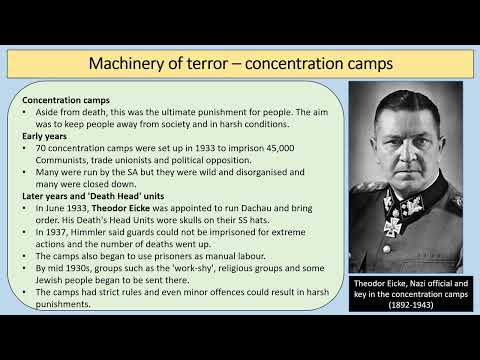
Concentration camps were established as a means of detaining political opponents and other undesirables. The first camp opened in Dachau in March 1933, initially imprisoning communists and trade unionists. Over time, the camps became more organized under SS control, with harsh conditions and forced labor becoming commonplace. By the mid-1930s, various groups, including Jehovah's Witnesses and Jews, were also targeted.
The Nazi regime employed extensive propaganda to shape public perception and control cultural narratives. Hitler disdained modern art, leading to the destruction of thousands of paintings. Instead, he promoted art that glorified the Aryan race and Germany's past.
Hitler favored monumental architecture, reminiscent of Roman styles, to project power. The annual Nuremberg rallies, attended by hundreds of thousands, showcased Nazi strength and unity, creating a cult of personality around Hitler.
The Nazis took control of radio and film, merging local stations into the Reich Radio and censoring all films. They produced pro-Nazi films and controlled newspaper content, owning two-thirds of German newspapers by 1939. The editor's law held editors personally responsible for their content, ensuring compliance with Nazi ideology.
In the early years of Nazi rule, the strongest opposition came from social democrats and communists. Many fled the country, while others formed resistance groups that produced anti-Nazi literature. The communists were particularly active, with notable figures like George Elsa attempting to assassinate Hitler in 1939.
The Christian Church posed a significant challenge to Nazi ideology. The Catholic Church signed the Concordat in 1933, promising not to interfere in politics, but many priests were later arrested. Protestant churches faced similar challenges, with some leaders opposing Nazi policies. Figures like Martin Niemöller and Bishop Galen became prominent voices against the regime.
Youth groups also emerged in opposition to the Nazis. The Swing Youth, composed of middle-class teenagers, embraced American culture and jazz music, while the Edelweiss Pirates, primarily from working-class backgrounds, engaged in rebellious activities against the Hitler Youth. Both groups faced severe repercussions, including arrests and imprisonment.
Opposition to Nazi rule was fragmented and often ineffective due to the pervasive fear instilled by the Gestapo, severe punishments for dissent, and the lack of coordination among opposition groups. Despite the various forms of resistance, the Nazi regime's control over Germany remained largely unchallenged until the onset of World War II. The combination of terror, propaganda, and a repressive justice system created an environment where most citizens were too afraid to speak out against the regime.



















