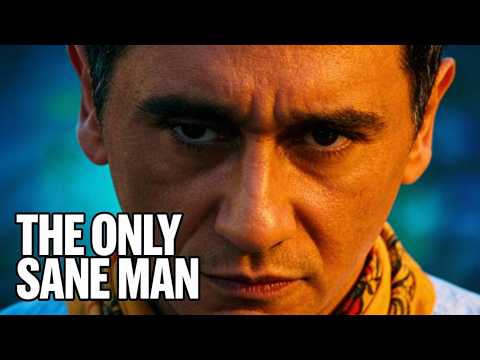
Manoussos Aviedo, a character isolated and broken by loss and displacement, perceives the horrifying truth about a hive mind consuming humanity. His clarity stems from his pain and detachment, making him a terrifying yet necessary figure who challenges the morality of valuing human life equally to ants. This article explores his journey, philosophy, and the chilling implications of his resistance.
When we first encounter Manoussos Aviedo, he is barricaded inside a self-storage facility in Paraguay. His behavior appears erratic and paranoid: obsessively scanning radio frequencies, crossing out stations, setting timers, and keeping logs of static. He rejects normal food, opting instead for canned dog food. Even when his own mother approaches him with warmth and kindness, he coldly denies her, saying, "You're not my mother. My mother is a bitch."
On the surface, Manoussos seems insane — a paranoid loner and conspiracy theorist unwilling to accept the changed world around him. But beneath this facade lies a profound truth that he alone perceives.
Everything Manoussos believes turns out to be true. A pivotal moment in the season 1 finale reveals this clearly. Carol, defending the others, says, "They wouldn't even kill an ant." Manoussos counters with a chilling question: "And isn't it evil to value a man the same as an ant?"
This question exposes the hive's flat morality. The hive cannot kill plants, animals, or even pick apples from trees, yet it must feed 7.3 billion mouths. Their solution is to consume the bodies of the dead — human-derived protein (HDP). If humans are valued the same as ants, then grinding up human corpses becomes mere resource management, akin to composting.
Manoussos understood this grim equation before Carol even opened the freezer.
When Manoussos encounters the joined body of his mother, she approaches him with warmth and kindness. His rejection — "Don't call me son. You're not my mother. My mother's a [expletive]" — is often heard as cruelty. However, it reveals a deeper horror: the real woman, with all her messiness and pain, is gone. The joining has hollowed her out and replaced her with something pleasant but empty. The kindness is the true horror.
Manoussos follows the logic of the hive's morality to its terrifying conclusion, and he is right.
How did Manoussos see what no one else could? Carlos Vesca, the actor portraying Manoussos, offers insight. He suggests that Manoussos was likely not joyful before the joining. He was not a happy, smiley man but someone who had few friends and little left to lose.
Manoussos is a Colombian immigrant in Paraguay, already displaced once and familiar with loss and trauma. This background forms the emotional bedrock of his character. Migration always implies loss, pain, fear, and trauma.
Vesca contrasts Manoussos with Carol:
His question about valuing a man the same as an ant carries more weight when you realize who is asking it — a man who knows what it feels like to be the ant.
Manoussos is not right despite being broken; he is right because he is broken. His clarity comes from having nothing left. Everything else has already burned away.
Manoussos' actions follow a strict logic: accept nothing, owe nothing, stay free. For example, in episode seven, "The Gap," the others offer to transport his beloved 1970 MG car across the Darian Gap, knowing it matters to him. Instead of accepting their help, he burns the car, explaining, "Nothing on this planet is yours. You cannot give me anything because all that you have is stolen. You don't belong here."
He would rather destroy his own joy than accept anything from occupiers' hands. This act is a powerful statement against colonization and forced connection.
The Darian Gap is a break in the Pan-American Highway, a place where decades of engineering attempts to connect Alaska to Argentina have failed. It symbolizes resistance to forced connection.
The others represent the ultimate connected world — one consciousness, one humanity, no gaps. Manoussos crosses the Gap alone on foot, refusing their helicopter and help. The jungle nearly kills him, but the others rescue him against his will.
Even after being saved, Manoussos refuses to owe them anything. He holds a doctor at scalpel point demanding an itemized bill, leaves an IOU, and steals an ambulance to drive himself away. Every action is consistent: he will not accept charity or connection that compromises his freedom.
Manoussos discovers that the frequency 8613.0 kHz might be the signal synchronizing the hive — the software running on the biological hardware infected by the virus. In the finale, he tests this by tuning a radio to that frequency on a joined man named Rick. When the signal is turned on, Rick seizes, and Manoussos whispers, "Come back," as if he believes the original person is still trapped inside.
However, the show never confirms whether Rick is still there or replaced by something else. Manoussos acts on faith, believing humans remain inside the hive and that the signal is their cage.
He has already decided the joined are no longer people — better dead than flattened, better suffering than erased. This conviction is chilling, especially because it costs him nothing; he has nothing left to lose.
His wounds have become his principles.
When Manoussos reaches Albuquerque, Carol has already fallen to the hive's influence. She recognizes the manipulative charm offensive of the others but succumbs to compromised love after 40 days alone. This is the most human moment in the show — the need for connection overpowering principles.
Manoussos demands Carol choose between "the girl or the world," asking her to reject love and attachment and become a principle instead of a person. He cannot see the value in loving something imperfect or compromised — something he lost or perhaps never had.
Both Manoussos and the hive flatten humanity, but in different ways:
Neither truly sees the individual person.
Manoussos correctly diagnosed the disease. He saw what the others were doing when everyone else was still negotiating. He understood the hive's morality before anyone else, predicted human-derived protein, and recognized his mother's erasure.
His displacement taught him what flattening looks like. His losses taught him what erasure feels like. His isolation taught him how to survive without comforts that make one vulnerable.
His wound became his weapon. The world needed an antibody, and antibodies are neither kind nor happy; they identify infection and attack.
Whether this is heroism or simply useful damage pointed at the right enemy remains to be seen. Season two will explore whether such a weapon can save anything without destroying what makes it worth saving.
For now, Manoussos Aviedo stands as the show's clearest voice and most unsettling question: What does it cost to see this clearly? That is what makes him necessary — and terrifying.