
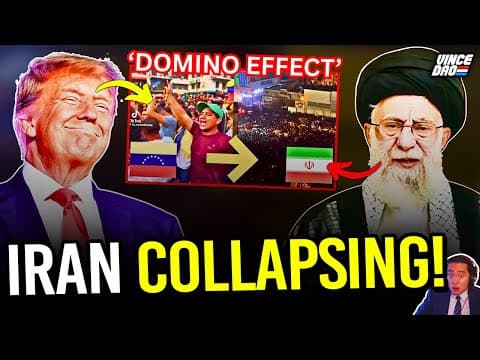
Hundreds of thousands of Iranians are protesting across more than 100 cities, including Tehran, driven by economic collapse, inflation, and political discontent. The protests follow significant blows to Iran's regional influence and come amid a digital blackout imposed by the regime. These events signal a weakening grip on power for Iran's government and reflect broader geopolitical shifts under the Trump administration's foreign policy.
In recent weeks, Iran has witnessed an unprecedented wave of anti-government protests sweeping through over 100 cities, including the capital, Tehran. Hundreds of thousands of demonstrators have taken to the streets, expressing their frustration by tearing up Iranian flags, setting fires, and confronting security forces. This surge of unrest is rooted in a deep economic crisis and growing dissatisfaction with the ruling regime.
The Iranian economy is in freefall, marked by soaring inflation and a severe currency crisis. Markets are deserted as people lack the financial means to shop or sustain their livelihoods. One local man described the situation succinctly: "None of the shops have customers because people don't have any money."
This economic hardship has been compounded by the aftermath of last summer's 12-day conflict involving Israel and the United States, which significantly weakened Iran's regional influence. The destruction of key Iranian allies, including the Lebanese militia Hezbollah and the Syrian government under Bashar al-Assad, has further destabilized the regime's position.
The current turmoil in Iran is part of a broader geopolitical shift influenced by the Trump administration's foreign policy. Over the past year, the so-called anti-American axis—comprising China, Russia, Venezuela, Iran, and North Korea—has shown signs of fracturing.
Despite longstanding fears that this coalition could pose a significant threat to U.S. global dominance, recent events suggest otherwise. The United States has reasserted its position as the sole superpower, delivering strategic blows to adversaries without engaging in prolonged military conflicts. Notable actions include targeted strikes on Iran's nuclear facilities and the removal of Venezuela's regime leader, effectively bringing that country under U.S. influence.
These developments have occurred with minimal retaliation from major powers like China and Russia, indicating either a reluctance to escalate tensions or a recognition of America's prevailing strength.
The protests in Iran are remarkable not only for their size but also for their geographic spread. Demonstrations have erupted in every province, involving hundreds of cities and massive crowds. This level of nationwide mobilization is unprecedented under the current regime.
In response, the Iranian government has taken drastic measures, including closing its airspace and imposing a digital blackout. Internet access, phone services, and cellular networks have been shut down to prevent news of the unrest from reaching the international community.
A significant catalyst for the protests was a call to action by Iran's exiled Crown Prince, the heir to the former monarchy toppled during the 1970s revolution. His appeal galvanized citizens to rise up and demand change, with many shouting slogans from their windows and flooding the streets.
This raises questions about the public's sentiment toward the monarchy and the current regime. While some may long for the stability or leadership of the Shah era, the protests primarily reflect a broader desire for reform and relief from economic hardship.
Although it remains uncertain whether the regime will survive these protests, it is clear that its grip on power is weakening. Even if the government endures, it will likely face pressure to implement reforms addressing the economic crisis and political grievances.
Such changes could impact Iran's spending on military activities and support for proxy groups like Hezbollah, potentially altering the balance of power in the Middle East.
The massive anti-government protests in Iran highlight a critical moment of instability fueled by economic collapse and political dissatisfaction. These events are intertwined with broader geopolitical dynamics shaped by U.S. foreign policy and the shifting alliances of global powers.
As Iran grapples with internal unrest and external pressures, the coming months will be pivotal in determining the country's trajectory and its role on the world stage.
This comprehensive overview underscores the significance of the ongoing protests in Iran and their implications for international relations and regional security.



















