This article explores the concept of peak steering angle in sim racing, a crucial technique for identifying cornering mistakes, particularly early apexes. By understanding peak steering angle, drivers can learn tracks faster, improve lap times, and enhance their overall racing skills. The article discusses how to apply this technique effectively, its limitations, and its significance in mastering both familiar and unfamiliar circuits.
Sim racing enthusiasts often seek ways to improve their performance on the track. One crucial technique that can significantly enhance your understanding of corners is the concept of peak steering angle. This article will delve into how mastering this technique can help you learn tracks more quickly, unlock free lap time, and avoid common mistakes like early apexing.
The peak steering angle is defined as the point in a corner where you have maximized your steering input and are ready to begin unwinding the steering wheel. Understanding this point is essential for sim racers, as it directly influences your cornering speed and exit performance.
Knowing where your peak steering angle occurs can transform your approach to learning new tracks. It allows you to identify whether you are apexing too early, which is a common mistake among drivers. By recognizing this, you can adjust your driving line and improve your exit speed, ultimately leading to faster lap times.
One of the most significant challenges in sim racing is identifying early apexes. An early apex can severely hinder your exit speed, making it crucial to recognize this mistake during practice. For instance, when observing a corner from above, it may be clear that a driver is apexing too early. However, when viewing from an onboard perspective, this can become less obvious, especially in marginal cases.
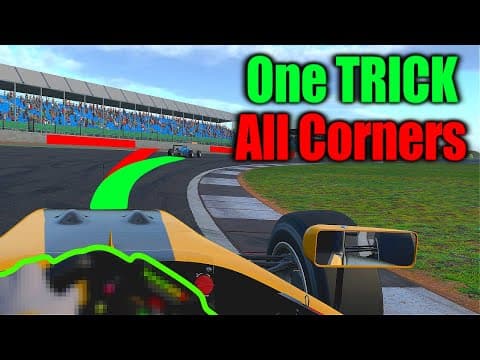
To illustrate this, consider three different corners. Initially, it may be difficult to determine which, if any, are early apexes. However, by focusing on the peak steering angle, you can gain clarity. If the peak steering angle occurs after the apex, it indicates that the driver took the corner too early.
Learning new tracks can be time-consuming, particularly if you are unaware of your apexing mistakes. Spending an hour practicing the wrong line can lead to frustration, as you may only realize your error after reviewing data post-session. This is where understanding peak steering angle becomes invaluable. By analyzing telemetry and observing the peak steering angle, you can quickly identify whether you are apexing too early.
The fundamental principle to remember is this: if you have to increase your steering angle after the apex while driving at the limit of grip, you have apexed too early. This simple rule can help you make immediate adjustments to your driving technique.
While the peak steering angle is a powerful tool, it does have limitations. It is most effective for normal corners—those that are not connected or double apex corners. In connected corners, an early apex may sometimes be necessary to set up for the next corner. Additionally, in double apex corners, the first apex is inherently an early apex, making it less applicable.
Another limitation is that this technique is only effective when you are driving at the limit of grip. If you are not pushing the car to its limits, you may manipulate the peak steering angle without realizing it. Therefore, it is essential to practice at or near the limit to gain accurate feedback.
To effectively use the peak steering angle technique, start by running laps and observing your steering input. If you consistently find yourself increasing the steering angle after the apex, it is a clear indication that you need to adjust your apex position. Experimenting with different apex placements will provide instant feedback on your cornering technique.
As you become more aware of the peak steering angle, it will become second nature to consider it in every corner. This awareness will not only help you understand unfamiliar circuits but also refine your skills on tracks you thought you knew well.
The peak steering angle is a crucial concept in sim racing that can dramatically improve your cornering technique and overall performance. By understanding and applying this technique, you can identify early apexes, learn tracks more efficiently, and ultimately extract more lap time from your driving. For those looking to deepen their understanding of sim racing, further exploration of this topic is available in specialized courses, such as the iRacing fundamentals course, which offers insights into throttle application and more.
By dedicating time to mastering the peak steering angle, you will enhance your sim racing skills and enjoy a more rewarding racing experience.