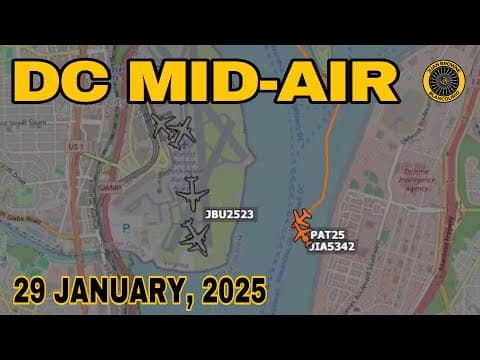
A recent mid-air collision between a Regional Jet and an Army National Guard helicopter near Washington D.C. raises serious concerns about air traffic control and safety protocols in busy airspace. This article explores the details of the incident, including flight paths, communication, and potential causes.
On January 29, 2025, a serious aviation incident occurred in Washington D.C. involving a Regional Jet and an Army National Guard helicopter. This collision took place just short of the final approach for Runway 33 at Ronald Reagan Washington National Airport (DCA). In this article, we will delve into the details of the incident, including the flight paths, air traffic control communications, and the implications for aviation safety.
The collision involved a CRJ700 Regional Jet operated by PSA Airlines for American Eagle, which was approaching DCA from Wichita. The aircraft was cleared for an approach to Runway 1, but it was maneuvering to land on Runway 33, a shorter runway measuring approximately 5,200 feet. The Army National Guard helicopter, believed to be either an UH-60 or VH-60, was operating out of Joint Base Bowling.
The airspace around DCA is known for its high traffic volume and complexity, including two prohibited areas to the north of the airport. The approach to DCA is particularly demanding, requiring pilots to navigate carefully through busy airspace while adhering to strict protocols.
The Regional Jet was executing a sidestep maneuver from Runway 1 to Runway 33. This maneuver involves a left dogleg entry to the shorter runway, which can be challenging, especially at low altitudes. The collision occurred at an altitude of just below 400 feet above ground level.
Video footage widely circulated on social media captured the moment of the collision. The Regional Jet was approaching from the south, while the helicopter was crossing from the left, leading to the unfortunate incident.
To understand the circumstances leading up to the collision, we can review the air traffic control (ATC) communications. The helicopter, identified by the call sign Pat 25, was in contact with the DCA tower. The tower asked Pat 25 if they had the CRJ in sight, to which the helicopter crew responded affirmatively and requested visual separation. The tower then cleared the helicopter to pass behind the CRJ.
Despite these communications, the helicopter did not see the CRJ and collided with it. This raises questions about the effectiveness of the communication protocols and the situational awareness of the helicopter crew.
Both the Regional Jet and the helicopter were equipped with Traffic Collision Avoidance Systems (TCAS). However, it is important to note that TCAS does not provide resolution advisories below 1,000 feet. Instead, it only alerts pilots to the presence of nearby traffic. This limitation may have contributed to the inability of the helicopter crew to avoid the collision.
At the time of the incident, weather conditions were reported to be good, with winds gusting from the north at 15 knots, peaking at 26 knots. The visibility was not a factor, but the background lighting and the bright landing lights of the CRJ could have made it difficult for the helicopter crew to see the approaching jet.
In the aftermath of the collision, investigators will need to examine several factors:
This incident marks the first major airline aviation accident in the United States since 2009, highlighting the need for a thorough investigation and potential reevaluation of air traffic control procedures in busy airspaces.
The mid-air collision near Washington D.C. serves as a stark reminder of the complexities and dangers of modern aviation. As investigations continue, it is crucial for aviation authorities to analyze the factors that led to this incident to enhance safety protocols and prevent future occurrences. The aviation community must remain vigilant in ensuring that air traffic control systems and pilot training are equipped to handle the challenges of busy airspace effectively.