Recent NATO-backed Ukrainian missile strikes on a Russian nuclear missile manufacturing plant mark a significant escalation in global conflict, prompting evacuations in the Middle East and shifts in global markets. Insider stock sell-offs, rising gold prices, and geopolitical instability in regions like Mexico and Iran underscore the urgency for preparedness as the world edges closer to potential widespread conflict.
The world is witnessing a critical escalation in geopolitical tensions, marked by NATO-backed Ukrainian forces striking deep inside Russia, targeting a nuclear missile manufacturing plant. This event, coupled with evacuations in the Middle East, insider stock sell-offs, and rising market volatility, signals a precarious moment in global affairs. This article provides a comprehensive update on these developments and their broader implications.
There are two types of people in times of crisis: those who panic early and those who panic late. The advice is clear—panic now while resources like food, electricity, and water are still available. Fear is an essential emotion that motivates survival and preparedness. As Warren Buffett famously said, "Be fearful when others are greedy and greedy when others are fearful." This principle applies not only to investing but also to personal preparedness.
Recent days have seen insiders dumping stocks and a significant sell-off in Bitcoin, including a billion-dollar dump by a Satoshi-era whale. Stocks are crashing, while gold and metals are surging, indicating a flight to safety amid uncertainty. This market behavior reflects growing concerns about the stability of the global economy and the potential for further conflict-driven disruptions.
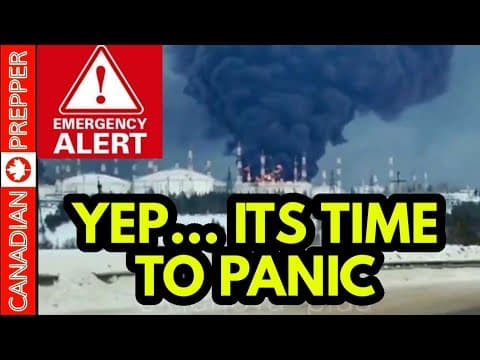
Ukrainian forces, supported by NATO intelligence and co-manufactured missiles known as Flamingo missiles, have successfully penetrated deep into Russian territory. They targeted a key Russian nuclear missile manufacturing plant located over 1,000 kilometers behind Russian lines. This plant produces critical missile systems such as Iskander, Kinzhal, Yars, and various ICBMs.
The strike has created a significant hole in the facility, potentially disrupting Russia's missile supply chain. This attack follows previous operations targeting Russian radars, nuclear bombers, ammunition depots, and other critical infrastructure supporting Russia's nuclear triad.
The ability of Ukrainian forces to strike such a high-value target with advanced missile technology—similar to Tomahawk or Storm Shadow cruise missiles—has shifted the conversation in Russia towards the possibility of a preemptive nuclear strike. The strike exposes vulnerabilities in Russia's air defenses, which are primarily designed to counter slower-moving threats like drones and loitering munitions.
Amid these developments, the United States and other countries are evacuating non-essential personnel from embassies and military bases in the Middle East, particularly in Lebanon and the Iranian theater. Oil companies are advising against non-essential travel to six Middle Eastern countries, reflecting concerns about escalating conflict.
The Pentagon has voiced concerns about a potential protracted conflict in the region, although these statements may be part of information warfare aimed at keeping adversaries uncertain.
The AI arms race is intensifying, with controversies surrounding AI models like Claude, which is reportedly being trained using thousands of fake accounts to outperform competitors. Advances in intelligence, surveillance, and reconnaissance (ISR) technologies have become force multipliers, allowing for more precise and efficient military operations with fewer resources.
Mexico is experiencing a civil war-like situation as drug cartels react violently to government actions. This unrest threatens to disrupt the supply of critical resources such as silver and gold, as Mexico is a major global supplier. The instability could have significant logistical and economic consequences.
Russian analyst Coragnov advocates for escalation dominance to halt NATO's advances, recommending demonstrative nuclear or conventional strikes in Europe to deter further aggression. He suggests Europe may not respond with equivalent nuclear force, implying a potential shift in the nuclear deterrence landscape.
The risk of nuclear conflict remains high, with the possibility that Israel or Iran could initiate a nuclear strike. If NATO targets Iran's vulnerable oil infrastructure, Iran may retaliate, leading to widespread destruction of oil refineries and skyrocketing oil prices.
Such developments would exacerbate food inflation and economic instability globally, as energy costs are a major driver of food prices. The bifurcation of commodity markets, including gold and silver, may occur as geopolitical divisions deepen.
The current global situation is volatile and rapidly evolving. From NATO's strike on a Russian nuclear missile plant to escalating tensions in the Middle East and instability in Mexico, the signs point to a world on the brink of significant conflict and economic disruption.
Individuals are urged to prepare now, stocking up on essentials and staying informed. Panic after the crisis hits will be too late. The time to act is now, while resources remain accessible and before the full impact of these geopolitical shifts is felt worldwide.
Stay vigilant and prioritize preparedness in these uncertain times.
Keep on prepping and stay safe.