Canary Wharf, a major business district in London, presents significant challenges for train changes due to its geographical layout and station design. Despite being served by multiple railway lines, the stations are poorly integrated, making navigation difficult for commuters. This article explores the reasons behind these challenges and offers alternative solutions for smoother transfers.
Canary Wharf, located in the London Docklands, is a bustling business district often compared to Manhattan due to its towering skyscrapers and commercial significance. However, for many commuters, changing trains at Canary Wharf can be a frustrating experience. This article delves into the reasons behind these challenges and offers insights into navigating the area more effectively.
One of the primary reasons for the difficulties in changing trains at Canary Wharf is its geographical layout. Historically, this area was home to the West India Docks, which were developed in the early 1800s. The construction of modern docks involved significant alterations to the landscape, resulting in large basins that complicate pedestrian movement.
As a result, even though some stations may appear close on a map, the actual distance and the convoluted routes between them can be quite misleading. For instance, the Elizabeth Line Station was constructed on an artificial island, further complicating access.
The train stations at Canary Wharf have evolved significantly over the years. The original Canary Wharf station, built in the late 1980s, was designed for a much smaller scale of development. As the area transformed into a major commercial hub, the station had to be redesigned to accommodate the influx of passengers.
The Docklands Light Railway (DLR) station was initially a simple two-platform structure, but as the demand grew, it was replaced with a larger, more complex station that opened in 1991. This new station, while impressive, is still challenging to navigate due to its location between two shopping malls.
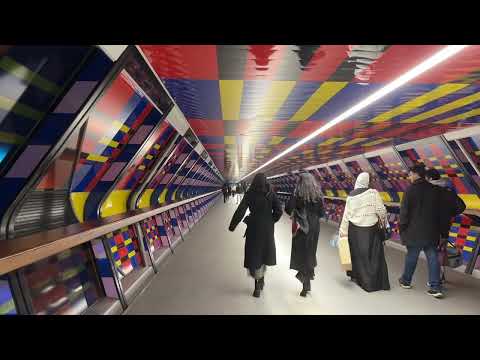
Despite the architectural appeal of the Canary Wharf Tube Station, which offers speedy access from ground to platform level, it is not designed for easy interchange between different lines. The Jubilee Line Station, for example, was built away from the DLR station to accommodate the surrounding skyscrapers, resulting in a convoluted journey for passengers needing to switch lines.
The Elizabeth Line also presents its own set of challenges. Although it provides a relatively straightforward interchange with the Jubilee Line, the connection with the DLR is less user-friendly. The DLR stations are not well integrated with the other lines, making it difficult for commuters to navigate between them.
Fortunately, there are alternative solutions for those looking to change trains without the hassle of navigating through Canary Wharf. The DLR stations at West India Quay and Heron Quays are located close to Canary Wharf and offer better interchange options.
Additionally, for those traveling to other destinations, the Elizabeth Line connects with the DLR at Stratford and Custom House, while the Jubilee Line meets the DLR at Canning Town. These alternative stations may offer more convenient transfer options than Canary Wharf itself.
While Canary Wharf stands as a symbol of modern business and finance, its train interchange facilities leave much to be desired. The combination of geographical challenges and the design of the stations contributes to a frustrating experience for many commuters. By exploring alternative stations and routes, passengers can navigate the complexities of the area more effectively.
In summary, while changing trains at Canary Wharf may feel like an uphill battle, understanding the layout and available options can help ease the journey.
Whether you are a seasoned commuter or a visitor to London, being aware of these challenges can make your travel experience smoother and more enjoyable.