
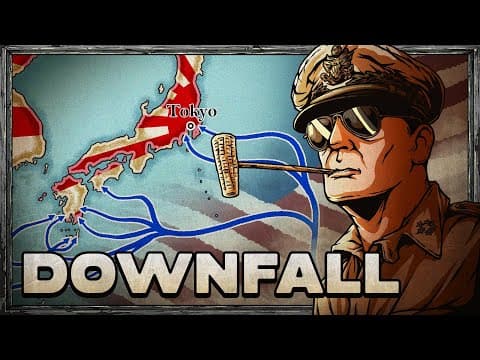
Operation Downfall was the planned Allied invasion of Japan during World War II, consisting of two main operations: Olympic and Coronet. The operation faced numerous challenges, including fierce Japanese resistance, logistical issues, and the eventual decision to use atomic bombs, leading to Japan's surrender and significant loss of life.
Operation Downfall was the codename for the planned Allied invasion of Japan during World War II, which was divided into two main operations: Olympic and Coronet. This blog post explores the details of these operations, the strategies employed by both the Allies and the Japanese, and the eventual outcome of the invasion.
Operation Downfall was designed to bring about the unconditional surrender of Japan. The operation was split into two parts:
Operation Olympic aimed to establish a staging ground by capturing airfields and ports in southern Kyushu through amphibious landings. The total occupation of the island was not deemed necessary, but securing key locations was critical for the subsequent phases of the invasion.
The objective of Operation Coronet was to land on the Kanto Plain and capture Tokyo. The U.S. planned to deploy hundreds of thousands of troops and tens of thousands of vehicles to support these operations, with military leaders allocating thousands of planes, hundreds of warships, and landing crafts.
In response to the impending invasion, Japanese military leaders devised Operation Ketsugo, which aimed to inflict heavy casualties on the invading forces to force a negotiated settlement. They envisioned a society that would engage in a die-hard resistance, utilizing every available resource to combat the invaders. Japanese propaganda encouraged the populace to prepare for a fierce defense, with slogans like "the sooner the Americans come, the better."
The Japanese military consolidated their remaining reserve armor into a mobile shock force to counterattack against the anticipated Allied invasion. They correctly predicted the time and location of the American landings and prepared accordingly, with nearly 900,000 entrenched soldiers ready to meet the 582,000 Allied servicemen expected to land.
As the invasion date approached, the Allies faced significant challenges, including:
Food supplies for the Japanese defenders began to dwindle, raising concerns about their ability to sustain a prolonged defense. Meanwhile, the Allies had to contend with the typhoon season, which threatened their amphibious landing operations.
The initial invasion date was set for October 1, 1945, but was postponed to December 1 due to a typhoon that wreaked havoc on Allied staging grounds. This delay allowed the Japanese to bolster their defenses further, increasing the number of defending troops and preparing for suicide attacks.
On December 1, 1945, the Allies launched Operation Olympic. Despite extensive planning, the invasion faced fierce resistance from Japanese forces. The Japanese strategy involved engaging the invaders as closely as possible to minimize the effectiveness of U.S. naval gunfire and air support.
The fighting was intense, with Allied forces encountering staunch resistance in the hilly countryside. The Japanese defenders, despite suffering from shortages of food and medical supplies, fought fiercely, leading to higher-than-expected casualty rates for the Allies. President Truman was alarmed by the casualty figures, which led him to reconsider the continuation of Operation Olympic.
As the battle progressed, the Allies achieved some objectives but faced overwhelming losses. Truman's concerns about public sentiment and the potential for calls for peace led to a significant shift in strategy. The planned invasion of Tokyo, Operation Coronet, was ultimately canceled.
With the war in Europe concluded, Truman authorized the use of atomic bombs on Japanese cities. By early 1946, the U.S. had developed a dozen nuclear weapons and prepared to drop them on urban centers to force Japan's surrender. The first bomb was dropped on Hiroshima on March 8, 1946, followed by another on Nagasaki a week later.
The decision to use atomic bombs, while aimed at avoiding a costly ground invasion, resulted in catastrophic loss of life and destruction. Japan ultimately accepted unconditional surrender terms, influenced by the devastation of the atomic bombings and the threat of Soviet invasion.
The aftermath of Operation Downfall saw Japan divided into occupation zones, leading to a prolonged period of tension during the Cold War. The operation highlighted the complexities and moral dilemmas of warfare, as the pursuit of victory came at an immense human cost.
In retrospect, Operation Downfall serves as a stark reminder of the brutal realities of war and the lengths to which nations will go to achieve their objectives, often at the expense of countless lives.



















