
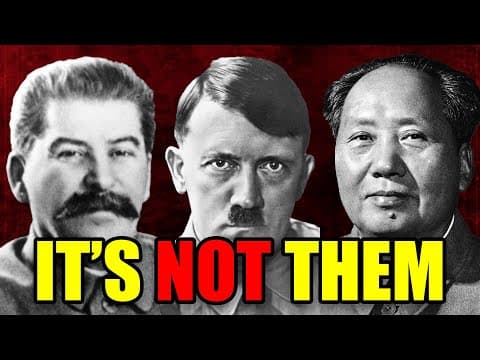
While Hitler, Stalin, and Mao are often cited as the deadliest dictators due to their high death tolls, Pol Pot surpasses them when considering the proportion of people killed relative to the population he ruled. Pol Pot's regime in Cambodia caused the deaths of approximately 36% of the population through forced labor, executions, and starvation during his four-year rule.
When discussing the worst dictators in human history, names like Adolf Hitler, Joseph Stalin, and Mao Zedong often come to mind. These leaders were responsible for the deaths of millions and shaped some of the darkest chapters in human history. However, when we consider the deadliest dictator by the proportion of people killed relative to the population they ruled, a different figure emerges: Pol Pot.
To understand who the deadliest dictator truly is, we must first define what "deadly" means. Is it the absolute number of deaths caused, or the proportion of deaths relative to the population? For example, the seasonal flu kills about 500,000 people annually but infects over a billion. Ebola, on the other hand, killed around 15,000 people but had a mortality rate of 50%. Which is deadlier?
The answer lies in the proportion of people killed relative to the population affected. This approach helps us understand the true impact of a dictator's rule on their country.
Let's look at the estimated death tolls and populations under the regimes of some infamous dictators:
| Dictator | Estimated Death Toll | Population at the Time | Kill Rate (%) |
|---|---|---|---|
| Adolf Hitler (Nazi Germany) | ~17 million | 79 million | 21% |
| Joseph Stalin (Soviet Union) | ~20 million | 162 million | 12% |
| Mao Zedong (China) | 40 to 80 million | 723 million | 8% |
While Mao had the highest absolute death toll, Hitler had the highest kill rate relative to his population at 21%. Stalin was second with 12%, and Mao third with 8%.
Pol Pot, leader of the Khmer Rouge in Cambodia, surpasses all three with an estimated kill rate of 36%. This means over a third of Cambodia's population perished under his regime.
Born Saloth Sâr in 1925 into a wealthy Cambodian family, Pol Pot was educated in elite schools and studied engineering in France. During his time in France, he became interested in Marxism and joined left-wing groups, including the French Communist Party.
Despite his political interests, Pol Pot was not academically gifted and struggled with his studies. He admitted to not fully understanding Marx's works and instead relied on interpretations from Stalin and Mao, both of whom had devastating impacts on their countries.
Returning to Cambodia in 1953, Pol Pot became leader of the communist Khmer Rouge during a time of civil war and political instability. The Khmer Rouge fought against a right-wing government supported by the United States and eventually took control of Cambodia's capital, Phnom Penh, in 1975.
Pol Pot adopted various pseudonyms to remain anonymous, only revealing himself as "Pol Pot" upon taking power.
Pol Pot declared the beginning of "Year 0," aiming to transform Cambodia into a classless, agrarian utopia. His regime sought to eliminate capitalism, private property, religion, family structures, money, and cities.
Immediately after taking power, the Khmer Rouge forced millions from cities to the countryside, labeling urban residents as "New People" and enemies of the state. Intellectuals, professionals, ethnic minorities, and anyone associated with urban life were targeted for execution, starvation, or forced labor.
Even peasants, or "Old People," faced harsh conditions, with increased work quotas and severe punishments for failure.
Individualism was suppressed. Food was communalized, families were separated, and language was altered so people referred to themselves as "we" instead of "I."
The most horrific aspect of Pol Pot's regime was the "Killing Fields," sites where approximately 1.5 million people were executed. The infamous Security Prison 21 (S21), a former high school turned torture center, held up to 1,000 prisoners at a time.
Prisoners were tortured daily, forced to confess to crimes against the party, and compelled to implicate others, perpetuating a cycle of arrests and executions. Confessions were often fabricated under extreme duress.
Executions were brutal, often carried out with blunt instruments to conserve ammunition. Children of prisoners were also killed to prevent future revenge.
Cambodia's average life expectancy plummeted from 40 to 18.9 years during Pol Pot's rule. Paranoia led to purges within the Khmer Rouge, killing many of its own leaders.
Vietnam invaded Cambodia in 1979, ending Pol Pot's regime. An estimated 2.5 million people died during his four-year rule, out of a population of just 7 million.
Despite the atrocities, Pol Pot lived until 1998, dying peacefully without facing justice. The Khmer Rouge retained international recognition for years due to geopolitical dynamics.
Pol Pot's regime stands as the deadliest in history when considering the proportion of the population killed. His radical policies, brutal repression, and genocidal actions devastated Cambodia, leaving scars that remain visible today.
Understanding Pol Pot's rise and reign is crucial to remembering the victims and learning from history to prevent such tragedies in the future.
Pol Pot married in 1985 and had a daughter at age 63. His daughter was married in 2014. Hopefully, she does not follow her father's political path.
This comprehensive look at Pol Pot's regime reveals the devastating impact of his rule and why he is considered the deadliest dictator in history by kill rate.



















