
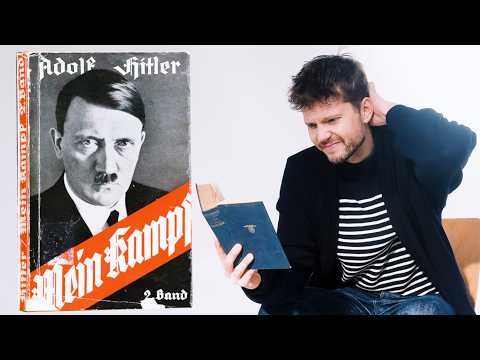
This article explores Adolf Hitler's "Mein Kampf," analyzing its content, historical context, and the dangerous ideologies it propagated. It examines Hitler's rise amid post-WWI turmoil, his use of propaganda, racial theories, and plans for war and genocide. The piece also draws parallels to modern political climates, warning against populism, conspiracy theories, and the erosion of democratic institutions.
"Mein Kampf" by Adolf Hitler is widely regarded as one of the most evil books in history. In it, Hitler outlines his life story, his plans to start a new world war, and his conviction that Germany must rid itself of the Jews. Though initially not taken seriously, once Hitler came to power, he implemented the ideas detailed in this book, which served as a blueprint for world conquest and genocide.
To understand the book, it is essential to grasp the context of Hitler's time. On April 1, 1924, Hitler was imprisoned in Landsberg prison after being convicted for attempting to overthrow the government. Despite his conviction, conservative judges were lenient, allowing him privileges such as receiving visitors and food parcels.
Hitler, deprived of his usual platform for speeches, decided to write a book to guide his followers. He began with his life story, using it to promote his political ideology. Born on April 20, 1889, in Braunau am Inn, Austria-Hungary, on the border with Germany, Hitler expressed early on his desire to unite German-speaking countries, a dream he realized when Nazi Germany annexed Austria.
The book is divided into two parts. The first is autobiographical, resembling a coming-of-age novel, detailing Hitler's upbringing, experiences in Vienna and Munich, his service in World War I, and his entry into politics. However, Hitler often distorted facts to fit his narrative.
The second part is thematic, outlining his party's ideas, the role of an ethnic state, opposition to communism, and foreign policy plans. Hitler's worldview is centered on the concept of struggle as a driving force of history, believing that only the fittest survive.
Hitler claimed his worldview was scientific, drawing on Charles Darwin's theory of evolution, which describes natural selection and survival of the fittest. He twisted this to justify racial competition, asserting that humanity consisted of competing races, with the Aryan race as the most noble and Jews and Slavs as inferior.
He advocated for a "völkisch" ethnic state based on racial purity, promoting selective breeding to enhance desirable traits. This ideology was not unique to Hitler; similar ideas were present in other countries, including the UK, where some advocated for eugenics.
Hitler's racial policies led to horrific actions. After the Nazis came to power in 1933, they sterilized 400,000 people and killed tens of thousands of invalid and mentally ill patients, including 5,000 children. These actions were justified by the belief in purifying the German race.
Hitler's experiences in World War I deeply influenced his worldview. He saw the war as a defining period, receiving the Iron Cross for bravery. However, Germany's defeat and the subsequent political upheaval created fertile ground for extremist ideologies.
Many veterans returned disillusioned, turning to extremist groups and conspiracy theories like the "stab-in-the-back" myth, which falsely claimed that Germany was betrayed by socialists and Jews. Hitler exploited these sentiments in his speeches, fueling political violence.
Hitler vehemently opposed the Treaty of Versailles, which ended World War I. The treaty imposed harsh penalties on Germany, including territorial losses, reparations, and military restrictions. Article 231, which placed sole responsibility for the war on Germany, was seen as unjust.
Hitler positioned himself and the Nazi party as the only true opponents of the treaty, using this stance to gain popular support. His propaganda was simple and repetitive, designed to appeal to the masses by identifying a single enemy: a combination of socialists, communists, and Jews.
Anti-Semitism was not unique to Hitler but had deep roots in European history. Jews were often marginalized, barred from guilds and farming, and forced into money lending and other trades. Rising nationalism intensified anti-Semitic sentiments.
In "Mein Kampf," Hitler described Jews as a race and a parasitic threat to Germany. Though he did not explicitly call for their extermination in the book, his language dehumanized them, laying the groundwork for the Holocaust.
Hitler's obsession with acquiring land, particularly in the Soviet Union, was driven by his belief that a great nation needed ample territory to sustain its people. He planned to destroy the Soviet Union, which he saw as controlled by a Jewish conspiracy.
Despite knowing the risks, Hitler invaded the Soviet Union in 1941, a campaign that ultimately contributed to his downfall. His aggressive foreign policy led to the outbreak of World War II.
After his release from prison in December 1924, Hitler published "Mein Kampf." Initially, the Nazi party had limited support, receiving only 2.63% of the vote in 1928. However, the global financial crisis of 1929 plunged Germany into depression, increasing the appeal of extremist parties.
By 1933, Hitler's book became a bestseller, and he rose to power, fulfilling his promises by initiating bold foreign policies and starting World War II with the invasion of Poland.
A century after the publication of "Mein Kampf," Hitler remains a figure of obsession and a symbol of evil. His political approach as a populist exploiting economic hardship and uncertainty has parallels in modern times.
Extreme right-wing nationalism is visible in Europe and America, where political rhetoric often scapegoats minorities and undermines democratic institutions. The use of simple, repetitive slogans and the creation of a common enemy mirror Hitler's propaganda techniques.
Warnings arise from recent political developments, including attempts to restrict free press, calls to purge institutions, and the demonization of political opponents. These trends highlight the importance of vigilance against populism and authoritarianism.
Reading "Mein Kampf" today is a chilling reminder of how dangerous ideologies can take root in times of crisis. Understanding the historical context and content of Hitler's book helps us recognize the signs of extremism and the importance of protecting democratic values, human rights, and social cohesion in our own time.
We must be cautious of politicians offering easy solutions and blaming societal problems on specific groups. History teaches us that such approaches can lead to devastating consequences.
This comprehensive examination of Hitler's "Mein Kampf" underscores the enduring relevance of history in informing our present and future choices. It is a call to remember, reflect, and resist the forces that threaten peace and humanity.



















