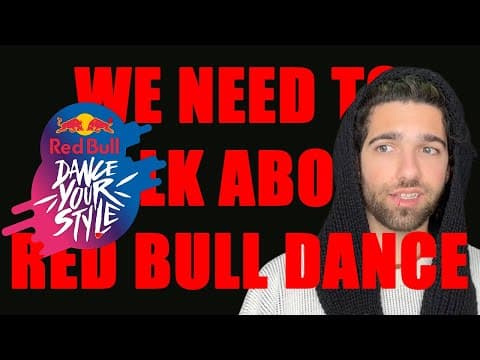
Red Bull Dance Your Style is a globally renowned street dance competition featuring diverse styles and dancers from around the world. However, concerns have arisen regarding minimal prize money, lack of dancer credit, and cultural erasure in favor of corporate content strategies. The article explores these issues, emphasizing the need for respect, fair compensation, and cultural acknowledgment for dancers.
If you spend any time on the Internet, chances are you've come across Red Bull's Dance Your Style competitions. Known as one of the most prominent street dance competitions worldwide, it brings together dancers from various styles and communities to compete locally, regionally, nationally, and ultimately on the world stage.
Red Bull Dance Your Style features dancers from 51 countries, representing styles such as whacking, breaking, popping, and Vogue. The competition culminates in world finals, like the 2025 event held at the Intuit Dome in Los Angeles, attracting thousands of spectators and numerous corporate sponsors including Red Bull, T-Mobile, and Takis.
Despite the scale and corporate backing, the prize money for competitors is surprisingly low. Nationals offer first place prizes of around $1,500 and second place $750, with regionals offering even less. Beyond travel and accommodation, dancers receive minimal financial compensation.
This is striking considering these dancers are among the best globally, generating millions of views and significant revenue for sponsors. In contrast, smaller, community-focused dance competitions often offer much larger prizes, sometimes exceeding $30,000, and ballroom dance events have been known to offer six-figure prizes.
While prize money is not the primary motivation for many dancers, who often compete for exposure and platform opportunities, this bargain appears increasingly unbalanced. Exposure does not pay rent, and the promise of career advancement through visibility is not always fulfilled.
Historically, footage from Red Bull Dance Your Style was available in long-form videos on platforms like YouTube, allowing viewers to experience the full competition context, including dancers' backgrounds, styles, and interactions.
Recently, however, Red Bull has shifted to short-form, TikTok-style highlight reels. These clips often lack proper credit to dancers, omit the names of dance styles and moves, and fail to educate viewers about the cultural significance of the performances. Instead, they focus on clickbait-style content designed to maximize engagement.
For example, a TikTok video showcasing "top five most unreal spins" from a breaking event did not credit any dancers or mention the dance style. The moves were given arbitrary, non-technical names, stripping away educational value and cultural context.
Similarly, a clip featuring voguing dancer Riley Prodigy was captioned simply as "she improvised this... in heels," without mentioning the dance style or the significance of the performance.
Street dance styles often originate from marginalized communities, including Black and LGBTQ+ groups. The removal of cultural identifiers and dancer credits in favor of commodified entertainment not only disrespects the artists but also erases the rich histories and identities behind these dance forms.
While short-form content has its place, it should not come at the cost of erasing the contributions and identities of dancers. Proper crediting, education about dance styles, and acknowledgment of cultural roots are essential.
Moreover, the lack of substantial financial support and recognition raises questions about the ethics of using dancers' talents primarily to fuel corporate content and brand engagement.
Despite Red Bull's extensive sponsorship of athletes in various sports, a search for Red Bull-sponsored dancers yields no results. This absence highlights a broader issue within the dance community, where dancers are often not recognized as athletes deserving of sponsorship and support.
Red Bull Dance Your Style exemplifies a wider trend where corporations capitalize on street dance's popularity while disconnecting it from its origins and the people who create its value. This exploitation is a symptom of a systemic problem in the commercialization of dance.
The dance community and audiences must advocate for:
Consumers also bear responsibility by critically engaging with content, demanding accountability, and supporting platforms and creators who honor these values.
The talented dancers who dedicate their lives to mastering and performing street dance styles deserve respect, fair pay, and recognition of their art's cultural significance. Red Bull Dance Your Style, while a major platform, must evolve beyond content farming and corporate branding to truly serve the dancers and communities that make it great.
This conversation is ongoing, and voices from within the dance community are vital to shaping a more equitable future.
If you have thoughts or experiences related to Red Bull Dance Your Style or the broader dance community, sharing them can help foster awareness and change.