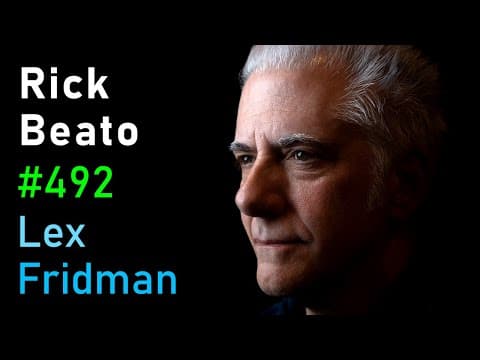
In an extensive conversation with Lex Fridman, Rick Beato, a renowned music educator and multi-instrumentalist, discusses his musical journey, the influence of legendary guitarists like Jimi Hendrix and Joe Pass, the role of jazz and perfect pitch in music education, the impact of technology and AI on music creation, and the evolving landscape of the music industry. He also shares personal anecdotes and advice for aspiring musicians.
Rick Beato, a legendary music educator, producer, songwriter, and multi-instrumentalist, sat down with Lex Fridman to discuss a wide range of topics related to music. From his early musical experiences to the influence of iconic guitarists, the role of jazz, perfect pitch, and the impact of AI on music, this conversation offers deep insights into the world of music and its future.
Rick's love for music began with listening to guitar solos, particularly the song "Hey Joe," which was the first solo he learned. He discovered the pentatonic scale through this song and practiced it obsessively with his younger brother. Their mother even played rhythm guitar to support their practice sessions.
Jimi Hendrix is often regarded as the greatest guitarist of all time. Rick acknowledges Hendrix's unique style, especially his rhythm playing, chord fragments, and riffs. Hendrix's approach was unconventional, often using his thumb over the top of the neck, which contributed to his distinctive sound.
Rick highlights the importance of jazz guitarists like Django Reinhardt, Charlie Christian, and Joe Pass. Django Reinhardt, despite having two fingers fused due to a fire, played incredibly fast lines with just two fingers, pioneering the gypsy jazz style. Joe Pass was a master of bebop guitar, known for his solo guitar work and complex chord voicings.
Bebop, developed by musicians like Charlie Parker and Dizzy Gillespie, introduced a sophisticated language of improvisation with fast tempos, angular lines, and chromaticism. Rick's father loved bebop, which influenced Rick's early exposure to complex music.
Rick discusses his son Dylan's perfect pitch—the ability to identify any note without a reference tone. He explains the difference between perfect pitch and relative pitch, emphasizing that relative pitch is more useful for musicians as it involves recognizing intervals and chords relative to a given note.
Rick offers an ear training course focusing on relative pitch, teaching students to identify melodic and harmonic intervals and chords through practice.
For beginners, Rick recommends starting with a good beginner guitar course focusing on open chords and basic strumming patterns. He stresses the importance of proper finger positioning to avoid muting unwanted strings and developing calluses to reduce finger pain.
As players progress, they can explore single-note playing, riffs, fingerpicking, and lead guitar techniques. Rick encourages daily practice, even if only for 10 minutes, to build consistency.
Rick's early videos featuring his son Dylan demonstrating perfect pitch went viral, garnering millions of views. Dylan could identify complex chords and notes at a young age, which fascinated musicians and educators worldwide.
Rick attributes Dylan's perfect pitch to early exposure to high-information music like Bach, jazz, and classical music, even prenatally.
Rick shares his top guitar solos, with Pink Floyd's "Comfortably Numb" often at the top. He admires David Gilmour's melodic sense, phrasing, and tone. Other notable guitarists include Mark Knopfler, Randy Rhoads, and Eddie Van Halen.
He discusses the unique tones and playing styles that make guitarists instantly recognizable, such as Brian May and B.B. King.
Miles Davis is highlighted as a pivotal figure in jazz, innovating across styles from bebop to fusion. His approach to music emphasized spontaneity and risk-taking, often recording without rehearsals to capture the raw energy.
Rick talks about legendary producers like Rick Rubin and the importance of the recording and production process. He shares stories from Abbey Road Studios and the evolution of recording technology.
The conversation touches on the complex relationship between musicians and drugs, noting that many great artists struggled with substance abuse, which influenced their creativity but also led to tragic outcomes.
Rick discusses songwriting processes, highlighting artists like Elton John who write music to lyrics, and Billy Corgan who uses chord extensions like sevenths and ninths to create melancholy moods.
He emphasizes the importance of dissonance in music to evoke emotion.
Rick addresses the rise of AI in music creation, acknowledging its potential as a tool for idea generation but expressing skepticism about AI replacing human musicians. He notes that AI-generated music often lacks soul and authenticity.
He encourages musicians to use AI as an assistant rather than a replacement.
Rick shares his experiences battling copyright claims on YouTube, fighting for fair use rights to use music clips in his educational videos. He has successfully contested thousands of claims with legal help.
The shift from physical albums to streaming platforms like Spotify has changed how people discover and listen to music. While streaming offers vast access and discovery, it also changes listening habits and artist compensation.
Rick uses ProTools as his primary DAW, along with Logic and Ableton. He owns around 100 amplifiers, each chosen for specific tonal qualities, and uses both real amps and amp simulators like Neural DSP.
Rick encourages focusing on mastering a craft rather than chasing fame. His YouTube channel started as a way to share knowledge and answer questions, growing organically through genuine interest.
He stresses the value of persistence, continuous learning, and authenticity.
Music serves to enlighten and create the soundtrack of our lives. It evokes emotions ranging from sadness to hope and excitement, connecting deeply with the human psyche.
Rick reflects on the power of music to transcend time and generations, celebrating the human achievement of creating instruments and harmonies.
This conversation with Rick Beato offers a rich exploration of music's past, present, and future, blending technical insights with personal stories and philosophical reflections. It is a valuable resource for musicians, educators, and music lovers alike.
Without music, life would be a mistake. — Friedrich Nietzsche
Thank you for reading this comprehensive discussion on music with Rick Beato and Lex Fridman.