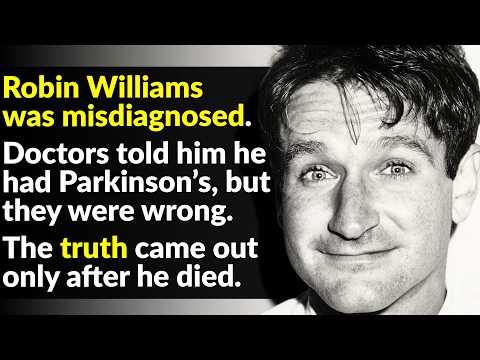
Robin Williams, beloved actor and comedian, was initially misdiagnosed with Parkinson's disease during the last year of his life. After his death, it was revealed he actually suffered from Lewy Body Dementia, a devastating brain disorder. This article explores his life, career, struggles, and the true nature of his illness.
Robin Williams was misdiagnosed. For the last year of his life, doctors told him he had Parkinson's disease, and he believed it. However, after his death, it was revealed that the diagnosis was incorrect. Instead, Williams suffered from Lewy Body Dementia, a devastating brain disorder that profoundly affected his health and mental state.
Robin Williams' career spanned decades, marked by his frenetic charm and ability to shift seamlessly between hilarious comedy and heart-wrenching drama. Despite his bombastic public persona, Williams was a shy and reserved child growing up in Chicago. He found solace and attention through humor, becoming the class clown and bonding with the family's maid, often his only confidante.
His parents' lack of attention caused him pain, which he adeptly hid. When his family moved from Michigan to California during his teenage years, Williams found a freer, more supportive school environment that nurtured his talents. By high school graduation, he was voted funniest and least likely to succeed.
Williams initially studied political science in college but dropped out after a few months to pursue acting. After three years at a community college, he earned a full scholarship to the prestigious Juilliard School in 1973, joining a select group of 20 students, including future stars like Kelsey Grammer and Christopher Reeve.
Despite doubts from instructors about his ability to perform serious roles without cracking jokes, Williams stunned audiences and classmates alike with his performance in a Tennessee Williams play, earning astonishment from peers such as Reeve.
Juilliard's classical training was rigid and ill-suited to Williams' style. At 25, he moved to San Francisco in 1976 to hone his stand-up comedy, later relocating to Los Angeles. There, he quickly encountered the city's darker side but also caught the attention of TV producers.
Williams landed a cameo on "Happy Days" as an alien named Mork, which led to the spin-off sitcom "Mork & Mindy" (1978-1982). The show was a massive hit, boosting his fame and opening doors for stand-up specials on HBO.
However, the comedy club scene also exposed him to drugs. Williams married Valerie Valardi in 1978, and their son Zachary was born in 1984, which motivated Williams to quit drinking and partying.
Williams' close friendship with comedian John Belushi ended tragically when Belushi died of a drug overdose in 1982. This loss was a wake-up call for Williams, who sought healthier coping mechanisms like running and cycling.
After separating from Valardi in 1988, Williams began a controversial relationship with Marsha Garces, his son's former nanny, whom he later married. They had two children together, Zelda and Cody.
Williams' film breakthrough came with "Good Morning, Vietnam," which earned him his first Academy Award nomination and established him as a leading man. He took on dramatic roles like "Dead Poets Society" and family-friendly films such as "Hook," "Aladdin," and "Mrs. Doubtfire," endearing him to a generation.
His friendship with Christopher Reeve remained strong, and Williams famously lifted Reeve's spirits after a paralyzing accident with humor.
Williams' role as the Genie in Disney's "Aladdin" was iconic. Disney animated the Genie character to Williams' stand-up comedy, but the studio later breached their agreement by using his voice and image for marketing without additional compensation, souring their relationship.
Williams won the Academy Award for Best Supporting Actor for "Good Will Hunting," a career high point. Despite professional success, he struggled privately with depression and substance abuse, relapsing into drinking in 2003 and entering rehab in 2006.
His marriage to Marsha Garces ended in 2008, and he later married Susan Schneider in 2011 after meeting her in an Apple store.
Around 2013, Williams began experiencing troubling symptoms: stomach issues, tremors, insomnia, anxiety, and paranoia. After a year of uncertainty, doctors diagnosed him with early-stage Parkinson's disease.
This diagnosis deeply affected Williams, whose quick wit and rapid-fire humor were central to his identity. The disease's progression was swift and relentless, leading to increased fear and paranoia.
On August 11, 2014, Williams died by suicide. An autopsy revealed the true cause of his symptoms was not Parkinson's but Lewy Body Dementia, characterized by abnormal protein deposits in the brain causing memory loss, hallucinations, insomnia, and symptoms often mistaken for Parkinson's.
Following his death, tributes poured in from fans, friends, and co-stars. Lisa Jakub, who acted alongside Williams in "Mrs. Doubtfire," shared how Williams supported her during a difficult time in school. Bradley Pierce, a child star from "Jumanji," credited Williams with inspiring him to openly discuss his own depression.
Robin Williams' life was a blend of extraordinary talent, personal struggles, and a tragic misdiagnosis that obscured the true nature of his illness. His legacy continues to inspire and touch the lives of millions worldwide.
This comprehensive look at Robin Williams' life and the truth behind his diagnosis sheds light on the challenges he faced beyond the spotlight and honors the memory of a beloved entertainer whose impact endures.