
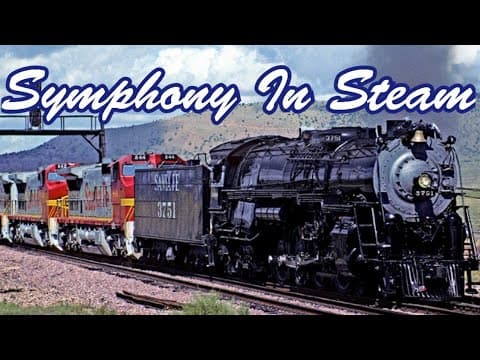
The Santa Fe 3751 steam locomotive, restored and celebrated in 1992, symbolizes the rich heritage of American railroads. This article explores its history, the transition from steam to diesel, and the emotional journey of retired engineers who operated it. The 3751's 1992 employee recognition trip from Los Angeles to Chicago rekindled memories and showcased the enduring legacy of steam power.
The story of the Santa Fe 3751 steam locomotive is a tale of dreams, perseverance, and the evolution of American railroads. It began with Cyrus K. Holiday, a pioneer and entrepreneur who envisioned a railroad carved out of the Old Santa Fe Trail. His vision led to the creation of the Atchison, Topeka and Santa Fe Railway, chartered in 1859, with construction starting in 1868.
Steam power revolutionized transportation and played a pivotal role in the advancement of the United States. Over its 125-year history, the Santa Fe Railway operated more than 3,000 steam engines. These locomotives were the backbone of passenger and freight service, symbolizing the industrial might and innovation of their era.
The 1930s marked the beginning of the end for steam locomotives as diesel engines began to replace them. In 1937, the red and silver twin diesel engines took the lead on the new luxury Super Chief trains, traveling from Chicago to Los Angeles in just 39 and a half hours—14 hours faster than their steam predecessors. These 3,600 horsepower Electromotive engines represented a new era of speed and efficiency.
By 1972, Amtrak took over the nation's passenger lines, and the iconic red and silver War Bonnet paint scheme gave way to a bright yellow and blue dedicated to freight service. However, the legacy of the red and silver War Bonnet returned in 1989 with a series of high horsepower diesel locomotives known as the Superfleet, which continue to operate today.
In the summer of 1992, steam and diesel power joined forces for a special employee recognition train. The Santa Fe 3751, restored to operational condition, teamed with three diesel-electric engines for a historic journey. On August 30th, 1992, nearly 35 years after its retirement, the Baldwin 484 locomotive pulled 12 cars filled with Santa Fe employees, friends, and family from Los Angeles to Chicago and back—the longest run of its life.
This journey was not just about the restoration or the glory days of steam but about honoring the men who operated the 3751 and preserving a living piece of railroad history.
Homer Henry, who organized and supervised the trip, shared that eight retired Santa Fe engineers operated the train over 17 or 18 days. For them, it was like riding a bicycle—the skills came back naturally. The engineers enjoyed interacting with schoolchildren along the route, handing out buttons and autographs, and sharing their passion for railroading.
Jack Elwood, a retired engineer with 41 years at Santa Fe, spent much of his career running steam engines, including the 3751. He recalled operating the engine in 1943 and expressed immense pleasure in working on it again. For him, handling the locomotive was an overwhelming experience, feeling the immense power coursing through his body when opening the throttle.
Frank Cottle, another retired engineer, described steam engines as living beings, each with unique characteristics. He reminisced about the thrill of running the Chief at speeds up to 124 miles per hour and the daily excitement of working with these machines. Cottle praised the restoration of the 3751, noting its pristine condition and the nostalgic warmth of the firebox.
Rufus King, who retired in 1986 after 39 years with Santa Fe, shared that running the 3751 again was a dream he never thought possible. He praised the restoration team for their miraculous work, describing the engine as a finely tuned Swiss watch that runs perfectly at any speed.
Setzer, a general supervisor of train handling, recounted a challenging run in a driving rainstorm where visibility was so poor that engineers had to hang out of the cab to see signals. This experience gave him a new appreciation for the hardships faced by steam-era engineers.
Jess Bootman, retired after 35 years, described the familiar sounds and smells of the 3751 and the joy of reconnecting with the engine. He noted the enthusiastic public response, with people from all walks of life waving and showing affection for the steam locomotive.
Max Smith, retired after 43 years, reflected on the trip as a wonderful experience that brought back forgotten memories. He emphasized the importance of preserving these machines as a testament to the railroad's past.
The 3751 represents more than just a locomotive; it embodies the heritage and commitment of the Santa Fe Railway and its employees. The combination of historical steam power with modern diesel locomotives during the 1992 journey highlighted the evolution of railroading and connected generations of railroad workers and enthusiasts.
The restoration and operation of the 3751 serve as a moving tribute to the golden era of railroads, inspiring pride and nostalgia among employees and the public alike.
The Santa Fe 3751's story is a symphony of steam, history, and human passion. From its origins in the 19th century to its celebrated 1992 journey, the locomotive stands as a testament to American ingenuity and the enduring spirit of railroading. The voices of the retired engineers and the enthusiastic public response underscore the deep connection between people and the machines that shaped their lives and the nation's progress.
The 3751 continues to inspire, reminding us of a time when steam power was the heartbeat of America’s railroads and the dreams of pioneers like Cyrus K. Holiday became reality.



















