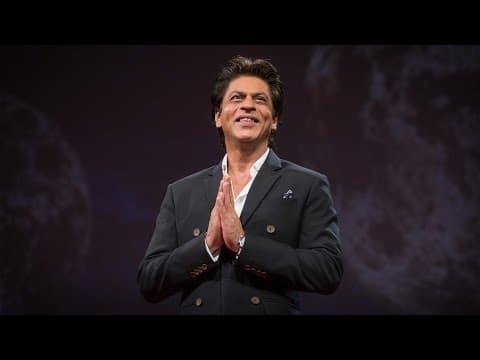
In his TED talk, Shah Rukh Khan shares his journey from a refugee colony to superstardom, reflecting on the complexities of humanity, the impact of fame, and the essential role of love in shaping our future. He emphasizes the need for compassion and connection in an increasingly digital world, urging us to embrace our shared humanity.
Namaskar. I'm a movie star, I'm 51 years of age, and I don't use Botox as yet. So I'm clean, but I do behave like a 21-year-old in my movies. I sell dreams and peddle love to millions of people back home in India who assume that I'm the best lover in the world. If you don't tell anyone, I'm going to tell you I'm not, but I never let that assumption go away.
I've also been made to understand there are lots of you here who haven't seen my work, and I feel really sad for you. That doesn't take away from the fact that I'm completely self-obsessed, as a movie star should be. When my friends, Chris and Juliet, called me here to speak about the future "you," naturally, it follows I'm going to speak about the present me. I truly believe that humanity is a lot like me. It is an aging movie star, grappling with all the newness around itself, wondering whether it got it right in the first place, and still trying to find a way to keep on shining regardless.
I was born in a refugee colony in New Delhi. My father was a freedom fighter, and my mother was, well, just a fighter like mothers are. Much like the original homo sapiens, we struggled to survive. When I was in my early 20s, I lost both my parents. I remember the night my father died, and the driver of a neighbor mumbled something about "dead people don't tip so well" and walked away into the dark. I was only 14 then, and I put my father's dead body in the back seat of the car, and my mother beside me, and I started driving back from the hospital to the house. In the middle of her quiet crying, my mother looked at me and said, "Son, when did you learn to drive?" I thought about it and realized, and I said to my mom, "Just now."
From that night onwards, much akin to humanity in its adolescence, I learned the crude tools of survival. The framework of life was very simple then. You just ate what you got and did whatever you were told to do. I thought celiac was a vegetable, and vegan was Mr. Spock's lost comrade in "Star Trek." You married the first girl that you dated, and you were a techie if you could fix the carburetor in your car. We relied on systems created through the toil and sacrifice of generations before to protect us, and we felt that governments actually worked for our betterment.
In my late 20s, I shifted to the sprawling metropolis of Mumbai, and my framework began to alter. I met people who had descended from all over the world, and definitions became more fluid. Work began to define you in an overwhelmingly equalizing manner, and all the systems started to feel less reliable. Ideas were flowing with more freedom and speed. My own creativity, supported by the resourcefulness of this collective endeavor, catapulted me into superstardom. By the time I was 40, I had done 50 films and 200 songs, and I had been knighted by the Malaysians and received the highest civil honor from the French government.
Then the internet happened. I started tweeting like a canary in a birdcage, assuming that people would admire my world for the miracle I believed it to be. However, we had not bargained for the village-like enclosure of thought, judgment, and definition that flowed from the same place that freedom and revolution were taking place. Everything I said took on new meaning, and everything I did was there for the world to comment upon and judge.
Four years ago, my wife Gauri and I decided to have a third child. It was claimed on the internet that he was the love child of our first child, who was 15 years old. We were disturbed as a family. My son, now 19, even now when you say "hello" to him, he just turns around and says, "But bro, I didn't even have a European driving license."
In this new world, reality became virtual, and virtual became real. I felt I could not be who I wanted to be or say what I actually thought. Humanity, like me, was going through a midlife crisis, becoming an overexposed prima donna. I started to sell everything, from hair oil to diesel generators. Humanity was buying everything from crude oil to nuclear reactors. I even tried to get into a skintight superhero suit to reinvent myself, but I failed miserably.
I believe that if there has been a momentous time for humanity to exist, it is now. The present you is brave, hopeful, innovative, and annoyingly indefinable. I realized that I was beginning to look more and more like the wax statue of me at Madame Tussaud's. In that moment of realization, I asked the most central question: Do I need to fix my face?
As an actor, I represent a modern expression of human creativity. The land I come from is the source of inexplicable but simple spirituality. India decided that I, the Muslim son of a broke freedom fighter, should become its king of romance. I've learned from the people of my country that the dignity of a life, a human being, a culture, a religion, a country resides in its ability for grace and compassion.
A mystic poet from my land famously wrote that all the books of knowledge you might read will not enlighten mankind about its future unless it is coupled with love and compassion for fellow beings. The two and a half alphabets that form the word "प्रेम" (love) are enough to enlighten mankind.
The future "you" has to be a you that loves. Otherwise, it will cease to flourish and perish in its own self-absorption. You can use your power to build walls or break barriers. You can use your faith to terrify people or give them courage. You can use your energy to build nuclear bombs or spread joy. My country has taught me that the capacity for a human being to love is akin to godliness.
In the last few days, the talks here and the wonderful people showing their talent are reasons enough for us to celebrate the future "us." But within that celebration, the quest to cultivate our capacity for love and compassion must assert itself.
I believe the future "you" is an infinite you, a chakra that perceives time and space differently. A you that returns to the original innocence of humanity, which loves from the purity of heart and dreams from the clarity of an untampered mind. The future "you" has to be like an aging movie star who believes in a world that is wholly, self-obsessively in love with itself. That, I believe, should be the future "you." Thank you very much. Shukriya.