
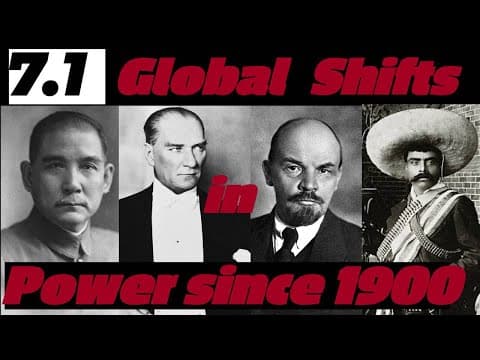
This blog post explores the significant shifts in global power dynamics after 1900, focusing on the collapse of major empires, the rise of nationalism, and the impact of revolutions in China, Russia, and Mexico, leading to the establishment of new political orders and the emergence of modern nation-states.
The early 20th century marked a pivotal period in global history, characterized by significant shifts in power dynamics. This blog post delves into the transformations that occurred after 1900, particularly the collapse of major empires and the rise of new political ideologies and movements.
The trends established in the previous century continued into the 20th century, particularly until the onset of World War I in 1914. European powers expanded their territories in Africa and Asia while consolidating control over existing colonies. Concurrently, the United States experienced economic imperialism, notably exemplified by the construction of the Panama Canal, which enhanced American influence, especially over Mexico.
By the end of the century, three significant land-based empires—the Qing, Russian, and Ottoman—faced collapse due to a combination of internal strife and external pressures. Each of these empires was characterized by autocratic governance, which became increasingly unpopular as Enlightenment ideals, such as popular sovereignty, gained traction.
All three empires experienced significant rebellions:
These empires, with their diverse ethnic and religious populations, faced resistance fueled by rising ethnic nationalism.
The Qing Dynasty's decline was exacerbated by external factors, including defeats in the Opium Wars and the Sino-Japanese War. The culmination of internal rebellions led to the 1911 Xinhai Revolution, which ended over 2,000 years of imperial rule in China and established the Republic of China in 1912, led by Sun Yat-sen. Sun's vision of nationalism was inclusive, aiming to unify all ethnicities within the nation.
The Ottoman Empire faced continuous challenges in the 20th century, particularly during the Balkan Wars, which resulted in significant territorial losses. The empire's ultimate defeat in World War I led to the loss of nearly all its territories, leaving only modern-day Turkey. The sultanate became a puppet regime under the victorious Allies until Mustafa Kemal Atatürk led the Turkish War of Independence, culminating in the establishment of the Republic of Turkey in 1923.
The Russian Empire's collapse was marked by a more explosive transformation. The disastrous performance of the Russian Army in World War I, coupled with severe economic hardships, set the stage for revolution. The February Revolution of 1917 began with protests in St. Petersburg, demanding an end to food rationing, the war, and autocracy.
The provisional government that emerged was viewed as illegitimate, leading to the rise of the Bolshevik Party, led by Vladimir Lenin. The October Revolution resulted in the Bolsheviks seizing power, ending Russia's involvement in World War I. Following a brutal civil war, the USSR was established, marking the rise of a communist state that implemented radical changes, including land redistribution and the promotion of Marxist ideologies.
Simultaneously, Mexico experienced its own revolution, which challenged the existing social and political order. President Porfirio Díaz ruled for 34 years, promoting economic liberalization that primarily benefited foreign investors and wealthy landowners while marginalizing the working class and poor peasants.
The revolution began in 1910 as a political response to a rigged election favoring Díaz. Francisco Madero emerged as a leader advocating for change, but his inability to address land reforms led to further unrest. Revolutionary leaders like Emiliano Zapata and Pancho Villa sought to rectify extreme wealth inequality and land ownership issues.
The revolution resulted in a protracted and violent struggle, claiming at least a million lives. In 1917, a new constitution was adopted, incorporating land reforms, although many were not implemented until the presidency of Lázaro Cárdenas in the 1930s.
The early 20th century was a transformative period marked by the collapse of empires and the rise of new political ideologies. The shifts in power dynamics set the stage for modern nation-states and the complex political landscape that would follow. As we continue to explore these historical developments, it is essential to understand their lasting impact on contemporary global relations.



















