
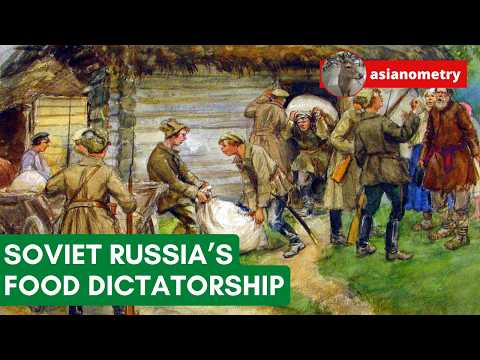
This blog post explores the desperate and brutal campaign for grain in Soviet Russia following the Bolshevik Revolution, detailing the agricultural challenges, government policies, and the resulting famine that led to millions of deaths.
In a telegram sent on January 15th, 1918, Vladimir Lenin wrote:
For God’s sake, take the most energetic and revolutionary measures to send grain, grain and more grain!!!
The Bolsheviks came to power chanting the slogan, "Peace, Land, and Bread". However, there was little bread available. Believing that greedy peasants were hoarding grain, the Bolsheviks forcibly seized it from the countryside, leading to tragic consequences. This post examines Soviet Russia's desperate and merciless campaign for grain.
At the start of the 1900s, the Russian Empire was predominantly agricultural, with 80% of the population living in rural areas. The urban population required only about 7-8% of the annual crop for sustenance. Approximately 26% of the peasants' grain production, primarily wheat, was sold to cities and exported at market prices. The Russian Empire was one of the world's largest wheat exporters, generating significant revenue for the government, which invested in a vast railway network to transport grain.
Despite this thriving grain business, the agricultural system was fragile. Peasants were not particularly productive and often sacrificed their own consumption to meet market demands. A shift in their habits, such as planting less grain or consuming more for themselves, could quickly deplete surpluses. A severe famine struck in 1891-1892, but for two decades following, favorable weather conditions allowed the system to hold. This stability ended with the outbreak of World War I in 1914.
The grain harvests of 1915 and 1916 were relatively good, yet food could not reach urban centers like Moscow due to market breakdowns and distribution issues. The Czarist government began purchasing large quantities of grain to support its army, leading to currency dilution and rising prices. In response, the government imposed price controls, which only exacerbated the situation by causing grain producers to withhold their surplus.
Transportation networks also deteriorated due to shortages of train cars and fuel, bad weather, and increased banditry. As a result, food prices soared, leading to protests from hungry workers in factories and weaving mills. The government attempted to centralize food procurement through a food monopoly, but resistance from peasants thwarted these efforts.
The food shortages contributed to the collapse of the Russian Empire, culminating in the February 1917 protests led by women demanding food. The Provisional Government that followed struggled to provide for urban residents and established a grain monopoly, but peasants resisted reporting their grain. The inability to secure food ultimately led to the downfall of the Provisional Government, paving the way for the Bolsheviks' rise to power in October 1917.
Upon taking power, the Bolsheviks faced a country on the brink of collapse. Lenin's initial decree aimed to end the war, but the Russian Army was disintegrating. The Bolsheviks signed a punitive treaty with Germany in March 1918, resulting in significant territorial and population losses, including the loss of Ukraine, a crucial grain-producing region.
The Russian Civil War began in May 1918, further complicating the food crisis as trade ties between cities and the countryside broke down. Urban dwellers began leaving cities for their villages, exacerbating labor shortages and reducing production of essential goods.
The Bolsheviks expected poorer peasants to support the urban proletariat by sharing their grain, but when they refused, the Bolsheviks labeled this resistance as "localism". The breakdown of transportation networks further hindered food distribution, with two-thirds of locomotives out of service by 1918. Banditry became rampant, with food officials requesting military escorts for grain trains.
Recognizing the importance of food for maintaining social order, Lenin declared a "food dictatorship" in May 1918, allowing the government to seize grain from peasants, particularly targeting the wealthier kulaks. This marked the beginning of a civil war in the countryside, as the government mobilized poorer peasants into committees to confiscate grain.
The Bolsheviks established the "committees of the poor" to identify and seize grain from kulaks. However, these committees often resorted to violence and became unpopular, leading to peasant unrest. The government also formed food requisition brigades, known as Prodotryads, which faced fierce resistance from villagers who viewed them as bandits.
The food shortages led to the rise of the black market and smugglers, known as Meshochniki or "bag men". Many urbanites traveled to the countryside to barter for food, while organized groups clashed with food requisition brigades. By August 1918, food supplies to Moscow had dwindled to a trickle, and desperate measures were taken to procure grain.
In January 1919, the Soviet government announced a policy for armed food requisitions, known as "prodrazverstka". Local agents were tasked with collecting grain quotas, often resorting to threats and force when peasants were unwilling to comply. By 1919, 15-20% of agricultural production was requisitioned, increasing to 30% the following year, which proved unsustainable.
The requisitioning policies forced peasants to surrender their seed grain, leading to a significant reduction in cultivated land. By 1919, crop yields had plummeted to 60% of pre-war levels. The government continued to impose unrealistic quotas, leading to widespread starvation. Reports of cannibalism began to emerge as desperate peasants resorted to extreme measures to survive.
By the end of 1920, the Soviet government acknowledged the impending famine and shifted its approach. The forced requisitions were replaced with a tax on harvests, known as Prodnalog. However, this new system still faced resistance, and tax collectors were often met with violence. The government resorted to military tribunals and paramilitary groups to enforce compliance.
By June 1921, the Soviet government recognized its inability to feed millions suffering from hunger and sought international assistance. The United States and Europe responded, providing food relief, although some of it came from regions that also faced shortages. The famine resulted in the deaths of an estimated five million people, with horrific accounts of cannibalism and suffering.
The period of forced food requisitions is often viewed as part of the disastrous "War Communism" years. Lenin's retreat to capitalism was seen as a temporary measure, but the struggle to manage peasant resistance would continue to cause suffering in Soviet Russia. The legacy of this brutal campaign for grain would have lasting implications for the Soviet state and its agricultural policies.



















