
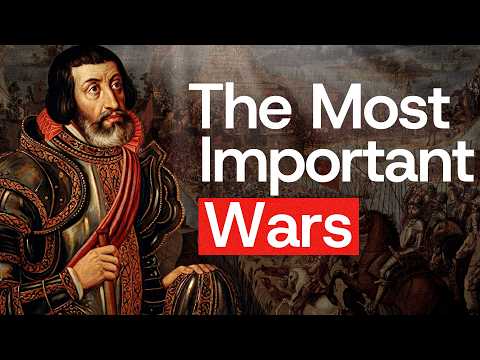
This article explores the ten most significant wars in history, detailing their causes, key events, and lasting impacts on the modern world, from the Gothic War leading to the fall of Rome to World War I reshaping global politics.
Wars have been a constant part of human history, shaping nations and societies. While countless conflicts have occurred, not all have had the same profound impact on the world we live in today. This article delves into what are considered the ten most important wars in history, focusing on their significance rather than their scale or the number of participants.
The Gothic War is often overlooked, yet it played a crucial role in the decline of the Western Roman Empire. Beginning in 376, Gothic tribes fled from the Huns and sought asylum within Roman borders. Emperor Valens allowed them to settle, hoping to bolster his army. However, poor treatment and lack of resources led to resentment among the Goths, culminating in a rebellion in 377.
The pivotal Battle of Adrianople in 378 resulted in a catastrophic defeat for the Romans, with Valens killed and much of his army lost. This defeat marked a turning point, as the Goths began to plunder Roman territories. Eventually, a peace treaty allowed the Goths to settle within the Empire, marking the first time a barbarian population was allowed to maintain its own laws and leaders within Roman territory. This event blurred the lines between Roman and barbarian cultures and set the stage for the eventual fall of the Western Roman Empire, leading to the Dark Ages in Europe.
The Chinese Civil War was a significant conflict that resulted in the establishment of the People's Republic of China under communist rule. The war's roots lay in the collapse of the Qing Dynasty in 1911, leading to a power struggle between the Nationalists, led by Chiang Kai-shek, and the Communists, led by Mao Zedong.
The war saw brutal fighting, including the Long March, where the Communists retreated under dire conditions. The conflict was temporarily halted during World War II as both factions united against Japanese aggression. However, after Japan's defeat, the civil war resumed, ultimately resulting in a Communist victory in 1949. The consequences of this war were profound, leading to the Great Famine and the Cold War tensions between China and the United States, as well as ongoing conflicts regarding Taiwan.
The Spanish conquest of the Americas was not a single war but a series of conflicts that led to the subjugation of vast territories in Central and South America. Beginning with Columbus's voyage in 1492, Spanish conquistadors like Hernán Cortés and Francisco Pizarro exploited divisions among indigenous peoples to conquer empires such as the Aztecs and Incas.
The impact of this conquest is still felt today, as it established Spanish as the dominant language in most of Latin America and led to the widespread conversion to Catholicism. The indigenous populations suffered immensely due to violence and diseases brought by Europeans, leading to the near destruction of their cultures.
The Second Punic War was a critical conflict between Rome and Carthage that solidified Rome's dominance in the Mediterranean. Hannibal's famous crossing of the Alps and his victories in battles such as Cannae posed a significant threat to Rome. However, Rome's resilience and strategic counterattacks, particularly by Scipio Africanus, ultimately led to Carthage's defeat.
The war's outcome established Rome as the preeminent power in the Mediterranean, paving the way for its expansion and the spread of Roman culture and language, which continues to influence many modern societies.
Often considered the first global conflict, the Seven Years War involved major powers across Europe, North America, and India. The war began with territorial disputes between Britain and France in North America and escalated into a broader conflict involving multiple nations.
The war resulted in significant territorial changes, with Britain gaining control over Canada and Florida, while France ceded its territories in North America. The war's conclusion marked the rise of Britain as a global superpower and set the stage for the American Revolution, as the British government sought to recoup war debts through taxation of the colonies.
Constantine's Civil War was pivotal in the transition of the Roman Empire to Christianity. Following the death of his father, Constantine was declared emperor, leading to a power struggle with Maxentius. The decisive Battle of Milvian Bridge in 312 saw Constantine reportedly receive a vision that inspired him to adopt Christianity.
His victory not only secured his rule but also led to the Edict of Milan in 313, which legalized Christianity in the Empire. This transformation had lasting effects on Western civilization, as Christianity became the dominant religion, influencing moral values, culture, and politics for centuries.
The Cold War was a prolonged period of geopolitical tension between the United States and the Soviet Union, characterized by ideological conflict between capitalism and communism. Although direct military confrontation was avoided, the two superpowers engaged in numerous proxy wars around the globe.
The Cold War led to significant developments in military technology, including the arms race and the Space Race, culminating in the moon landing. The conflict also shaped international relations, leading to the establishment of NATO and the Warsaw Pact, and continues to influence global politics today, particularly in regions like Eastern Europe and Asia.
The early Muslim conquests were a series of military campaigns that expanded Islam from the Arabian Peninsula to vast territories across the Middle East, North Africa, and into Europe. These conquests occurred during a time when the Byzantine and Sassanian Empires were weakened by prolonged conflict.
The rapid expansion of Islam established it as one of the world's major religions, with profound cultural, political, and social impacts that are still evident today. The conquests also laid the groundwork for the Islamic Golden Age, which contributed significantly to advancements in science, philosophy, and the arts.
World War II was the largest and deadliest conflict in human history, involving numerous nations and resulting in unprecedented destruction. The war began with Germany's invasion of Poland and quickly escalated, leading to significant battles across Europe and Asia.
The war's conclusion reshaped the global order, leading to the establishment of the United Nations and the onset of the Cold War. The Holocaust and the use of atomic bombs on Hiroshima and Nagasaki highlighted the war's moral and ethical implications, influencing international human rights legislation and the creation of the state of Israel.
World War I fundamentally altered the political landscape of the world. Triggered by the assassination of Archduke Franz Ferdinand, the war involved a complex web of alliances and resulted in unprecedented casualties and destruction.
The aftermath saw the collapse of empires, including the Austro-Hungarian, Ottoman, and Russian Empires, leading to the creation of new nations and borders that often ignored ethnic and cultural divisions. The Treaty of Versailles imposed harsh penalties on Germany, fostering resentment that contributed to the rise of Adolf Hitler and the onset of World War II.
The war's legacy is evident in the ongoing geopolitical tensions and conflicts that can be traced back to the decisions made during and after World War I, making it arguably the most significant war in human history.



















