
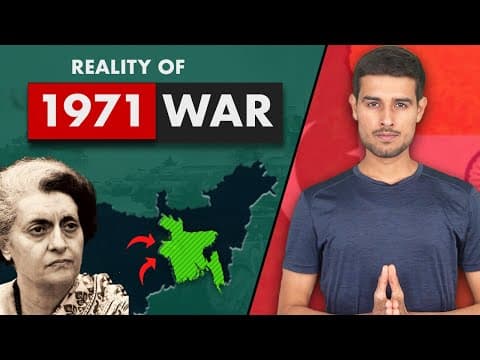
The 1971 India-Pakistan War, initiated by Pakistan's Operation Chengiz Khan, led to the independence of Bangladesh. This blog post explores the historical context, the political dynamics between East and West Pakistan, and the events that culminated in the war, highlighting the struggles for autonomy and the impact of language imposition.
On December 3, 1971, Pakistan launched Operation Chengiz Khan, attacking multiple Indian airfields and marking the beginning of the 1971 India-Pakistan War. This conflict ultimately led to the creation of Bangladesh, a new nation born from the struggle for independence. But what were the underlying reasons for this war? Why did Bangladesh seek independence from Pakistan? And what role did India play in this historical narrative? This blog post delves into the events leading up to the war, the political landscape of Pakistan, and the aftermath of the conflict.
To understand the 1971 war, we must first look back at the Indian subcontinent's history before British colonial rule. The region, which includes present-day India, Pakistan, Bangladesh, Nepal, Burma, and Sri Lanka, was once home to numerous autonomous kingdoms, each with its own culture and traditions. The Bengal region, which encompasses modern-day Bangladesh and West Bengal, was predominantly ruled by Muslim monarchs since the 13th century. During this time, a culture of coexistence between Islam and Hinduism flourished, with various religious backgrounds represented in high offices and local communities.
In 1757, the East India Company began its control over Bengal, leading to British colonial rule until 1947. The partition of India and Pakistan was a devastating event that displaced millions and resulted in widespread violence. The Lahore Resolution of 1940, which called for a separate Muslim state, was rooted in fears that Muslims would become a minority in a unified India. The partition drew borders along religious lines, ignoring the social and cultural ties that existed among communities.
The partition resulted in the division of Bengal, with West Bengal joining India and East Bengal becoming East Pakistan. Despite being the majority in Pakistan, Bengalis in East Pakistan faced political and economic marginalization, as power was concentrated in West Pakistan, particularly among Punjabis and Mohajirs.
After the partition, Pakistan was established as a parliamentary democracy, but the central government wielded significant power, undermining the democratic process. The political landscape was tumultuous, with multiple military coups and a lack of representation for East Pakistanis. The economic disparity between East and West Pakistan became increasingly evident, with the majority of national resources allocated to West Pakistan despite East Pakistan contributing significantly to the national revenue.
One of the most contentious issues was the imposition of Urdu as the sole national language, which alienated the Bengali-speaking population of East Pakistan. In 1952, protests erupted over this language policy, leading to the deaths of several students and marking the beginning of the Bengali Language Movement. This event is commemorated annually as Language Martyr's Day in Bangladesh.
The political climate continued to deteriorate, culminating in the Six-Point Movement led by Sheikh Mujibur Rahman, which demanded greater autonomy for East Pakistan. The West Pakistani government viewed these demands as separatist threats, leading to increased tensions and the arrest of Sheikh Mujibur in 1968.
The 1970 general elections in Pakistan revealed a deep divide between East and West Pakistan, with the Awami League winning a landslide victory in East Pakistan but failing to secure any seats in West Pakistan. The refusal of the West Pakistani government to recognize the election results sparked widespread protests in East Pakistan, with calls for independence growing louder.
On March 7, 1971, Sheikh Mujibur delivered a historic speech advocating for freedom, igniting the Bengali nationalist movement. The situation escalated when the Pakistani military launched Operation Searchlight on March 25, 1971, targeting civilians and political leaders in East Pakistan. This brutal crackdown led to widespread atrocities and the declaration of independence by Sheikh Mujibur Rahman, marking the official start of the Bangladesh Liberation War.
As the conflict intensified, millions of refugees fled to India, prompting Prime Minister Indira Gandhi to consider military intervention. On December 3, 1971, Pakistan attacked Indian airfields, initiating a full-scale war. India's military response was swift and effective, leading to a decisive victory over Pakistani forces in East Pakistan.
On December 16, 1971, the Pakistani military surrendered, resulting in the establishment of Bangladesh as an independent nation. The Simla Agreement signed in 1972 recognized Bangladesh's sovereignty, and the international community, including the United Nations, followed suit.
The birth of Bangladesh was a significant moment in South Asian history, but it was not without its challenges. Sheikh Mujibur Rahman, hailed as the father of the nation, faced political instability and was eventually assassinated in 1975. The subsequent years saw Bangladesh grappling with military rule and political turmoil, echoing the struggles faced by Pakistan.
Today, the story of Bangladesh serves as a reminder of the complexities of national identity, the consequences of language imposition, and the importance of political representation. The lessons learned from this tumultuous period continue to resonate in contemporary discussions about governance and cultural diversity.
In conclusion, the 1971 India-Pakistan War was not just a military conflict; it was a culmination of historical grievances, cultural tensions, and the quest for self-determination. Understanding this history is crucial for appreciating the dynamics of South Asia today.



















