
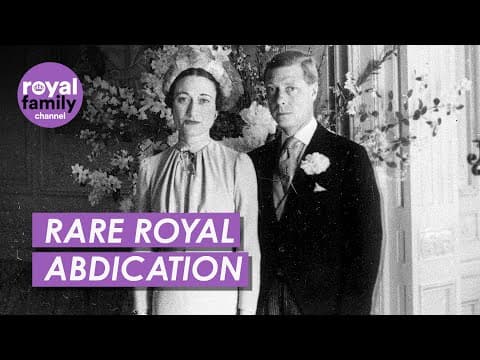
King Edward VIII's abdication in 1936 marked a significant moment in British history, driven by his desire to marry American divorcée Wallis Simpson, which led to a constitutional crisis and reshaped the monarchy.
In a surprising announcement just before the new year, Denmark's Queen Margrethe II declared her abdication. This event prompts reflection on the last British monarch to abdicate, King Edward VIII, who made headlines in 1936 after ruling for less than a year. His decision to renounce the throne was unprecedented and stemmed from his controversial relationship with American divorcée Wallis Warfield Simpson.
Edward VIII ascended to the throne following the death of his father, King George V, in January 1936. His reign was marked by a significant personal dilemma: his desire to marry Wallis Simpson, who was not only an American socialite but also a twice-divorced woman. At that time, the Church of England and many British politicians deemed her an unacceptable choice for a prospective queen.
Wallis Simpson was previously married to Ernest Simpson, an English-American businessman, and had also divorced a U.S. Navy pilot. The royal family's disapproval of Edward's relationship with Wallis intensified as he became increasingly determined to marry her. Despite the mounting pressure and disapproval from the government and the church, Edward proposed a marriage arrangement that would grant Wallis no rights of rank or property. This proposal was rejected by then Prime Minister Stanley Baldwin as impractical.
As the situation escalated, British newspapers began to report on the impending crisis, leading to discussions in Parliament. With no resolution in sight, Edward made the historic decision to abdicate the throne on December 10, 1936. The following evening, he addressed the nation via radio, stating:
"I have found it impossible to carry the heavy burden of responsibility and to discharge my duties as king as I would wish to do without the help and support of the woman I love. God bless you all. God Save the King."
On December 12, 1936, Edward's younger brother, the Duke of York, was proclaimed King George VI, marking a new chapter for the British monarchy.
Following his abdication, Edward was given the title Duke of Windsor. He married Wallis Simpson in June 1937 in France, and the couple spent the next two years traveling across Europe, where Edward was controversially honored by Nazi officials. Notably, in October 1937, he met with Adolf Hitler, a moment that has been referenced in popular culture, including the hit Netflix series "The Crown."
As World War II erupted, Edward took on a role as a liaison officer in France until the country fell to Nazi forces. He then relocated to Spain, where a plot by the Nazis to kidnap him and install him as a puppet king in Britain was uncovered. Despite his past sympathies towards the Nazis, Winston Churchill offered him the governorship of the Bahamas, which Edward accepted, narrowly escaping a Nazi SS team sent to capture him.
In 1945, Edward resigned from his post in the Bahamas and returned to France, where he and Wallis settled primarily in Paris. He made occasional visits to England, including for the funerals of King George VI in 1952 and his mother, Queen Mary, in 1953. Edward VIII passed away in Paris in 1972 and was buried at Frogmore on the grounds of Windsor Castle.
The abdication of King Edward VIII was a pivotal moment in British history, reshaping the monarchy and highlighting the complexities of royal duty versus personal desire. His love for Wallis Simpson not only altered the course of his life but also had lasting implications for the British royal family and the institution of the monarchy itself.



















