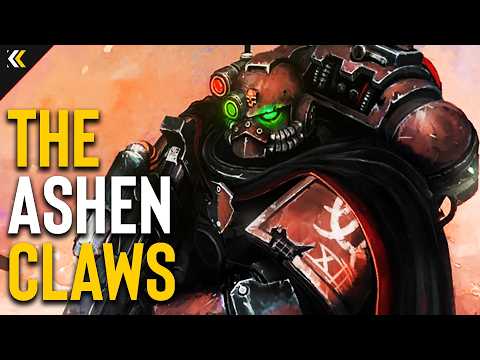
The Ashen Claws are a unique Space Marine force descended from the Raven Guard Legion, operating independently along the galactic fringe. Born from the aftermath of the Horus Heresy, they maintain loyalty to the Imperium but function outside its formal structures, emphasizing self-sufficiency, stealth, and pragmatic warfare. Their ambiguous status challenges traditional Imperial classifications, embodying survival and adaptation over conformity.
Recovered data fragments from Frontier Archive vaults reveal the existence of a mysterious and anomalous Space Marine force known as the Ashen Claws. Operating along the outer edges of the Segmentum Pacificus, this group bears heraldry reminiscent of the Raven Guard Legion but with distinct alterations. Unlike typical Imperial Navy fleets, the Ashen Claws are unregistered and operate with a high degree of autonomy, maintaining a unique identity forged through necessity and survival.
The Ashen Claws trace their origins to the closing stages of the Horus Heresy, a tumultuous period when the Raven Guard Legion suffered catastrophic losses, notably during the Drop Site Massacre on Istvaan V. This event decimated much of the Legion's command and material strength, forcing survivors into a prolonged reconstruction phase under Primarch Corvus Corax.
Due to wartime urgency, the Legion employed experimental gene-seed production and rapid induction methods, resulting in warriors with subtle genetic deviations. Several expeditionary contingents were dispatched beyond direct oversight to continue fighting traitor forces in distant theaters. These detachments, emphasizing stealth and sudden violence, gradually developed autonomous command cultures due to fractured Imperial communications.
As the Imperium reorganized post-Heresy, many such forces were recalled or reassigned into new Chapter structures. However, some units, including the Ashen Claws, remained isolated due to warp storms, navigational collapse, and administrative overload, operating beyond centralized authority for extended periods.
The Ashen Claws evolved from Ravenguard descendants and reinforcements from related gene lines, establishing a semi-permanent operational zone along the galactic fringe. Initially driven by survival, they secured resources independently, defended isolated human populations, and maintained war material without Mechanicus oversight.
Their armor shifted from the Raven Guard's sable black to a pale ashtoned coloration, practical for camouflage in dust-heavy frontier environments and symbolic of their separation from the parent Legion. Genetic analyses indicate their gene-seed remains broadly stable, with minor deviations consistent with early post-Istvaan reconstruction strains.
Organizationally, the Ashen Claws operate under a loose but effective hierarchy where command is earned through demonstrated capability rather than strict adherence to Codex structures. Their doctrine emphasizes reconnaissance, precision strikes, and calculated intimidation over large-scale engagements.
The Ashen Claws maintain small, highly mobile fleets relying on rapid translation and sudden concentration of force. They act as conditional protectors of nearby human settlements, expecting logistical support and aspirants in exchange for ruthless elimination of external threats such as xenos raiders, renegades, and pirates.
Unlike many Codex-compliant Chapters, they lack extensive fortress-monasteries or ceremonial infrastructure, living primarily aboard strike cruisers and adapted escort vessels. Their equipment philosophy favors modification over replacement, with armor and weapons maintained beyond standard cycles and adapted for reliability and ease of maintenance.
Armor systems incorporate components from multiple historical patterns, power networks are rerouted for redundancy, and plating is reinforced at stress points identified through combat experience. Their pale, matte armor finish reduces thermal contrast and serves as practical camouflage, reapplied in the field using mineral-based compounds.
Weapons are selected for reliability under irregular maintenance, with bolters modified for simplified firing mechanisms and reinforced recoil assemblies. Close combat weapons are personalized and maintained over decades, fostering intimate relationships between warrior and weapon.
Fleet vessels are extensively restructured for endurance, featuring modular fabrication spaces for producing spare parts and munitions. Maintenance protocols prioritize accessibility, allowing rapid repairs without dry dock intervention. Reconnaissance technology favors passive detection and long-range pattern analysis to minimize electronic signatures.
Communications rely on burst transmissions encrypted with archaic ciphers, limiting exposure and dependence on Imperial relay networks. Transport and deployment emphasize precision insertion via strike craft optimized for rapid disembarkation and minimal detection.
The Ashen Claws' engagements are characterized by stealth, infiltration, and elimination of enemy command structures before main assaults. They avoid territorial expansion, focusing instead on neutralizing threats, securing resources, and enforcing deterrence within their operational sphere.
Their conflicts are finite interventions marked by rapid appearance, decisive violence, and immediate withdrawal. This behavior has contributed to their ambiguous reputation, as Imperial observers often encounter only the aftermath of their actions.
Logistical records indicate calculated resource exchanges with frontier worlds rather than formal tithes, emphasizing industrially practical materials over ceremonial goods. Medical and gene-seed preservation practices are conservative but effective, relying on inherited knowledge from the Legion era.
The Ashen Claws rarely commit full strength to single engagements, maintaining reserves and emphasizing survival, likely influenced by historical memories of near annihilation during the Heresy.
The Ashen Claws exist adjacent to Imperial systems rather than within them. They reject centralization but maintain enough structural familiarity to avoid classification as deviant. Their ambiguous status has led to cautious respect and watchful acceptance by Imperial authorities.
Attempts to formally integrate or sanction the Ashen Claws have repeatedly failed due to their transient presence and refusal to submit to invasive audits. They neither openly rebel nor seek recognition, operating under self-imposed limitations that preserve their autonomy.
Inquisitorial records describe the Ashen Claws as neither hostile nor fully compliant, acting in ways aligned with humanity's preservation but without submitting to investigation or doctrinal oversight. Their operational opacity and cultural minimalism challenge Imperial institutions' ability to categorize them.
Historical records attribute several key frontier stabilizations to the Ashen Claws, including:
These actions have maintained a chain of frontier systems that might otherwise have fallen into darkness, preserving human settlements and reducing the need for large-scale Imperial interventions.
The Ashen Claws exhibit a culture shaped by survival, adaptability, and rejection of distant authority. They retain reverence for the Emperor expressed through action rather than liturgical observance. Rituals are functional, and ceremonial artifacts are minimal or absent.
Their psychological profile aligns with Raven Guard traits such as patience, observation, and controlled aggression but with reduced emphasis on hierarchical obedience. Authority is respected when tactically justified, and initiative is expected at all levels.
Interactions with non-Estartis populations are pragmatic and restrained, providing efficient assistance without fostering prolonged contact or worship. Their loyalty centers on humanity rather than Imperial bureaucracy.
The Ashen Claws maintain a closed logistical ecosystem, extracting and processing raw materials locally and fabricating components independently. Their technology is conservative, focusing on reliability and predictability rather than innovation.
Battlefield remnants show controlled munitions expenditure and selective damage to hostile assets, preserving civilian infrastructure. Equipment often lacks identifying marks, possibly to avoid doctrinal scrutiny or technological tracing.
Their fleet size remains modest but highly serviceable, avoiding expansion that would compromise autonomy. Trade flow in their regions shows unusual economic continuity and stability.
The Ashen Claws represent a unique and enduring anomaly within the Warhammer 40k universe. Born from the crucible of the Horus Heresy and shaped by isolation and necessity, they embody a self-reliant brotherhood that preserves the genetic and tactical legacy of the Raven Guard while rejecting the rigid structures of the modern Imperium.
Their existence challenges assumptions about Space Marine conformity, demonstrating that survival and loyalty can persist outside formal recognition and control. The Ashen Claws continue to fight the wars they were created for, operating as a tolerated irregularity whose methods and identity remain shrouded in mystery.
Their story is one of adaptation, resilience, and the complex interplay between duty and independence in a galaxy at war.
This comprehensive overview synthesizes recovered data, archival records, and inquisitorial reports to illuminate the enigmatic Ashen Claws, offering insight into their origins, culture, operations, and enduring place within the Imperium's vast and complex tapestry.