
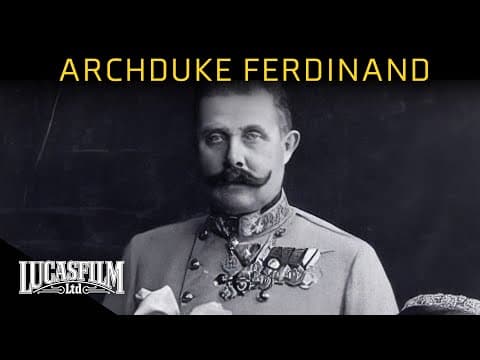
The assassination of Archduke Franz Ferdinand in June 1914 triggered a series of events that led to World War I, reshaping Europe and ending the era of monarchies. This blog post explores the life of the Archduke, the political tensions of the time, and the consequences of his death.
June 1914 marked a pivotal moment in history as Archduke Franz Ferdinand, heir to the Austrian throne, embarked on a journey to Sarajevo, accompanied by his wife Sophie. This trip, intended for both pleasure and business, would inadvertently set off a catastrophic chain of events that plunged Europe into war, ultimately reshaping the continent and ending the reign of royal families.
Franz Ferdinand was born into the Habsburg dynasty, one of the oldest and most prestigious royal families in Europe, with a reign over Austria that spanned 900 years. At 51 years old, he was eager to assume his role as ruler, despite a tumultuous path to his position. Initially considered a sickly child with little expectation of inheriting the throne, he developed a strong desire to prove himself, particularly to his uncle, Emperor Franz Joseph.
Emperor Franz Joseph, who ascended to the throne at 18, was a stern ruler dedicated to preserving the monarchy's power. His reign was marked by personal tragedies, including the execution of his brother Maximilian and the suicides of his son Rudolph and Rudolph's mistress. Amidst these challenges, Franz Ferdinand's marriage to Sophie Chotek, a woman of non-royal blood, scandalized the court and strained his relationship with the Emperor.
Franz Ferdinand's love for Sophie defied royal tradition, which typically dictated that marriages be politically motivated. The Emperor imposed harsh conditions on their union, ensuring that their children would be excluded from the line of succession. Despite the court's disdain, Franz Ferdinand and Sophie traveled extensively, often receiving the respect and honor denied to them in Vienna.
As the early 20th century unfolded, European monarchies faced increasing pressure from their subjects, who demanded political reforms and representation. While some rulers resisted change, others, like Britain’s George V, adapted to constitutional monarchy. Franz Ferdinand envisioned a more inclusive government that would address the needs of various ethnic groups within Austria-Hungary, but his plans were stymied by his uncle's rigid rule.
Austria-Hungary's relationship with Serbia was fraught with tension, particularly as Serbia sought to expand its territory to include ethnic Serbs living in Austria. This ambition fueled the formation of the Black Hand, a terrorist organization committed to achieving Serbian unification through violent means. The group's activities were particularly concentrated in Bosnia-Herzegovina, where Franz Ferdinand was scheduled to visit in June 1914.
Franz Ferdinand's visit to Sarajevo was both a personal celebration of his wedding anniversary and a political gesture to connect with the Bosnian people. However, the announcement of his visit prompted the Black Hand to mobilize. On June 28, 1914, during a motorcade through the city, an assassination attempt was made. The first attack failed, but shortly after, Gavrilo Princip, a member of the Black Hand, successfully shot the Archduke and Sophie.
The assassination sent shockwaves through Europe. Franz Ferdinand had been a proponent of peace and reform, and his death was a devastating blow to hopes for stability. The Austrian government, seeking to blame Serbia rather than the terrorists, viewed the incident as an opportunity to address the perceived threat from Serbia.
The assassination set off a series of diplomatic crises, leading Austria-Hungary to declare war on Serbia. This action triggered a web of alliances that drew in major powers across Europe, including Germany and Russia. The resulting conflict escalated into World War I, which lasted over four years and resulted in millions of deaths.
The war marked the decline of monarchies across Europe. Kaiser Wilhelm II of Germany abdicated, Tsar Nicholas II of Russia was executed, and the Habsburg dynasty crumbled, leading to the dissolution of Austria-Hungary. By 1919, the empire had fragmented into several new nations, including Austria, Czechoslovakia, and Yugoslavia.
The assassination of Archduke Franz Ferdinand was not just a tragic event; it was a catalyst that ignited a global conflict and transformed the political landscape of Europe. The consequences of that fateful day in Sarajevo were profound, leading to the end of an era characterized by royal rule and the emergence of new nations. The legacy of this event serves as a reminder of how a single act can alter the course of history, costing millions of lives and reshaping the world as we know it.



















