
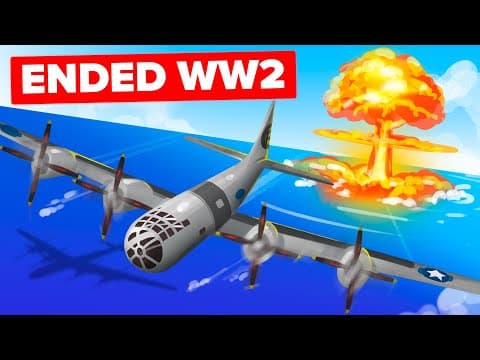
This blog post provides a detailed chronological account of the atomic bombings of Hiroshima and Nagasaki, exploring the events leading up to the bombings, the missions themselves, and the aftermath of these historic and devastating attacks during World War II.
On August 6 and August 9, 1945, the United States dropped atomic bombs on the Japanese cities of Hiroshima and Nagasaki, marking a pivotal moment in World War II and world history. This blog post chronicles the events leading up to these bombings, the missions themselves, and their devastating aftermath.
The skies were clear over southern Japan as Colonel Paul Tibbets, Jr. piloted the Enola Gay towards Hiroshima. The crew prepared to unleash the most powerful explosion ever used in war. Captain William Parsons checked the atomic bomb, Little Boy, ensuring it would detonate at the correct altitude. Tibbets ascended to 31,000 feet, waiting for confirmation from reconnaissance planes.
With the target in sight, Tibbets instructed his crew to prepare for the drop. The gravity of the moment weighed heavily on the crew as they reflected on their loved ones, uncertain if they would return.
Tibbets transferred command to Major Thomas Ferebee, the bombardier. As Ferebee lined up the Aioi Bridge, the target for the bomb, he instructed the crew to don protective goggles.
"Bomb’s away!" Ferebee shouted as the bomb fell from the aircraft. Tibbets maneuvered the Enola Gay away from the blast zone, racing against time as the bomb plummeted towards Hiroshima.
As the bomb detonated, a blinding flash illuminated the sky. Sargent Bob Caron, the tail gunner, described it as "a peep into hell." The explosion unleashed unprecedented destruction.
Lise Meitner and Otto Frisch, fleeing Nazi Germany, discovered that bombarding uranium with neutrons could release vast amounts of energy. This discovery laid the groundwork for nuclear fission.
Enrico Fermi and Neils Bohr discussed the potential for sustained chain reactions, realizing the immense power that could be harnessed from atomic energy.
Following the attack on Pearl Harbor, the U.S. was thrust into World War II, leading to the Manhattan Project's initiation.
General Leslie R. Groves was appointed to lead the Manhattan Project, with J. Robert Oppenheimer at the helm of the scientific team tasked with developing the atomic bomb.
At the University of Chicago, the first controlled nuclear chain reaction was achieved, proving the feasibility of nuclear energy.
The U.S. government forcibly relocated communities to establish the Hanford facility for plutonium production, prioritizing national security over local populations.
Following President Franklin D. Roosevelt's death, Harry S. Truman was briefed on the Manhattan Project and the atomic bomb's progress.
The first atomic bomb test, known as the Trinity test, successfully demonstrated the bomb's destructive power, leading to military decisions regarding its use against Japan.
The Bockscar, carrying the Fat Man bomb, took off towards Japan. Major Charles Sweeney struggled with visibility over the primary target, Kokura, and ultimately redirected to Nagasaki.
Fat Man detonated with a force equivalent to 21,000 tons of TNT, instantly vaporizing 40,000 people and destroying 40% of Nagasaki's buildings.
The bombings resulted in the immediate deaths of approximately 70,000 in Hiroshima and 40,000 in Nagasaki, with many more suffering from radiation exposure and injuries.
On August 14, 1945, Japan announced its unconditional surrender, leading to the end of World War II. The U.S. military occupied Japan for seven years following the war.
The bombings left lasting scars on the cities and their inhabitants, with thousands suffering from radiation-related illnesses in the years that followed. The ethical implications of using atomic weapons continue to be debated.
The atomic bombings of Hiroshima and Nagasaki remain the only instances of nuclear weapons used in warfare. They not only changed the course of World War II but also ushered in a new era of nuclear power and international relations, with profound implications for humanity's future.



















