
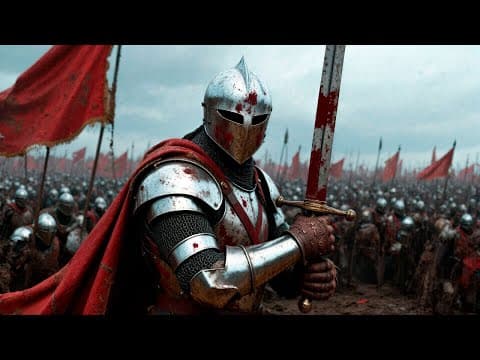
On November 25, 1177, King Baldwin IV of Jerusalem led 500 knights to a stunning victory against Saladin's 26,000-strong army. This blog explores the battle's key moments, tactics, and the extraordinary leadership of a teenage leper king who defied the odds and changed the course of history.
On November 25, 1177, a dying 16-year-old boy with bandaged hands and 500 knights faced down 26,000 of Islam's finest warriors. By sunset, the most powerful Muslim army in the world lay shattered, and history's most unlikely military genius had written his legend in blood. This battle, known as the Battle of Montgisard, is a remarkable tale of courage, faith, and tactical brilliance.
The year 1177 marked a dark hour for the Crusader kingdoms. For nearly eight decades, Christian knights had clung to their precarious footholds in the Holy Land, but the tide was turning. The great Crusader fortresses were falling one by one, overwhelmed by a resurgent Islamic world united under Saladin.
In Jerusalem, Baldwin IV, crowned at 13, ruled with a clarity that stunned both friend and foe. Despite suffering from advanced leprosy, which ravaged his body, Baldwin was determined to defend his kingdom. Facing him was Saladin, a military genius who had united Egypt and Syria, commanding an army that had crushed every force sent against it.
The power dynamic was heavily skewed. The Crusader states could muster perhaps 15,000 men scattered across various fortresses, while Saladin commanded over 100,000 warriors. The situation seemed hopeless, and Jerusalem's nobles were already making secret preparations for exile. However, Baldwin IV was not ready to give up.
As autumn turned to winter in 1177, Baldwin received alarming intelligence: Saladin was massing an army of 26,000 mounted warriors, including his elite Mamluk cavalry, with the clear intention of capturing Jerusalem. Despite the overwhelming odds, Baldwin made a fateful decision to confront Saladin. He insisted on leading his army into battle, despite his deteriorating health.
Baldwin's forces consisted of only 500 knights, including 80 Templar warrior monks, and around 3,000 infantry. The odds were staggering: 52 enemies for every Christian knight. Yet Baldwin rallied his men, declaring, "We faced 26,000 with God."
On November 25, Baldwin's exhausted force marched 45 miles in 36 hours, a grueling pace for any soldier, let alone a king suffering from leprosy. As they approached Saladin's scattered forces, Baldwin's knights were filled with despair upon realizing the true size of the enemy army. However, Baldwin's resolve inspired them to charge into battle.
At 2 p.m., Baldwin raised his bandaged hand, signaling the charge. The 500 knights, despite their fatigue and injuries, surged forward. Saladin, overconfident and unaware of Baldwin's intentions, was caught off guard. His forces were scattered and unprepared for the onslaught.
The Crusader charge was swift and fierce, with Baldwin leading from the front. The impact was devastating; the Mamluks, elite warriors who had never known defeat, were thrown into chaos. Baldwin's tactical genius shone through as he recognized the terrain's advantages, funneling the Muslim forces into traps.
As the battle raged, panic spread among Saladin's troops. The Crusaders, fueled by faith and desperation, pressed on, pushing back against the overwhelming numbers. Baldwin's infantry, hidden from view, suddenly appeared on the Muslim flank, further demoralizing Saladin's forces.
By 2:45 p.m., the Muslim army began to crumble. The Mamluks, once the pride of Saladin's forces, broke and fled. Saladin himself, witnessing the disintegration of his army, abandoned his horse for a camel, a sight that shattered the last remnants of morale among his troops.
The pursuit of the fleeing Muslims turned into a massacre. The Crusaders, driven by a mix of vengeance and divine inspiration, chased down their enemies for miles. By the end of the day, the battlefield was littered with the bodies of 20,000 Muslim warriors, while the Crusaders suffered heavy losses but emerged victorious.
Baldwin IV, despite his injuries and exhaustion, led his men in prayer, thanking God for their miraculous victory. The spoils of war were immense, providing the Crusader states with resources that would sustain them for years.
The Battle of Montgisard stands as a testament to the power of faith, leadership, and tactical brilliance. Baldwin IV's extraordinary victory against overwhelming odds not only saved Jerusalem but also reshaped the power dynamics in the region. Saladin's reputation was tarnished, and the psychological impact of the defeat resonated throughout the Muslim world.
Baldwin IV continued to lead despite his deteriorating health, earning respect even from his enemies. However, the victory at Montgisard was bittersweet, as it bought only a temporary reprieve for the Crusader states.
In the end, the battle serves as a powerful reminder that sometimes, courage and belief can overcome even the most daunting challenges. The legacy of Baldwin IV and the Battle of Montgisard continues to inspire those who face insurmountable odds, proving that faith can indeed move mountains.



















