
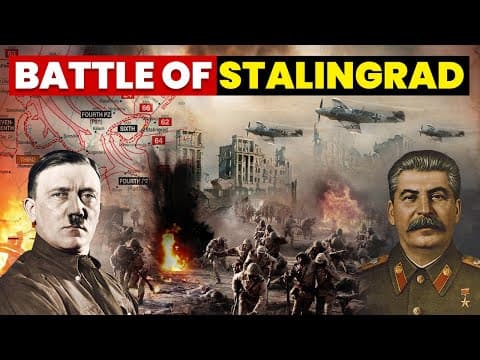
The Battle of Stalingrad, fought between July 1942 and February 1943, was one of the bloodiest battles in history, marking a significant turning point in World War II. This blog post explores the strategic decisions, key figures, and the brutal realities of the battle that led to the defeat of Nazi Germany and the rise of Soviet power.
On July 17, 1942, World War II had escalated into a fierce struggle among the world's greatest powers. Adolf Hitler's Nazi army had already ravaged much of Western Europe and was now poised to invade the Soviet Union, targeting the resource-rich territories and the city of Stalingrad. Named after the Soviet dictator Joseph Stalin, Stalingrad became a symbol of pride and resistance for the Soviets, who were determined to defend it at all costs.
The battle began as the German and Soviet forces clashed, resulting in rivers of blood and widespread devastation. For months, the fighting continued, with the German Luftwaffe bombarding Stalingrad relentlessly. Initially, the Nazis celebrated victories, but as winter approached, the tide began to turn. The brutal cold proved to be a significant factor, crippling the German forces and allowing the Soviets to regroup and counterattack.
Stalingrad was not just a city; it was a crucial industrial hub for the Soviet Union. Control over Stalingrad meant control over the Volga River, which was vital for transporting goods and resources. Hitler believed that capturing Stalingrad would not only deal a blow to Soviet morale but also secure vital oil supplies from the Caucasus region.
In June 1942, Hitler launched Operation Blue, aiming to capture both Stalingrad and the Caucasus. The German army advanced rapidly, initially achieving significant victories. However, Hitler's decision to split his forces to attack both targets simultaneously was met with skepticism from his commanders, who preferred a more focused approach.
The German Sixth Army, under General Friedrich Paulus, made substantial gains, capturing key locations and pushing deep into Soviet territory. However, the Soviets were preparing for a fierce defense, with Stalin issuing orders to protect Stalingrad at all costs.
As the German forces advanced, Stalin implemented a series of strategies to bolster the defense of Stalingrad. He ordered the evacuation of civilians and the relocation of resources while reinforcing the military presence in the city. The Soviet command, led by General Vasily Chuikov, adopted a strategy known as "hugging the enemy," which involved engaging the Germans at close quarters to negate their advantages.
By late 1942, the Soviet Red Army had regrouped and launched a counteroffensive known as Operation Uranus. This operation encircled the German Sixth Army, cutting off their supply lines and trapping them in Stalingrad. The harsh winter conditions further exacerbated the situation for the German troops, who were ill-prepared for the extreme cold.
The Battle of Stalingrad was marked by extreme brutality on both sides. The urban warfare led to horrific casualties, with both military personnel and civilians suffering immensely. The Soviets employed snipers and female bomber regiments, known as the "Night Witches," who conducted nighttime raids on German positions, further demoralizing the enemy.
As the siege continued, the conditions for the German soldiers deteriorated. Starvation, cold, and relentless Soviet attacks took their toll. On January 31, 1943, Paulus, facing insurmountable odds, decided to surrender. By February 2, 1943, approximately 91,000 German soldiers had capitulated, marking a significant defeat for the Nazis.
The Battle of Stalingrad resulted in staggering losses, with estimates of over 1.1 million Soviet casualties and around 800,000 German soldiers killed or captured. This battle not only marked a turning point in World War II but also signaled the beginning of the decline of Nazi Germany.
The Battle of Stalingrad stands as a testament to the resilience and determination of the Soviet forces. Hitler's ambition to capture the city ultimately led to one of his greatest blunders, reshaping the course of the war. Had he not pursued Stalingrad, the outcome of World War II might have been drastically different. The lessons learned from this battle continue to resonate in military strategy and history today.



















