
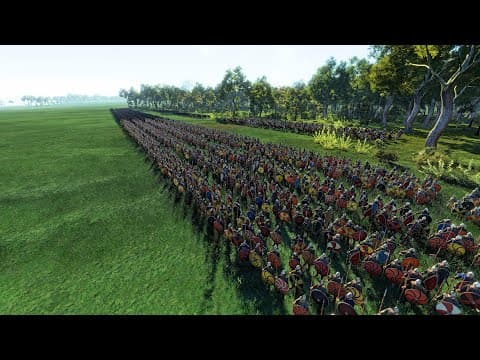
In 732, the Battle of Tours marked a pivotal moment in European history as Charles Martell led the Franks to victory against the Umayyad Caliphate, halting Islamic expansion into Western Europe. This battle not only secured the Frankish realm but also laid the foundation for the Carolingian dynasty and shaped the future of Christendom.
In the early 8th century, Western Europe faced a significant threat from the rapidly expanding Islamic superpower, the Umayyad Caliphate. This regime had swiftly advanced across North Africa and into the Iberian Peninsula, overthrowing the Visigoth Kingdom by 711. By the 720s, Umayyad governors in Al-Andalus were pushing northward, raiding deep into Frankish territories and spreading Islam through military conquest.
The Franks, led by Charles Martell, the mayor of the Palace of Austrasia, were at the forefront of the resistance against this expansion. Although not a king, Martell wielded considerable power, relying on military success and the loyalty of the Frankish nobility. His reputation as a hardened warrior and strategist was built on a series of campaigns that solidified his control over Gaul, modern-day France.
In 732, the Umayyad governor of Al-Andalus, Abd al-Rahman Algafiki, launched a significant military expedition northward. Estimates of his forces range from 20,000 to 25,000 men, primarily cavalry. They crossed the Pyrenees, advanced through Aquitaine, sacked Bordeaux, and defeated Duke Odo of Aquitaine. Faced with this formidable threat, Odo sought assistance from Martell, despite their previous rivalry.
The Muslim army was a diverse and battle-hardened force, consisting of Berber cavalry, Arab veterans, and light infantry skilled in mobile warfare. In contrast, Martell's army comprised approximately 15,000 to 20,000 men, primarily heavy infantry. The core of his strength lay in the disciplined Frankish foot soldiers, armed with shields, spears, and swords, and protected by armor. They fought in tightly ordered ranks, forming a defensive phalanx rather than engaging in open-field charges.
The two armies met between Tours and Poitiers, near the road linking the Lier and Vienne rivers. Charles Martell strategically chose a strong defensive position on elevated terrain surrounded by woods, which limited the mobility of the Umayyad cavalry. For a week, both armies skirmished, neither willing to commit to a full battle.
When the battle finally commenced, the Muslim cavalry launched repeated charges against the Frankish lines. Each time, the infantry held firm, their shields and spears braced in disciplined formation. Despite the Muslim cavalry's reputation for speed and shock, the Franks remained resolute, utilizing their phalanx formation effectively. Abd al-Rahman, confident in his cavalry's ability to break through, continued the relentless assaults, but the Franks did not yield.
As the day wore on, the continuous Muslim charges began to take a toll on the Frankish lines. Charles Martell recognized the need for a counterattack. He rotated his ranks, sending less experienced troops to the forefront to relieve the weary soldiers. Abd al-Rahman seized this opportunity to send in infantry to probe for weaknesses in the Frankish formation.
During the heat of battle, Martell and Odo devised a risky strategy to attack the lightly defended Muslim camp. Odo led the Frankish cavalry around the main battle line, successfully reaching the camp and launching an attack. The Muslim garrison managed to hold off Odo's men long enough for Abd al-Rahman to be alerted.
As news spread through the Muslim ranks that their camp was under attack, panic began to set in. Abd al-Rahman ordered his main force to return to defend the camp, pursued by Charles and his infantry. Although Odo could not break through the camp's defenses and retreated, Charles saw an opportunity to launch a full-scale attack on the disorganized Umayyads.
The two forces clashed fiercely, with the Muslims initially holding their ground. However, a significant turning point occurred when Abd al-Rahman was struck in the head by a projectile, killing him instantly. Despite this, the news of his death did not immediately reach the Muslim troops, allowing them to continue fighting.
Realizing the battle was taking a toll on his men, Charles ordered a tactical retreat back to the Frankish camp, intending to besiege the Muslim camp the following day. However, when the Franks formed up for battle the next morning, they found no response from the Muslims. The Umayyads, realizing their leader had fallen and exhausted from the battle, chose to withdraw during the night, leaving behind supplies and loot.
Charles Martell's victory at the Battle of Tours was hard-won and significant. While later Christian chroniclers hailed it as a decisive turning point that saved Europe from Muslim conquest, modern historians recognize the complexities of the situation. Although Muslim power in Iberia remained strong and raids into southern Gaul continued, the battle effectively checked northern expansion, secured Martell's reputation, and laid the groundwork for the Carolingian dynasty that would soon rise to prominence under Charlemagne.



















