
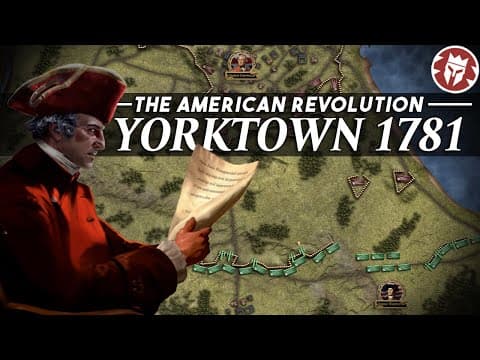
The Battle of Yorktown in 1781 marked a decisive moment in the American Revolution, leading to the eventual defeat of British forces under Cornwallis. This post explores the events leading up to the battle, the strategies employed by both sides, and the aftermath that shaped the future of the United States.
The Battle of Yorktown, fought in 1781, was a pivotal moment in the American Revolution that ultimately led to the defeat of British forces. This post delves into the events leading up to the battle, the strategies employed by both the American and British forces, and the significant aftermath that shaped the future of the United States.
By 1781, Britain was facing significant challenges in the war. The southern campaign led by Lt. General Charles Cornwallis had suffered its first major setback at Kings Mountain. With his forces diminished and his supply lines stretched thin, Cornwallis was forced to withdraw from North Carolina into South Carolina. Heavy rains at the Catawba River further complicated his situation, forcing him to camp near Land’s Ford while he awaited better weather and improved health.
The British were also struggling in other theaters. In India, the British East India Company faced threats from France and the Kingdom of Mysore. In the Caribbean, French forces were gaining the upper hand, and a disastrous hurricane in 1780 had devastated British naval capabilities. The political situation in Britain was dire, with calls for peace growing louder as the war continued to go poorly.
While the British were faltering, the French were also facing difficulties. Their finances were nearing collapse, and Louis XVI’s government was under pressure to take a more active role in North America. Meanwhile, George Washington was strategizing to turn the tide of the war. After the disastrous southern campaign, he replaced General Horatio Gates with Nathaniel Greene, a more capable leader.
Greene took command of the Southern Department in October 1780, with orders to preserve his army and defeat Cornwallis. He had a small force of about 1,500 soldiers, but Cornwallis’ army was also struggling with desertion and supply issues. Greene’s strategy involved avoiding direct confrontation and instead using guerrilla tactics to harass the British.
Greene and his council devised a plan to lure Cornwallis into a trap. They aimed to divide his forces and draw them into the wilderness where they could be defeated in smaller engagements. Greene sent cavalry under Col. “Light Horse” Harry Lee to disrupt British supply lines while Daniel Morgan led a smaller force to recruit militia and forage for supplies.
As Cornwallis learned of Morgan’s movements, he dispatched Banastre Tarleton to confront him. However, Morgan’s strategic withdrawal led to the Battle of Cowpens, where American forces decisively defeated Tarleton’s troops. This victory significantly weakened Cornwallis’ army and boosted American morale.
Following the defeat at Cowpens, Cornwallis was determined to crush Greene’s forces. He ordered a rapid march north, but Greene skillfully retreated, using the backcountry roads to evade capture. Greene’s forces successfully crossed the Dan River just ahead of Cornwallis, who was left frustrated and without a clear path forward.
After regrouping, Greene launched a campaign to discourage Loyalist support for Cornwallis. He sent Lee back across the Dan to confront a group of Loyalists, resulting in Pyle’s Massacre, which shattered Loyalist morale. Greene then prepared for a confrontation with Cornwallis at Guilford Courthouse.
The battle, fought on March 15, 1781, was a tactical victory for Cornwallis, but it came at a heavy cost. His forces suffered significant casualties, rendering them combat ineffective. Greene’s strategy of retreating after inflicting damage allowed him to preserve his army for future engagements.
With Cornwallis’ forces weakened, he was ordered to move to Virginia to link up with British forces there. However, he faced logistical challenges and a lack of reinforcements. Meanwhile, Washington was preparing to take decisive action against Cornwallis, aided by French forces under Rochambeau.
Cornwallis arrived in Yorktown in August 1781, where he began fortifying his position. However, he was unaware of the full extent of the American and French forces converging on him. Washington’s strategic deception kept British forces in New York distracted while he moved south.
By September 17, 1781, Washington’s forces, along with the French, laid siege to Yorktown. The allied forces bombarded Cornwallis’ troops, who were cut off from reinforcements and supplies. Despite desperate pleas for help, no relief came from British forces in New York.
On October 17, 1781, Cornwallis surrendered, marking a significant turning point in the war. His defeat at Yorktown did not end the American Revolution, but it initiated a series of events that would lead to the eventual independence of the United States.
The Battle of Yorktown was a culmination of strategic planning, military engagement, and the shifting tides of war. It showcased the resilience of the American forces and the importance of alliances, particularly with France. While the battle itself did not conclude the war, it set in motion the events that would ultimately lead to American independence. The legacy of Yorktown continues to resonate in the history of the United States as a symbol of perseverance and strategic victory in the face of adversity.



















