
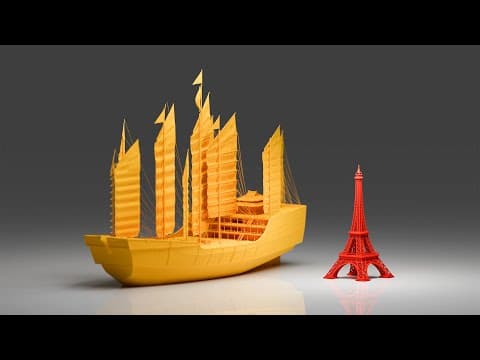
This blog post explores the fascinating history of the Ming treasure ships, their construction, the empire's ambitions, and the eventual decline of this maritime power, revealing how myth and reality intertwine in the legacy of these colossal vessels.
In the late 1300s, a Portuguese ship sailed the seas, but it was the Ming treasure ships that truly captured the imagination of the world. These vessels, with decks the size of villages and towering masts, were part of a fleet built by the Ming dynasty to assert dominance over its neighbors and crush its enemies. This blog post delves into the story of these colossal ships, the man behind their creation, and how their legacy faded into myth.
The tale begins with a 10-year-old boy living in Yunan Province, under Mongol control. His father, a minor official, is killed, and the boy finds himself in the hands of a Ming general. In a moment of quick thinking, he lies about the whereabouts of the Mongol emperor, which leads to his capture and eventual transformation. This boy, later known as Zheng He, would rise to become one of the most legendary figures in maritime history.
Zheng He was taken to the Ming court, where he underwent a drastic transformation. The Ming dynasty, unlike previous Chinese empires, elevated eunuchs to positions of power. These castrated men were seen as trustworthy, as they could not produce heirs and thus had no competing bloodlines. Zheng He, despite his physical limitations due to his condition, grew to be nearly 7 feet tall, making him an imposing figure in the court.
As the Ming dynasty faced instability and threats from the Mongols, Zheng He proved his worth as a military commander. His close relationship with the emperor, Yongle, allowed him to rise through the ranks. Unlike his father, who kept eunuchs at bay, Yongle relied on Zheng He and other eunuchs to solidify his power.
To legitimize his rule and expand Ming influence, Yongle ordered the construction of the largest fleet the world had ever seen. This fleet was not just for trade; it was a show of power. The ships were designed to carry soldiers and cavalry, intimidating neighboring states into submission. The centerpiece of this fleet was the treasure ships, massive vessels measuring 56 meters wide and 136 meters long, equipped with advanced technology for their time.
Zheng He commanded a fleet of 27,000 men, including military officers, sailors, and clerks. His expeditions took him beyond India, reaching as far as the eastern coast of Africa. He established military bases and demonstrated the might of the Ming dynasty, leading to a period known as Pax Ming, where China came closest to becoming a colonial power.
However, the reliance on eunuchs created resentment among the Confucian civil service. After a series of natural disasters, including a lightning strike that destroyed part of the Forbidden City, the bureaucrats criticized Yongle's spending on the voyages. Although he initially halted shipbuilding, he later reinstated Zheng He’s expeditions. After Yongle's death, his successor, Hongxi, dismantled the fleet, deeming the voyages a waste of resources.
As time passed, the grandeur of the treasure ships became the stuff of legend. Historical records, including a novel by Lu Maong, exaggerated their size and numbers, leading to myths that overshadowed the truth. While the Ming dynasty kept meticulous records, discrepancies arose regarding the actual size and number of ships in the fleet.
Modern scholars debate the actual dimensions of the treasure ships, with some suggesting they were likely half the size of the legends. Excavations near Nanjing revealed giant timbers that could have supported massive vessels, hinting at the reality behind the myths. However, no evidence supports the construction of ships of such size in ancient China, leading to ongoing discussions about their true capabilities.
The story of the Ming treasure ships is a captivating blend of history and myth. Zheng He’s voyages symbolize the ambition of the Ming dynasty and its attempts to assert dominance on the global stage. While the treasure ships may have faded into legend, their impact on maritime history and the legacy of Zheng He continue to inspire awe and curiosity today.



















