
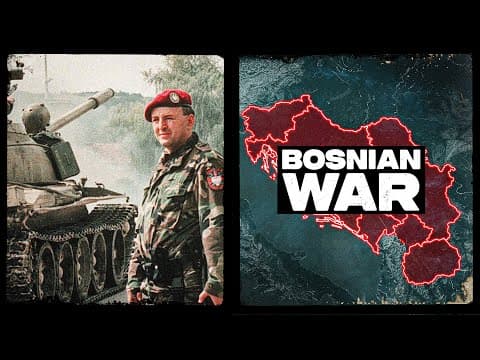
The Bosnian War (1992-1995) was a brutal conflict following Yugoslavia's breakup, involving ethnic tensions among Bosniaks, Serbs, and Croats. Fueled by nationalism and led by Slobodan Milosevic, it featured sieges, ethnic cleansing, and genocide, culminating in the Dayton Accords. The war caused around 100,000 deaths and reshaped Bosnia's political landscape, leaving lasting scars and ongoing challenges.
In the early 1990s, as the Soviet Union was fracturing, Yugoslavia, a federation of six republics, was also unraveling. The collapse of communism gave way to rising nationalism, which exploited ethnic and religious differences. This shift led to a series of conflicts, most notably the Bosnian War, a devastating conflict that reshaped the Balkans and left deep scars on its people.
By the end of 1991, Croatia, Slovenia, and Macedonia declared independence from Yugoslavia. Macedonia's departure was peaceful, but Slovenia and Croatia fought wars to secure their independence. Serbia, predominantly populated by Christian Serbs, opposed the breakup and, together with Montenegro, sought to become the successor state to Yugoslavia. They held the majority of power and the Yugoslav army, aiming to maintain control rather than allow independent states to form.
Bosnia and Herzegovina was a diverse republic within Yugoslavia, with roughly half its population being Bosnian Muslims (Bosniaks), about a third Christian Serbs, and 17% Croats. These groups had coexisted relatively peacefully under communism, united by the Yugoslav ideology. However, as new countries emerged, ethnic tensions intensified, with groups fearing domination by others.
In late 1991, a largely Croat region in Bosnia declared itself an independent state, though it was not internationally recognized. Some Croat leaders sought full secession, but initially cooperated with the Bosnian government as a state within a state.
In 1992, Bosnia held an independence referendum, with 99% voting for independence from Yugoslavia. The turnout was 63%, mostly Bosniaks, as Bosnian Serbs boycotted the vote. In response, Bosnian Serbs declared their own state within Bosnia, called Republika Srpska, recognized only by Serbia and Montenegro.
Slobodan Milosevic, the Serbian leader, was a hyper-nationalist who sought to create a "greater Serbian" nation. He directed the Yugoslav army, dominated by Serbs, to support Bosnian Serbs in securing territory, marking the start of the Bosnian War.
The Yugoslav army quickly surrounded Sarajevo, the Bosnian capital, positioning tanks, artillery, and snipers on surrounding hills. Their goal was to capture the city swiftly. The siege involved indiscriminate attacks on civilians, killing thousands over years.
Bosniaks and Croats formed an alliance to defend their independence, but the Serbs had the advantage of a large, professional army. Despite a UN-negotiated agreement for Yugoslav army withdrawal, many Serb troops continued fighting under Bosnian Serb command.
Serb forces engaged in systematic ethnic cleansing, targeting Bosniak homes, burning villages, and separating men from women. Men were sent to concentration camps or executed, while women suffered severe abuses in prisons. The international community was hesitant to intervene militarily, imposing sanctions and sending peacekeepers who largely maintained neutrality.
The alliance between Bosniaks and Croats deteriorated, leading to conflict between them. Croat forces attacked Bosniak areas, including the city of Mostar, destroying mosques and killing civilians. This internal conflict complicated the war further.
NATO enforced a no-fly zone over Bosnia, but this did little to stop ground violence. The UN established safe zones to protect civilians, especially Bosniaks fleeing ethnic cleansing. However, these zones were poorly defended due to insufficient troop commitments, and Serb forces frequently attacked them.
In 1994, the US helped broker peace between Bosniaks and Croats, renewing their alliance against Serbs. Milosevic, feeling economic pressure from sanctions, cut ties with Bosnian Serbs to regain Western favor, but Bosnian Serbs continued their brutal campaign.
All sides committed human rights abuses, but Serb forces held about 70% of Bosnia's territory and pushed back UN peacekeepers. NATO increased airstrikes, but Serbs responded by taking peacekeepers hostage and shooting down a US F-16.
In July 1995, Serb forces attacked Srebrenica, a UN-declared safe zone with nearly 10,000 Bosniak refugees. The lightly armed Dutch UN peacekeepers were overwhelmed and unable to defend the civilians. Serb soldiers systematically executed approximately 8,000 Bosniak men and boys, marking the deadliest genocide in Europe since World War II.
The Srebrenica massacre galvanized international action. The US and NATO took a more active role, planning for UN withdrawal and arming the Bosnian government. A peace plan divided Bosnia into two entities: the Federation of Bosnia and Herzegovina (mostly Bosniaks and Croats) and Republika Srpska (mostly Serbs), each with some autonomy.
With shifting military momentum favoring Bosniaks and Croats, Serbs returned to negotiations. The Dayton Accords were signed in December 1995 by the presidents of Croatia, Bosnia, and Serbia, officially ending the war.
The war resulted in approximately 100,000 deaths and displaced millions, predominantly Bosniak Muslims. The UN tribunal tried 161 individuals for war crimes. Slobodan Milosevic was imprisoned for crimes against humanity but died before his trial concluded.
Today, Bosnia remains divided along ethnic lines, with ongoing political tensions fueled by nationalism and differing views on the war's legacy. The physical and psychological scars of the conflict endure, reminding the world of the devastating consequences of ethnic hatred and war.
The Bosnian War was a complex and tragic conflict born from the collapse of Yugoslavia and the rise of ethnic nationalism. It involved sieges, ethnic cleansing, genocide, and international intervention. Understanding this war is crucial to grasping the challenges of post-Cold War Europe and the importance of international efforts to prevent such atrocities in the future.
This overview aims to provide a factual and comprehensive understanding of the Bosnian War, acknowledging the complexity and sensitivities surrounding the topic. The conflict's history continues to influence the region and serves as a somber lesson on the dangers of nationalism and ethnic division.



















