
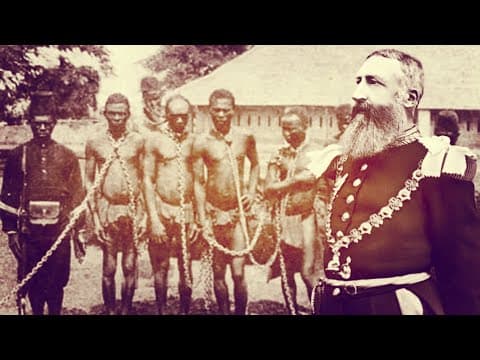
King Leopold II of Belgium exploited the Congo for rubber, leading to widespread atrocities and the deaths of millions. His reign, marked by violence and forced labor, remains a dark chapter in colonial history, with lasting impacts on the region.
Long after European powers agreed to abolish slavery, one nation, led by one man, continued to exploit and oppress. King Leopold II of Belgium, driven by the lure of wealth, presided over a regime of unimaginable cruelty in the Congo, a legacy that still resonates in Africa today.
In 1884-1885, the Congress of Berlin, organized by German Chancellor Otto von Bismarck at the request of King Leopold II, saw representatives from major European powers gather to carve up Africa. This meeting, known as the Scramble for Africa, resulted in the establishment of borders and colonies, with Belgium controversially claiming the Congo as a personal possession of Leopold rather than a colony.
From 1885 to 1908, the Congo Free State, now the Democratic Republic of the Congo, was effectively the private property of King Leopold. He sought to monopolize the lucrative rubber trade, transforming the region from a seemingly worthless jungle into one of the richest locations on Earth due to the rising demand for rubber products spurred by the Second Industrial Revolution.
The rubber boom led to the nationalization of land, with vast territories allocated to private companies for rubber harvesting. Leopold retained over 97,000 square miles for himself, becoming one of the world's wealthiest individuals. American companies, including those owned by Harvey Samuel Firestone Sr., sought rubber for tire production, leading to a drastic increase in rubber quotas imposed on local workers.
Between 1891 and 1906, these companies operated without legal or humane oversight, exploiting both the rubber trees and the local population through forced labor and violence. The Congolese were coerced into labor under threats of death, with entire villages destroyed for non-compliance.
The Force Publique, established in 1885, enforced Leopold's brutal labor policies. Composed of white officers and black soldiers, the Force Publique numbered 19,000 by 1900. Many soldiers were recruited from distant regions to ensure they had no sympathy for the Congolese people. They were often tasked with enforcing the rubber quotas through extreme violence, including killings and mutilations.
The atrocities committed were horrific. Those who resisted were often killed, and the collection of severed hands became a gruesome symbol of the regime's brutality. Soldiers were required to provide proof of their killings, leading to a culture of terror where hands were collected as a form of currency to meet rubber quotas.
Witnesses, including missionaries and historians, documented the horrors of Leopold's regime. Accounts describe soldiers committing unspeakable acts, including forcing young men to kill their own family members. The collection of severed hands was not only a punishment but also a means to incentivize soldiers, who were poorly paid and allowed to pillage as compensation.
Historian Adam Hochschild, in his book "King Leopold's Ghost: A Story of Greed, Terror, and Heroism in Colonial Africa," highlights the chilling reality of life under Leopold's rule. The atrocities were so severe that many historians classify the events as a form of genocide, although Leopold's greed rather than a systematic intent to exterminate defined his actions.
The legacy of King Leopold II's reign in the Congo is one of profound suffering and exploitation. By 1901, it was estimated that over 500,000 Congolese had died due to disease, famine, and violence. The lack of food and healthcare for workers contrasted sharply with the lavish lifestyles of European overseers.
In June 2020, King Philippe of Belgium expressed regret for the violence and cruelty committed during the colonial period, yet he failed to mention Leopold as the primary responsible party, and no reparations were offered.
The Congo under King Leopold II serves as a stark reminder of the depths of human greed and cruelty. While the world moved towards abolishing slavery, Belgium's king and his accomplices engaged in a brutal exploitation that resulted in the deaths of millions. The Congo's tragic history continues to impact its people and serves as a cautionary tale about the consequences of unchecked power and greed.



















