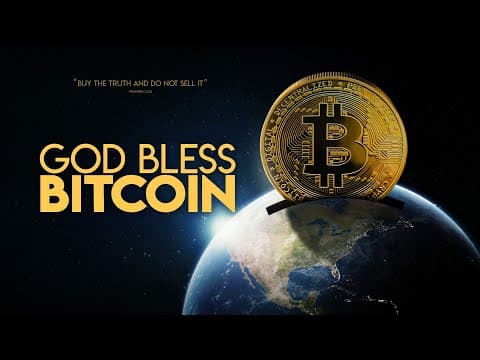
This blog post explores the historical context of money, the impact of inflation, and how Bitcoin offers a solution to economic inequality and government control. It discusses the moral implications of fiat currency, the advantages of Bitcoin as a decentralized currency, and its potential to empower individuals and communities globally.
In a world where economic systems seem increasingly rigged against the average person, the documentary "God Bless Bitcoin" presents a compelling argument for the adoption of Bitcoin as a solution to the problems created by traditional fiat currencies. This post delves into the historical context of money, the impact of inflation, and how Bitcoin offers a way forward for individuals and communities alike.
The narrative begins with a reflection on the past, recalling a time when a single income could support a family. This changed dramatically after President Nixon decoupled the dollar from gold in 1971, allowing for unchecked money printing. This decision was primarily made to finance the Vietnam War, leading to a gradual erosion of the dollar's purchasing power.
The documentary highlights the detrimental effects of fiat currency, particularly inflation, which disproportionately affects the working class. Inflation is often misunderstood; it can arise from natural disasters (physical inflation) or from the government increasing the money supply (monetary inflation). The latter is the more common form and is responsible for the majority of inflationary pressures in the economy.
As the government prints more money, the value of existing currency diminishes, leading to a situation where the average American struggles to meet basic needs. The average income now falls short of the cost of living, forcing many to work multiple jobs just to make ends meet.
The documentary argues that inflation is a form of theft, as it erodes the purchasing power of hard-earned money. The current financial system is designed to benefit the elite, creating a cycle of wealth concentration that leaves the working class behind. This system fosters a sense of economic slavery, where individuals are trapped in jobs that do not allow for creativity or innovation.
Governments create money through digital printing and credit systems, which often leads to irresponsible financial decisions that burden citizens. The documentary posits that this system is immoral, as it perpetuates inequality and economic distress.
Bitcoin emerges as a potential solution to the problems posed by fiat currency. It is a decentralized digital currency that cannot be manipulated by governments or central banks. With a capped supply of 21 million coins, Bitcoin offers a stable store of value that contrasts sharply with the inflationary nature of fiat currencies.
Bitcoin's blockchain technology allows for peer-to-peer transactions without the need for intermediaries, reducing transaction costs and increasing efficiency. This system empowers individuals by giving them control over their own money, free from government interference.
The documentary emphasizes that Bitcoin can restore economic freedom to individuals, allowing them to store and transfer value without the risk of government seizure. This is particularly relevant in countries with oppressive regimes, where citizens often face restrictions on their financial activities.
Bitcoin's ability to facilitate transactions across borders without the need for traditional banking systems makes it a powerful tool for financial inclusion. It provides a means for individuals in developing countries to participate in the global economy, bypassing corrupt local currencies.
The documentary also explores the ethical implications of Bitcoin. It argues that Bitcoin embodies principles of fairness and equality, as it is accessible to anyone with an internet connection. Unlike fiat currencies, which can be manipulated for political gain, Bitcoin operates on a transparent and immutable ledger.
Bitcoin's potential to empower marginalized communities is highlighted throughout the documentary. It can provide financial agency to individuals who have been historically excluded from the financial system, such as women in conservative societies who may not have access to bank accounts.
The documentary concludes with a hopeful vision for the future, where Bitcoin could replace fiat currencies as the global standard. This shift could lead to a more equitable economic system, reducing the power of governments to manipulate money supply and, consequently, the economy.
As the world grapples with economic inequality and the consequences of broken money, the case for Bitcoin becomes increasingly compelling. It offers a path toward financial freedom, empowerment, and a more just society. The documentary encourages viewers to consider the implications of their financial choices and the potential of Bitcoin to reshape the future of money.
In summary, "God Bless Bitcoin" presents a thorough examination of the failures of the current financial system and the promise of Bitcoin as a transformative force. By understanding the historical context of money, the impact of inflation, and the ethical implications of currency, individuals can make informed decisions about their financial futures. Bitcoin represents not just a new form of money, but a movement toward economic justice and empowerment for all.