Las Vegas lacks direct public transit from its airport to the Strip, despite millions of tourists arriving monthly. Current options involve multiple transfers or costly rideshares, with past proposals for better transit often failing due to various obstacles. The future of transit may hinge on private ventures like Elon Musk's Boring Company, but significant improvements remain uncertain.
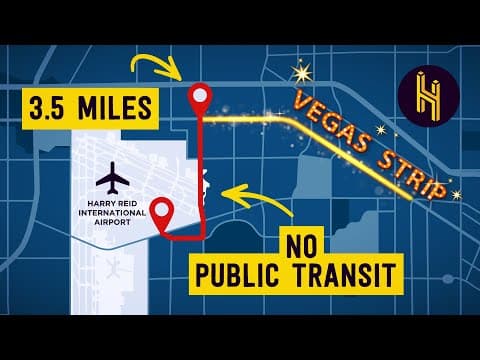
Picture this: you land in Las Vegas, greeted by the bright lights and sounds of slot machines. After a few rounds of play, you realize you need to budget for transit from the airport to your hotel on the Strip. However, when you check Google Maps, you find there’s no direct public transit option available. The only ways to get from Harry Reid International Airport to the Strip, a mere 3.5 miles away, involve multiple bus transfers or an expensive rideshare that you can’t afford after your gambling losses. This raises the question: why is there no straightforward public transit connecting the airport to the Strip?
In early 2025, Las Vegas was welcoming approximately 3.3 million tourists each month. Most of the attractions, including casinos, magic shows, and fountains, are concentrated along Las Vegas Boulevard, commonly known as the Strip. With hotel room occupancy rates hovering in the mid-80s, a significant portion of these visitors arrive by air. According to the LA Times, in 2019, 58% of arriving passengers opted for rideshares like Uber or Lyft, with 85% of those rides directed to hotels on the Strip. Given this heavy flow of visitors, the need for efficient transit from the airport to the Strip is evident.
While it’s not entirely accurate to say there’s no public transport connecting the airport to the Strip, the existing options are limited and inconvenient. Two bus routes, the 108 and 109, provide service from the airport to the South Strip Transit Terminal (SST) in about 10 to 15 minutes. From there, passengers can transfer to the Deuce, a double-decker bus that runs 24/7 along the Strip. However, the Deuce does not stop at the airport, requiring travelers to lug their suitcases through multiple transfers.
Another option is the Centennial Express, which picks up passengers at the airport but does not travel directly up the Strip. Instead, it crosses the Strip before heading downtown. For those staying near the intersection of the Centennial Express route, this bus can be a viable option, but it still requires additional transfers to reach the Strip.
Las Vegas does have a monorail system, which was initially planned to run up the Strip but was rerouted due to concerns from casino owners about aesthetics and potential competition. The monorail connects the Horseshoe Casino to the MGM Grand and has been operational since 1995, with expansions completed in 2002. Despite its popularity, with nearly 5 million riders annually, the monorail faces challenges, including difficulties in obtaining replacement parts. The Las Vegas Convention and Visitors Authority (LVCVA) has indicated that the monorail may need to be decommissioned between 2032 and 2034.
Attempts to extend the monorail to the airport have been made in the past, including a feasibility study approved in 2005. However, federal grants fell through, and the company that owned the monorail went bankrupt during the Great Recession. Various proposals for extensions to serve the Strip's west side, downtown, and Allegiant Stadium have also failed, often attributed to lobbying from taxi and limousine services, high costs, and a lack of political will.
As the monorail faces an uncertain future, the prospects for public transit connecting the airport to the Strip appear bleak. Recent investments in bus rapid transit during the Biden administration focused more on local residents than on tourist hotspots, and there are currently no expansion plans in sight.
In a surprising turn, Elon Musk's Boring Company has entered the scene. In 2021, the Las Vegas Convention Center contracted Musk's company to build a people mover system. The result was a 0.8-mile tunnel system designed to transport people between exhibit halls. However, this system has been criticized for not living up to the futuristic vision initially presented, as it primarily consists of Tesla cars driven by humans at relatively low speeds.
Plans for expansion of this tunnel system include a route to the airport, but the logistics of tunneling under the airport present challenges due to federal oversight requirements. Instead, the current plan involves bringing the tunnels to the surface near the airport, where Teslas would navigate surface roads for the final mile. This approach does little to alleviate congestion and does not significantly resemble traditional public transit.
The future of public transit from the airport to the Strip in Las Vegas remains uncertain. While private ventures like Musk's Boring Company may offer some solutions, they do not address the fundamental need for efficient and accessible public transit options for the millions of tourists visiting the city each month. As Las Vegas continues to grow as a tourist destination, the hope for a more integrated and user-friendly transit system remains a gamble in itself, one that many travelers are eager to see pay off.