
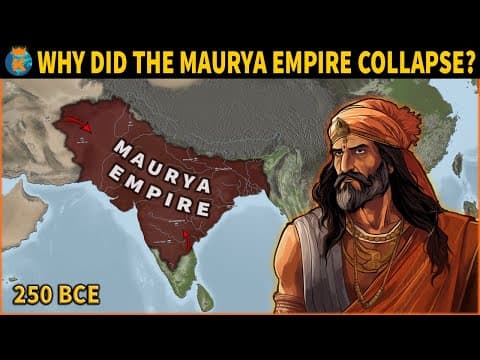
The Maurya Empire, once the largest empire in ancient India, collapsed due to a combination of weak leadership after Ashoka, internal strife, and external pressures from foreign invaders. This blog post explores the rise and fall of the empire, highlighting key figures and events that shaped its history.
The Indian subcontinent in the early centuries BC was a land of empires, with the Nanda Empire dominating the northern regions. This period was marked by significant events, including the encounters with Alexander the Great. However, the rise of the Maurya Empire, founded by Chandragupta Maurya, would soon overshadow the Nanda Empire.
The story of the Maurya Empire begins with Chanakya, a teacher and philosopher who had a falling out with Emperor Dhana Nanda of the Nanda Empire. Driven by a desire for revenge, Chanakya vowed to bring about the collapse of the Nanda Empire. After fleeing to Taxila, he encountered a young man named Chandragupta Maurya, who impressed him with his strategic thinking during a role-playing game.
With Chanakya's guidance, Chandragupta began to seize the territories left vulnerable after Alexander the Great's death in 323 BC. By 321 BC, Chandragupta had successfully overthrown the Nanda Empire and established the Maurya Empire. His reign was characterized by military conquests and diplomatic relations, particularly with the remnants of Alexander's empire. By 303 BC, he had forced Seleucus I Nicator, one of Alexander's generals, to sign a peace treaty, further solidifying his power.
Chandragupta's son, Bindusara, succeeded him and expanded the empire southward to modern-day Karnataka. Bindusara's reign was relatively stable, with few challenges, and he ruled until the 270s BC. Following his death, a power struggle ensued among his sons, ultimately leading to the ascension of Ashoka.
Ashoka's reign marked a significant turning point in Maurya history. Initially viewed with skepticism due to his ruthless tactics in the war against his brothers, Ashoka's character transformed after the brutal conquest of Kalinga in the 260s BC. The war resulted in massive casualties and suffering, leading Ashoka to embrace Buddhism and promote non-violence.
Ashoka's conversion to Buddhism influenced his policies, leading to a period of peace and no further territorial expansion. His edicts, which spread his new philosophy, became a hallmark of his reign. However, after Ashoka's death in 232 BC, the empire faced a leadership crisis, as none of his sons were capable of taking the throne.
Ashoka's grandson, Dasharata, succeeded him but lacked the strength to maintain the empire's vast territories. Although Dasharata's cousin, Samprati, managed to regain some lost lands, the empire continued to weaken under subsequent rulers. The last emperor, Brihadrata, faced challenges from within and outside the empire.
In the 180s BC, during a military parade, Brihadrata was assassinated by his general, Pushyamitra Shunga, marking the end of the Maurya Empire and the rise of the Shunga Empire. The reasons for the Maurya Empire's collapse are complex and multifaceted.
The collapse of the Maurya Empire cannot be attributed to a single cause but rather a combination of weak leadership, internal conflicts, and external threats. After Ashoka's reign, the empire struggled to maintain its former glory, ultimately leading to its downfall. The Maurya Empire's history serves as a reminder of the complexities of governance and the delicate balance required to maintain a vast empire.



















