
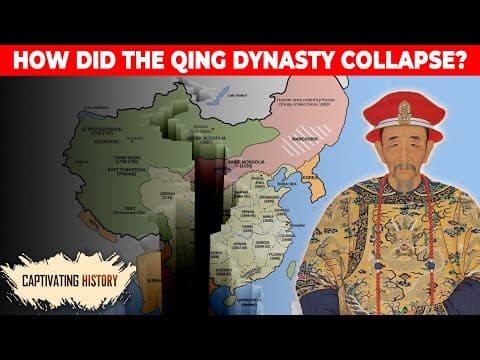
The Qing Dynasty, which ruled China for over 250 years, faced a gradual decline due to internal strife, external pressures, and a series of rebellions and wars, culminating in its collapse in 1912. Key factors included economic crises, corruption, the Opium Wars, and significant uprisings like the Taiping Rebellion and the Boxer Uprising.
The Qing Dynasty ruled a vast empire for over 250 years until internal strife, external factors, and a succession of wars and rebellions led to its downfall. This article explores the key events and circumstances that contributed to the collapse of one of the largest empires in history.
Succeeding the Ming dynasty in 1644, the Qing emperors established the fourth-largest empire in history. The Qing dynasty not only doubled the size of the Ming territory but also tripled its population, integrating various ethnic groups, including Tibetans, Mongols, Burmese, Tai peoples, and the indigenous people of Taiwan. The Manchu-centered Qing dynasty was distinct from previous imperial dynasties, viewing China as part of a larger, multinational political entity.
The founders of the Qing dynasty were from the Manchu Aisin Gioro clan based in Manchuria, a region shared by China and Russia today. Early rulers maintained their Manchu customs, prayed to Buddha, and referred to themselves as "Bogd Khan" in dealings with the Mongols, while also ruling in the Chinese Confucian tradition as the "Sons of Heaven" with the "Mandate of Heaven."
The Qing Empire began its steady decline in the late 18th and early 19th centuries. The empire was plagued by poverty and constant rebellions, while also facing foreign aggression from Western powers seeking to colonize China economically and territorially. Despite a population exceeding 400 million, a low tax rate led to a fiscal crisis, corruption among officials, and a failure of the ruling elite to maintain peace. This environment fostered widespread questioning of the Qing dynasty's legitimacy, leading to organized uprisings.
In 1781, tensions escalated between two branches of Islamic mystics, the Jahriyya Sufis and the Khafiyya Sufis, in the Qinghai and Gansu provinces. The Qing Dynasty suppressed these rebellions, displacing the Jahriyya community to prevent further revolts. The White Lotus movement, a secret religious organization, initiated another rebellion from 1796 to 1804, symbolizing national and religious resistance against the Qing. The impoverished population joined the White Lotus in their uprising against high taxes, leading to a significant threat to the Qing government.
The Qing forces responded with brutality, ultimately quelling the rebellion in 1804. However, the unrest continued, with Li Wenchang, a leader of the White Lotus, declaring 1813 as the year of rebellion. Despite initial successes, the Qing forces crushed this uprising in 1814, leading to further instability.
By 1820, China had the largest economy in the world, but the situation deteriorated drastically following the Opium Wars in the mid-19th century. The British Empire imposed opium trade on China, weakening its sovereignty. The Qing officials, plagued by corruption, struggled to combat the opium trade effectively. In 1839, the Daoguang Emperor tasked scholar Lin Zexu with eradicating the opium trade, leading to the First Opium War, which ended in 1842 with the Treaty of Nanking. This treaty forced China to open its ports to foreign trade and ceded Hong Kong to Britain.
The Second Opium War began in 1856, resulting in further humiliation for the Qing Dynasty. During this period, the Taiping Rebellion erupted, led by Hong Xiuquan, who claimed to be the "Heavenly King" and sought to overthrow the Qing dynasty. This civil war, which lasted over a decade, was the most violent conflict of the 19th century and significantly weakened the Qing's political and economic structure.
In response to these challenges, the Self-Strengthening Movement emerged, aiming to adopt Western technology while preserving Confucian values. This movement, which lasted from 1861 to 1895, saw attempts at military and institutional reforms. However, widespread corruption hindered its effectiveness.
The Qing dynasty faced further humiliation in the First Sino-Japanese War, losing Taiwan and the Kingdom of Joseon (modern-day Korea) to Japan. In 1898, the Guangxu Emperor initiated the Hundred Days' Reform to modernize the government and society, but conservative opposition led to its failure after just 103 days.
Between 1899 and 1901, the Boxer Uprising occurred, fueled by anti-imperial sentiment and a desire to expel foreign influence. The Qing Empress, Dowager Cixi, supported the Boxers, leading to conflict with the Eight-Nation Alliance. Although the Boxers initially forced the alliance to retreat, they were ultimately defeated, and Peking was captured in 1900.
In 1911, the Xinhai Revolution, or Chinese Revolution, began, led by the underground resistance movement Tongmenghui. This movement gained widespread support and successfully overthrew the Qing dynasty, leading to the abdication of the six-year-old Emperor Puyi. The establishment of the Republic of China in 1912 marked the end of the Qing Dynasty.
The collapse of the Qing Dynasty was the result of a complex interplay of internal strife, economic challenges, and external pressures. The legacy of this once-mighty empire continues to shape China's history and identity today. Understanding the factors that led to its downfall provides valuable insights into the dynamics of power, governance, and societal change.



















