
This blog post explores the role of Robert Lohmeyer, a pioneering photochemist, in creating the first color photographs of Africa, particularly in Namibia, and how these images served as propaganda for German colonialism, reflecting the racial hierarchies and ideologies of the time.
The Atlantic Ocean meets the western coastline of Namibia, a country that was once one of four German colonies in Africa. At the beginning of the 20th century, Namibia became the stage for a revolutionary development in visual documentation: the first color photographs of Africa and its people. This blog post delves into the life and work of Robert Lohmeyer, a pioneering photochemist whose images played a significant role in promoting German colonialism.
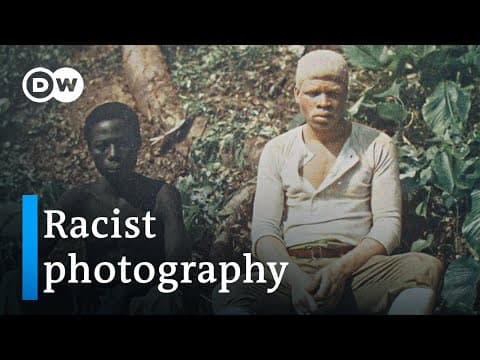
Robert Lohmeyer was tasked with creating color portraits in Africa, a new and sensational technique at the time. In his diary, he reflected on the challenges of taking "type images"—racialized photos intended to showcase African people to a German audience. This marked the beginning of using three-color photography as a tool for generating popular support for Germany's colonial ventures.
In March 1909, Lohmeyer set sail for German South West Africa, now Namibia. He compiled a private photo album documenting his travels, featuring black and white images of his arrival in Swakopmund, the main port of the colony. However, his initial impressions were disappointing, describing the landscape as an endless sandy desert devoid of life.
Lohmeyer effectively served as the "PR director" for Germany's colonies, producing color photographs that depicted the beauty of these distant lands. His primary focus was on human subjects, categorized by European anthropologists, which allowed Germans to see color images of African people for the first time. These photographs were not merely artistic; they were tools of colonial propaganda, reinforcing the notion of racial hierarchies.
The imagery produced by Lohmeyer reflected the pervasive belief in the superiority of the European race. His photographs depicted indigenous populations as belonging to various tribes and ethnic groups, each portrayed with differing degrees of civilization. This visual narrative supported the idea of a racial hierarchy, with white Europeans at the top and black Africans at the bottom.
Lohmeyer was born in Leipzig in 1879 and later studied at the Royal Technical College in Berlin, where he learned from renowned photochemist Adolf Miethe. Miethe's invention of the three-color camera allowed for the capture of vibrant images, which were crucial for disseminating the colonial concept. Lohmeyer's work was seen as patriotic, and he was welcomed into the circles of colonial high society.
Lohmeyer's photographs presented an idyllic view of the colonies, showcasing landscapes, architecture, and the supposed prosperity of German rule. However, this portrayal was misleading, as large areas of the colonies were barren wilderness, and the reality of colonial exploitation was often omitted from his work.
The photographs taken by Lohmeyer also depicted the exploitation of indigenous populations. In Togo, for example, the native population was relegated to the outskirts of colonial cities, receiving inferior medical treatment and living conditions. Lohmeyer's images contributed to a narrative that justified the colonial presence as a civilizing mission, while in reality, it often resulted in severe hardship for the local people.
Lohmeyer's work conveniently ignored the brutal realities of colonial rule, including the Herero and Nama genocide that began in 1904. His photographs presented a sanitized version of colonial life, devoid of the violence and oppression faced by the indigenous populations. This selective representation served to reinforce the colonial narrative back in Germany.
Despite the atrocities associated with German colonialism, Lohmeyer's photographs enjoyed a revival in the years following World War I. They were repurposed by the Nazi regime, which sought to rekindle colonial nostalgia and promote its own racist ideologies. The images were used to appeal to a longing for the old colonies, further entrenching the racial stereotypes they originally propagated.
Today, Lohmeyer's photographs are still prevalent in various forms of media, often stripped of their historical context. Current discussions around racism and cultural appropriation provide an opportunity to reassess these images critically. It is essential to contextualize and comment on the circumstances of their creation and use, recognizing their role as witnesses to German colonial history and the legacy of racist ideology.
Robert Lohmeyer's pioneering color photographs represent a significant milestone in the history of photography. However, they also embody the complex and troubling legacy of colonialism. As we engage with these images today, it is crucial to approach them with a critical eye, acknowledging the power dynamics and ideologies they represent. By doing so, we can better understand the historical context of colonialism and its lasting impact on contemporary society.



















