
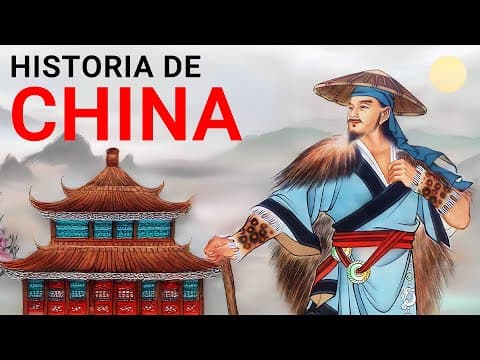
This comprehensive overview of China's history explores its evolution from ancient civilization along the Yellow River to its current status as a global superpower, detailing key dynasties, cultural developments, and significant events that shaped the nation.
China, a land steeped in mystery for the ancient world, has a rich history that spans over 5,000 years. The Silk Road connected distant kingdoms, suggesting that China possessed immense wealth and power. While other civilizations fell dramatically, China continued to rise through countless dynasties and emperors, forming the global superpower we know today. From constructing the longest structures in the world to hosting the deadliest wars in human history, China is the oldest continuous civilization on Earth. To understand this fascinating land, we must start from the beginning.
Most of China's early settlements emerged along the Yellow River in the north and the Yangtze River in the south. The people lived in alluvial plains and led agricultural lifestyles, cultivating millet and rice abundantly. However, a significant problem plagued these growing communities: the floods of the Yellow River displaced or killed inhabitants, destroying their crops and homes.
The legendary Yu the Great, possibly a mythological figure, was tasked with controlling the river's flow. Yu understood that the waters were not the greatest enemy of the settlers; rather, it was the lack of effective management. His father, Gun, had previously attempted to control the rivers for a decade, building dikes and dams that ultimately failed. Determined to succeed where his father had not, Yu recruited the help of Ho, another agricultural genius credited with introducing millet to humanity. Together, they designed an irrigation system based on canals that diverted excess water to the sea while conserving some for crop irrigation. With this, the era of floods came to an end, and Yu was named the ruler of China, marking the beginning of the Xia Dynasty.
The Xia Dynasty prospered under Yu, remaining an agricultural society credited with creating significant Chinese inventions such as stone tools for agriculture and the lunar calendar. Eventually, Yu divided the territory into nine provinces, each governed by its own lord, all owing allegiance to him. As Yu aged, the question of succession arose. He chose not to pass leadership to his son, Chi, but rather to his Minister of Justice, Gao Yao. Unfortunately, Gao Yao died shortly after, leading to the selection of a tribal leader named Yi. The provincial followers, having admired Yu for 45 years, insisted that Chi be his successor, establishing a hereditary system that would last for millennia.
By the 10th century BCE, the Xia Dynasty met its fate. The last ruler, Ye, was cruel and sadistic, waging wars for personal vengeance and indulging in violence. The concept of the Mandate of Heaven existed in ancient China, which stated that heaven granted power to noble men, but any evil leader would be overthrown. Ye's tyranny led to the rise of a new rebel power, the Shang Dynasty, which quickly overthrew the Xia. Unlike the Xia, the Shang had a written history, with oracle bone inscriptions providing insights into their daily lives and traditions.
The Shang Dynasty, which ruled around 3,600 years ago, was highly mobile, frequently traveling to islands and coasts during conquests. They employed a feudal system that enriched the nobility while subjecting peasants to difficult lives. The Shang were deeply religious, with high priests wielding significant influence over the land, often performing human sacrifices for favorable weather and fortune. The Shang Dynasty lasted for about 600 years, marked by constant struggles with tribes and internal conflicts.
The Zhou Dynasty, which followed the Shang, lasted from 1046 BCE to 256 BCE and is known for significant philosophical developments. This period saw the emergence of Confucianism, Legalism, and Taoism. Confucius, born in the state of Lu, sought to restore moral order in a decaying society through social relationships and respect for elders. Legalism, on the other hand, posited that humans are inherently bad and require strict laws and punishments to maintain order. Taoism emphasized harmony with the universe and the acceptance of natural balance.
During the Eastern Zhou period, known as the Warring States period, seven states vied for dominance, leading to the rise of the Qin state under Qin Shi Huang, who would become the first emperor of a unified China.
The Qin Dynasty, though short-lived from 221 BCE to 206 BCE, was pivotal in establishing a centralized government. Qin Shi Huang implemented significant reforms, including standardizing currency, weights, and measures, and initiating the construction of the Great Wall to protect against northern nomadic tribes. The harsh legalist policies of the Qin led to widespread resentment among the populace.
Following the fall of the Qin, the Han Dynasty (206 BCE - 220 CE) marked a golden age in Chinese history. The Han expanded China's territory and established the Silk Road, facilitating trade and cultural exchange. Confucianism became the state philosophy, emphasizing family loyalty and virtue. The Han era saw advancements in technology, agriculture, and the arts, solidifying China's cultural identity.
After the Han, China entered a period of fragmentation known as the Three Kingdoms (220-280 CE), followed by the Jin and the Southern and Northern Dynasties. This era was characterized by constant warfare and shifting power dynamics. The Sui Dynasty (581-618 CE) briefly unified China before giving way to the Tang Dynasty (618-907 CE), which is often regarded as another high point in Chinese civilization, marked by cultural and economic prosperity.
The Song Dynasty (960-1279 CE) is noted for its advancements in technology, including the invention of gunpowder, the compass, and printing. Despite military weaknesses, the Song fostered a vibrant economy and cultural life, leading to a flourishing of arts and literature.
The Mongol Empire, under Genghis Khan and later Kublai Khan, established the Yuan Dynasty (1271-1368 CE). This period saw significant cultural exchange and the introduction of foreign influences into China. However, the Mongol rule was marked by heavy taxation and social unrest, leading to the rise of the Ming Dynasty.
The Ming Dynasty (1368-1644 CE) is known for its efforts to restore Han Chinese rule and culture. The Great Wall was rebuilt, and maritime exploration was initially encouraged before a shift towards isolationism. The Ming faced internal strife and external threats, culminating in their downfall due to the Manchu invasion.
The Qing Dynasty (1644-1912 CE) was the last imperial dynasty of China. It faced numerous challenges, including the Opium Wars, which resulted in significant territorial losses and the imposition of unequal treaties. The Taiping Rebellion and Boxer Rebellion further weakened the Qing, leading to widespread discontent.
In 1911, the Qing Dynasty was overthrown, leading to the establishment of the Republic of China. However, political instability and warlordism plagued the nation. The Chinese Civil War erupted between the Nationalists (KMT) and the Communists (CCP), culminating in the CCP's victory in 1949 and the establishment of the People's Republic of China.
Mao Zedong's leadership was marked by radical reforms, including the Great Leap Forward and the Cultural Revolution, which resulted in millions of deaths. After Mao's death in 1976, Deng Xiaoping initiated economic reforms that opened China to the global market, leading to rapid economic growth.
Today, China is a global superpower with significant economic and military influence. Under Xi Jinping, the country has pursued aggressive policies both domestically and internationally, raising concerns about its intentions in regions like Taiwan and Hong Kong. As China continues to evolve, its rich history remains a testament to its resilience and complexity.
In conclusion, the history of China is a tapestry of dynasties, philosophies, and cultural transformations that have shaped not only the nation itself but also the world at large. The stories of its past will continue to resonate for generations to come.



















