
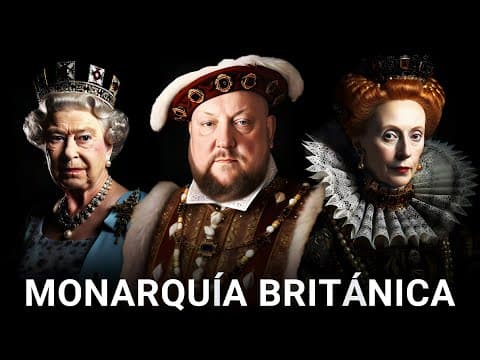
This comprehensive overview traces the history of the British monarchy from its origins with Egbert of Wessex in the 8th century to the present day, highlighting key events, figures, and transformations that shaped the monarchy and its relationship with the British people.
The British royal family we know today is just one generation within a remarkable monarchy that spans over a thousand years. But how did a lineage that once ruled vast lands lose its power? Through more than a millennium of succession wars, global conquests, betrayals, and monumental stone buildings that still stand today, the entire royal history has been documented and preserved with countless kings and queens, each with their own story. This is the complete history of the British monarchy.
Our story does not begin with the Scots or the English, but with a prince named Egbert, born in 771 AD. At the time of Egbert's birth, England did not exist; instead, the British Isles were a mosaic of warring kingdoms formed by Angles, Saxons, Jutes, and Britons, all fighting for control and influence. Born to the King of Kent and the grandson of the King of Wessex, young Egbert had strong claims over both territories. After his father died when he was just ten years old, a bloody struggle for the crown ensued.
Eventually, in 802 AD, Egbert was crowned King of Wessex. He quickly consolidated his power, controlling Kent, Essex, Sussex, Cornwall, and large parts of Wales. Even Northumbria submitted to the crown of Wessex. However, the Kingdom of Mercia remained a different story, as the two kingdoms had been at war for centuries. Despite some successes, Egbert's reign changed the landscape of Britain forever, initiating a policy of consolidation and expansion that would continue for the next 200 years, ultimately leading to the unification of Britain and the birth of England.
Egbert died in 839 AD and was succeeded by his son Aethelwulf, who soon faced a new threat: the Danes. The Danish invasion officially began in 842 AD. Although Aethelwulf was victorious at the Battle of Aclea in 851 AD, pushing the Danes back to sea, he knew this was just the beginning. The new threat forced Mercia and Wessex into an uneasy alliance, ending nearly 300 years of conflict.
Aethelwulf was succeeded by his son Aethelbald, whose reign was short and unpopular, especially among the clergy due to his marriage to his father's widow. After Aethelbald's death, his brother Aethelbert took the throne, but he too faced Viking invasions led by Ragnar Lothbrok and his son Ivar the Boneless, which grew in violence and frequency.
In 865 AD, Aethelred ascended to the throne, and the Great Pagan Army captured York, establishing the first significant Danish stronghold on English soil. Aethelred had no choice but to face the invaders in battle. He was defeated at Reading in 871 AD but was saved by his brother Alfred, who led the army and managed to push the Danes back at the Battle of Ashdown.
Alfred, later known as Alfred the Great, inherited a kingdom on the brink of collapse. In 874 AD, the Great Pagan Army marched on Mercia, defeating King Burgred and forcing him into exile. With Mercia defeated, all that stood between the invaders and total control of England was Alfred and the Kingdom of Wessex. Surrounded by Danish forces, Alfred was pushed into a remote marsh in Somerset, where betrayal from his allies seemed imminent.
However, Alfred did not lose hope. He emerged from the marsh and surprised the Danish army at Edington, forcing King Guthrum to retreat. After being baptized as a Christian, Guthrum withdrew to East Anglia, allowing Alfred to consolidate his victories. Alfred transformed Anglo-Saxon society, establishing fortified towns, building schools, and fostering knowledge. He also instituted the division of law between the Saxons and Danes, a cultural and political division that still resonates in Britain today.
Alfred was succeeded by his son Edward the Elder in 899 AD. Edward focused on improving the administration of his lands and expanding his territory. He captured the Viking capital of York, although he only held it for a year. Edward died in 924 AD, leaving the crown to his son Aethelstan, who would become the first true king of all Anglo-Saxon kingdoms.
Aethelstan conquered Northumbria and pushed the Danes into Scotland, uniting the Anglo-Saxons and forming the Kingdom of England. His reign marked the beginning of a new era of stability and governance, with significant legal reforms and a focus on European politics.
The Plantagenet dynasty began with Henry II, who became king in 1154 AD. His reign was marked by conflicts with Thomas Becket, the Archbishop of Canterbury, and the establishment of common law. Henry's sons, Richard the Lionheart and John Lackland, faced their own challenges, including the loss of Normandy and the signing of the Magna Carta in 1215 AD, which limited the power of the monarchy.
The Wars of the Roses followed, a series of civil wars for control of the throne between the houses of Lancaster and York. This tumultuous period saw the rise of figures like Richard III and Henry Tudor, who ultimately defeated Richard at the Battle of Bosworth in 1485, marking the end of the Plantagenet dynasty and the beginning of the Tudor era.
Henry VII established the Tudor dynasty, which would see significant changes in England, including the English Reformation under Henry VIII, who broke from the Catholic Church to marry Anne Boleyn. His daughter Elizabeth I would become one of the most famous monarchs in history, overseeing a golden age of exploration and cultural flourishing.
Elizabeth's reign was marked by the defeat of the Spanish Armada in 1588 and the establishment of England as a global power. However, the monarchy faced challenges in the following centuries, including the English Civil War, the execution of Charles I, and the establishment of the Commonwealth under Oliver Cromwell.
The monarchy was restored in 1660 with Charles II, who brought a sense of stability after the chaos of the Civil War. His brother James II faced opposition due to his Catholicism, leading to the Glorious Revolution of 1688, which saw William of Orange take the throne alongside his wife Mary.
The 18th and 19th centuries saw the expansion of the British Empire, the Industrial Revolution, and significant social changes. Monarchs like George III faced challenges from American independence and internal unrest, while Queen Victoria presided over a vast empire and significant cultural advancements.
The 20th century brought two World Wars, with the monarchy adapting to changing times. George VI led the nation through WWII, becoming a symbol of resilience. His daughter Elizabeth II ascended the throne in 1952, overseeing a period of modernization and change within the monarchy.
Elizabeth's reign has seen significant social transformations, the decolonization of Africa, and the evolution of the British monarchy into a more modern institution. As of 2023, her son Charles III now sits on the throne, continuing the legacy of a monarchy that has endured for over a millennium.
The history of the British monarchy is a complex tapestry woven with power struggles, cultural shifts, and the evolution of governance. From Egbert of Wessex to Charles III, the monarchy has adapted to the changing landscape of Britain and the world, reflecting the resilience and continuity of this ancient institution.



















