
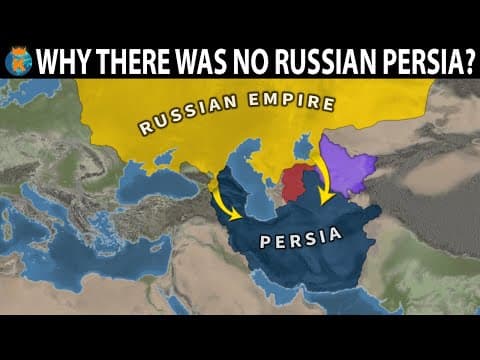
This blog post explores the intricate historical relationship between Russia and Persia, detailing the geopolitical struggles, wars, and treaties that shaped their interactions. Despite opportunities for conquest, Russia's focus on Western expansion and the shifting dynamics of power ultimately prevented a full-scale invasion of Persia.
The Caucasus Mountains, situated between the Black and Caspian Seas, have long served as a geographical boundary between Europe and Asia. This region has been a focal point of trade and conflict throughout history, particularly during the early modern period when it became a contested territory among three major powers: Russia, Persia, and the Ottoman Empire. This blog post delves into the historical dynamics that shaped the relationship between Russia and Persia, examining why Russia never fully conquered Persia despite numerous conflicts and opportunities.
The relationship between Persia and Russia dates back centuries, with trade flourishing between the two nations as early as their inception. The 16th century marked a significant turning point, primarily due to an Ottoman blockade against Persia that began in 1514. By the end of the century, a vibrant trade network had developed, exchanging silk, leather goods, furs, and other luxuries. Alongside trade, diplomatic envoys facilitated a loose anti-Ottoman alliance, as both nations recognized the threat posed by the Ottoman Empire.
The conflicts between Persia and the Ottoman Empire were deeply rooted in religious differences, with the Shia Safavid dynasty of Persia opposing the Sunni Turks of the Ottoman Empire. However, these religious disputes often served as justifications for territorial and political ambitions rather than being the primary cause of conflict. Similarly, while the Russians and Ottomans had their own religious tensions, their disputes were more focused on access to the Black Sea and Mediterranean trade routes.
In the early 17th century, the Persians and Ottomans clashed for control of the Caucasus. Persia sought assistance from its Russian ally, but internal strife in Russia, including a succession crisis and civil war, limited their support. By the time Michael Romanov ascended to the Russian throne in 1613, Persia had already secured control over the contested lands.
The 18th century saw further conflicts, particularly with the Afghan invasion of Persia in 1721, which destabilized the region. Russia, under Peter I, offered aid to the Persian Shah, but this assistance came with territorial strings attached. The subsequent Treaty of St. Petersburg and the Treaty of Constantinople resulted in significant territorial losses for Persia, although negotiations in the following years returned much of this territory.
The Treaty of Gorgievski in 1783 marked a pivotal moment, transferring the kingdom of Georgia from Persian to Russian control. This shift was further solidified when the new Persian Shah, Agha Mohammad Khan, attempted to reclaim lost territories, leading to further conflicts with Russia.
Beginning in 1804, Russia and Persia engaged in a series of wars over territory. The Treaty of Gulistan in 1813 and the Treaty of Turkmenchay in 1828 reaffirmed Russian dominance in the region, with Persia ceding more territory and paying a substantial indemnity. These treaties established a long-lasting Russian presence in the Caucasus, which persisted until the collapse of the USSR in the early 1990s.
During the 20th century, the geopolitical landscape shifted dramatically. In 1907, Russia and Great Britain divided Persia into zones of influence, with Britain controlling the south and Russia the north. This division was motivated by British interests in protecting India and securing oil resources.
Throughout World War I, Persia attempted to maintain neutrality but became a battleground for the Ottomans, British, and Russians, resulting in significant civilian casualties. The post-war period saw a coup that replaced the government with Reza Pahlavi, who aligned with Britain against Soviet influence.
During World War II, Persia, now Iran, again sought neutrality but was invaded by both Russia and Britain to secure supply lines and oil fields. Although both powers agreed to withdraw after the war, the USSR needed reminders from the newly formed United Nations to honor this agreement.
Ultimately, Russia's historical trajectory and strategic interests explain why it never fully conquered Persia. The focus on Western expansion and European interests overshadowed the potential for conquest in Persia. Despite numerous conflicts and shifting alliances, Persia did not hold the same allure for Russia as the territories to the west, leading to a complex but ultimately non-conquering relationship between the two nations.



















