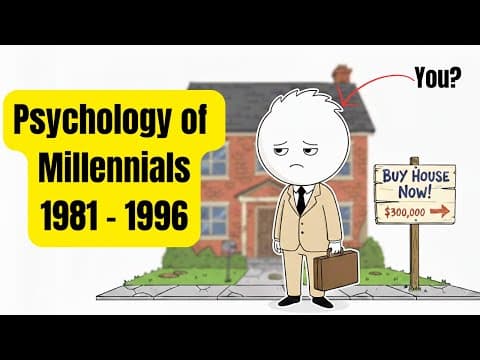
Millennials, born between 1981 and 1996, face a unique psychological landscape shaped by high expectations, economic instability, and social pressures. Despite being told they were special and capable of anything, many struggle with financial hardships, mental health issues, and delayed life milestones. This article explores the cognitive dissonance, social media impact, and existential anxieties defining this generation's experience.
Millennials, defined as those born between 1981 and 1996, represent a generation caught in a paradoxical psychological experiment. They were raised with the message that they were special and capable of achieving anything, yet many find themselves struggling to attain the financial stability and life milestones that previous generations took for granted. This article delves into the unique psychological and economic challenges faced by Millennials, exploring how these factors have shaped their mental health and worldview.
Millennials were raised during the self-esteem movement of the 1980s and 1990s, characterized by parenting trends such as helicopter parenting and the ubiquitous "everyone gets a trophy" mentality. These approaches aimed to foster confidence and a sense of achievement. However, the reality that awaited Millennials was starkly different.
Graduating into the 2008 recession, Millennials encountered a drastically altered economic landscape. Jobs were scarce, and the cost of higher education skyrocketed, with a Master's degree often costing more than a house did in previous generations. The Pew Research Center confirmed in 2020 that Millennials are the first generation in modern American history expected to be worse off financially than their predecessors.
This mismatch between expectation and reality has created a psychological state known as cognitive dissonance, where Millennials simultaneously hold conflicting beliefs about their self-worth and achievements.
Psychologist Jean Twenge, author of Generation Me, highlights that Millennials score higher on narcissism scales compared to previous generations. Paradoxically, they also report higher levels of anxiety and depression. This duality reflects a generation that feels both exceptional and worthless at the same time—a complex trauma response paired with a polished professional image.
Millennials came of age alongside the rise of social media platforms like Facebook (launched in 2004) and Instagram (2010). Unlike Gen Z, who grew up with these platforms from childhood, Millennials were teenagers and young adults during this digital revolution. This timing meant they were learning to navigate adulthood while simultaneously performing their lives for an online audience.
Research by Dr. Tim Kasser shows that basing self-worth on external validation, a behavior encouraged by social media, negatively impacts mental health. Millennials often find themselves in a continuous cycle of seeking approval, which can exacerbate feelings of anxiety and inadequacy.
Traditional markers of adulthood—marriage, home ownership, and having children—are being delayed or skipped by many Millennials. Surveys indicate that while they desire these milestones, economic barriers such as high housing costs and student debt make them difficult to achieve without significant financial support or luck.
This prolonged uncertainty leads to a psychological condition known as allostatic load, where the body remains in a state of low-level stress, anticipating life changes that never materialize. Millennials often feel stuck, living in expensive apartments with limited progress toward their envisioned futures.
Millennials were taught a straightforward social contract: study hard, earn a degree, get a good job, and work your way up. However, the economic landscape shifted dramatically. College tuition increased tenfold, entry-level jobs demand years of experience, and the gig economy offers precarious work without benefits.
Criticism of Millennials for job hopping overlooks the fact that corporate America has transformed employment relationships. Pensions have disappeared, full-time roles have been replaced by contract work, and layoffs have become common. Millennials' perceived lack of loyalty is a rational adaptation to an unstable job market.
Despite challenges, Millennials are among the most educated and diverse generations in history. Growing up with the internet exposed them to multiple perspectives and versions of truth, fostering a questioning attitude toward established systems. This critical thinking is often misinterpreted as entitlement or difficulty but reflects a deeper interrogation of societal norms.
Millennials have played a pivotal role in destigmatizing mental health issues, openly discussing anxiety and depression. However, they face unprecedented stressors: overwhelming student debt, soaring housing costs, and job insecurity.
This combination results in a generation that is both self-aware and overwhelmed, navigating mental health challenges in a world that often seems stacked against them.
Adding to their burdens, Millennials witness the ongoing deterioration of the planet and are frequently tasked with addressing climate change despite having less institutional power and resources. Climate anxiety has become a recognized psychological phenomenon, contributing to feelings of helplessness and existential dread.
Millennials embody a generation shaped by soaring expectations, economic instability, social media pressures, delayed adulthood, and multiple overlapping crises. Their psychological responses—marked by cognitive dissonance, anxiety, and resilience—are understandable reactions to a rapidly changing world where the old maps no longer guide the new territory.
Understanding the psychology of Millennials requires empathy and recognition of the complex forces at play. They are not simply "anxious" or "entitled"; they are navigating unprecedented challenges with a unique blend of hope, frustration, and determination.