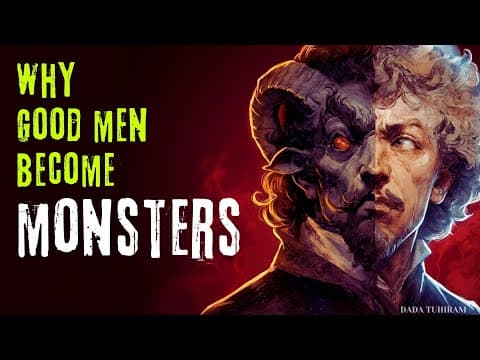
This article explores the hidden dark side within seemingly good people, revealing how power and authority can expose the monster inside everyone. Drawing from psychological experiments and real-life examples, it challenges the illusion of inherent goodness and explains how societal roles and fear of consequences keep our darker impulses in check. Without these restraints, anyone can become a tyrant or oppressor.
Imagine attending the wedding of an old friend — the one who was always considered the kindest, most straightforward person in school. Everyone believed he would never harm anyone. But on the wedding night, as drinks flow and the groom's friends gather, the atmosphere changes. Jokes turn into power plays. Suddenly, this once gentle friend starts pushing a poor waiter, mocking him, asserting dominance just because it’s his friend’s wedding and he feels entitled.
This transformation is not limited to weddings. In offices, people who once casually criticized their bosses become tyrants when promoted. In government offices, those who stood patiently in line suddenly exploit their small authority to create hurdles for others.
We like to believe we are good people because of our morals, upbringing, and principles. We think that those who commit crimes or oppress others are inherently bad, while we are fundamentally different. But this is a misconception. The truth is, we are good only because we have not yet been given the power or freedom to reveal our true selves.
When no one is watching, and there is no fear of punishment or social consequences, the dark side within us emerges — a side that even we might fear.
History and psychology show that the difference between humans and animals is a thin line defined by the fear of consequences. This fear restrains us from acting on our darkest impulses. Remove this fear, and people behave like the soldiers of Hitler or the most toxic managers in offices.
From childhood, we are taught to be good, to help others, and to avoid thinking ill of anyone. But no one teaches us how people who appear good on the outside can rot from within. Family, society, and systems slowly break down a normal person, turning them into part of what they once hated.
Most people judge themselves by their intentions, not their actions. They justify small compromises — lying to a boss, forwarding hateful messages, or succumbing to social pressures — as necessary or harmless. Yet, others see these actions as betrayal, cowardice, or cruelty.
This gradual erosion of integrity is how monsters are born — through small compromises and self-deception.
In 1971, psychologist Philip Zimbardo conducted a now-infamous experiment at Stanford University. Twenty-four normal college students were randomly assigned roles as guards or prisoners in a simulated prison. Within days, the guards began abusing their power, humiliating and torturing prisoners psychologically and physically. One prisoner suffered a severe mental breakdown.
The experiment was halted after six days due to the extreme behavior exhibited. These were not criminals or psychopaths but ordinary students transformed by the roles and authority given to them.
This experiment revealed that authority kills empathy. When given power, people often lose their compassion and become tyrants.
In everyday life, we see this transformation repeatedly. People who were once friendly and humble become harsh and oppressive when promoted or given authority. The question is: did they suddenly become bad, or was there always a dark side waiting to emerge?
The answer lies in the power dynamics and the fear of consequences that keep this dark side suppressed.
Society teaches us to be good, but often rewards those who are cunning, manipulative, or ruthless. The honest employee may be overlooked for promotion in favor of the sycophant. The kind relative may be ignored while the wealthy but unscrupulous one is respected.
This injustice breeds resentment and silence. People endure this quietly, hoping for divine justice, but inside, their dark side only grows stronger, waiting for an opportunity.
Often, those who feel powerless in one area of life take out their frustrations on those weaker than them — a stressed employee yelling at family members, a bullied person becoming a bully at home.
This cycle perpetuates the emergence of the monster within.
Most people are unaware of their hidden dark side. Recognizing it is crucial to prevent becoming the monster or falling victim to one.
Understanding that power and authority can corrupt anyone helps us stay vigilant and compassionate.
The idea that some people are inherently good and others inherently bad is an illusion. Everyone harbors a dark side that can emerge under certain conditions, especially when power is unchecked and fear of consequences is removed.
By acknowledging this truth, we can better understand human behavior, avoid self-deception, and strive to keep our empathy alive even when given power.
The challenge is to confront the monster within before it controls us or others control it for their own ends.
This exploration into dark psychology reveals that the "nice guy" facade often hides a potential monster shaped by circumstances, power, and fear. Recognizing this can lead to greater self-awareness and a more compassionate society.