
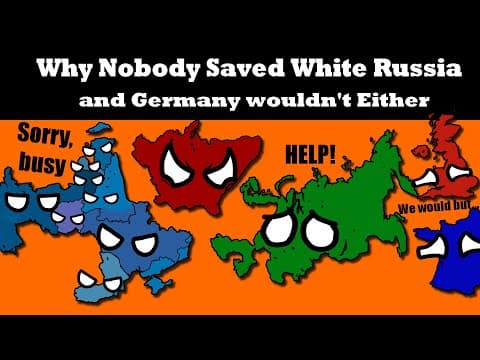
This article explores why the Allied powers and Germany did not intervene to save White Russia during the Russian Civil War. It examines the geopolitical, military, and social factors that influenced their decisions, revealing a complex interplay of interests and risks that ultimately led to inaction.
The Russian Revolution and the subsequent civil war present a fascinating case study in international relations and military strategy. A common narrative suggests that the Bolsheviks faced not only internal opposition from the White armies but also a united front from the capitalist world, particularly the Allied powers. However, a closer examination reveals that the reality of intervention was far more complicated. This article delves into the reasons why neither the Allies nor Germany intervened decisively to save White Russia during this tumultuous period.
Upon seizing power, the Bolsheviks found themselves in a precarious situation. Their government was fragile, threatened by potential German invasions, counterrevolutions, and possible Allied interventions. They had promised the Russian populace peace, land reforms, and food, but fulfilling these promises while managing relations with both the Germans and the Allies proved to be a daunting task.
To secure peace, the Bolsheviks signed the Treaty of Brest-Litovsk, which resulted in significant territorial losses and economic burdens. This treaty not only ended Russia's involvement in World War I but also deepened internal divisions among revolutionary factions, with some advocating for continued resistance against Germany in hopes of a broader revolution.
The early interventions by the Allies in 1918 were not aimed at destroying Bolshevism but were primarily motivated by the ongoing conflict with Germany. The Allies occupied strategic ports like Vladivostok and Arkhangelsk, hoping to secure supplies and facilitate the exit of the Czechoslovak Legion trapped in Russia. However, these interventions were cautious and limited, reflecting the Allies' focus on the war against Germany rather than a commitment to restoring the White armies.
Despite these motivations, the interventions were plagued by logistical challenges and low morale among Allied troops, who were often unclear about the purpose of their deployment.
As the war in Europe progressed and the Central Powers began to collapse, the priorities of the Allies shifted. The Red Army had grown significantly, and the potential for a full-scale intervention against Bolshevism became a topic of discussion. However, despite having the military capacity to intervene, the Allies hesitated.
The White armies, which were the primary opposition to the Bolsheviks, were fragmented and lacked a unified political vision. This disunity made it difficult for the Allies to determine who they were supporting and what kind of government would emerge from a potential victory.
The White factions were often at odds, with differing ideologies and goals. This infighting frustrated Allied efforts to provide coherent support, as there was no clear leader or unified strategy to rally behind.
While the Allies were hesitant, one might assume that Germany, having fought against the Bolsheviks, would have a vested interest in intervening on behalf of the White armies. However, the German approach was also complex and fraught with challenges.
In summary, the lack of intervention by both the Allies and Germany in the Russian Civil War can be attributed to a combination of war weariness, political uncertainty, and the fragmented nature of the White armies. While there were compelling reasons to intervene, the risks and complexities involved ultimately led to inaction. The Allies opted for a cautious approach, relying on local forces rather than committing to a full-scale military intervention, while Germany's interests were more focused on economic control than on restoring the old order in Russia. Thus, the narrative of a united front against Bolshevism is more nuanced than it appears, revealing the intricate web of geopolitical considerations that shaped the course of the Russian Civil War.



















