
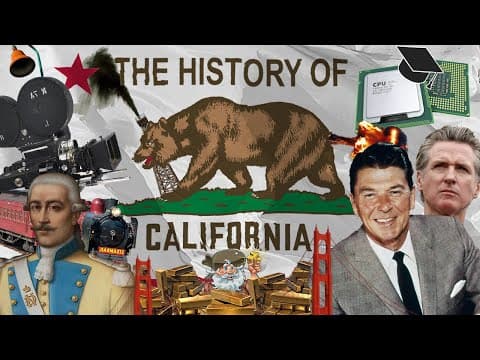
This blog post explores the rich and complex history of California, detailing its indigenous roots, European exploration, the impact of the mission system, the Gold Rush, and the rise of Silicon Valley. It highlights key events, cultural shifts, and the evolution of California into a major economic and cultural force in the United States.
California's history is a tapestry woven from the threads of indigenous cultures, European exploration, colonization, and modern technological advancements. This post delves into the significant events and transformations that have shaped California into the state it is today.
California was initially settled by indigenous peoples as early as 17,000 BC. By the 15th century AD, the population was estimated to be between 100,000 and 700,000, comprising six major tribal language groups. These tribes experienced the effects of European contact through trade and disease long before the arrival of Spanish settlers in the late 18th century.
The first European exploration of California began with Francisco de Oñate in 1539, who claimed the region for Spain. However, it wasn't until 1769 that a significant Spanish expedition, led by Gaspar de Portolá and missionary Junípero Serra, established a foothold in California. They founded missions along the coast, starting with San Diego and Monterey, marking the beginning of a complex relationship with the indigenous populations.
The California mission system was established to convert indigenous peoples to Catholicism and integrate them into Spanish colonial society. Over the next few decades, 21 missions were built along a route known as El Camino Real. While the missions were intended to be centers of religious and agricultural life, they often led to the exploitation and suffering of the indigenous populations, who were forced into labor and faced devastating epidemics of European diseases.
In 1821, Mexico gained independence from Spain, and California became part of the Mexican Republic. The mission system faced increasing opposition from local Californios, who sought to secularize the missions and redistribute land. By 1838, the process of secularization was complete, leading to the decline of the missions and the rise of large ranchos owned by Californio elites.
The discovery of gold at Sutter's Mill in 1848 triggered the California Gold Rush, attracting hundreds of thousands of prospectors and settlers from around the world. This influx of people transformed California's demographics and economy, leading to rapid urbanization and the establishment of new towns. However, the Gold Rush also exacerbated tensions between different racial and ethnic groups, particularly against indigenous peoples and Chinese immigrants.
California was admitted to the Union as a free state in 1850, a significant event in the context of the national debate over slavery. The state experienced political turmoil during the Civil War, with divisions between pro-Union and pro-Confederate factions. Despite its geographical distance from the main theaters of war, California contributed significantly to the Union's efforts, particularly through gold production and military enlistment.
As the 20th century approached, California began to emerge as the center of the film industry. Hollywood became synonymous with cinema, producing iconic films and establishing a cultural legacy that would influence global entertainment. The rise of the studio system and the star system defined the industry, leading to the creation of major film studios and the establishment of Hollywood as the cultural capital of the United States.
The latter half of the 20th century saw California evolve into a technological powerhouse, particularly with the rise of Silicon Valley. The region became the epicenter of innovation in computing and technology, driven by the development of microchips and the internet. Companies like Intel, Apple, and Google emerged, reshaping not only California's economy but also the global landscape of technology.
California's history is marked by a series of transformative events that have shaped its identity and role in the United States. From its indigenous roots and colonial past to its current status as a technological leader, California continues to be a dynamic and influential state. The interplay of cultures, economies, and innovations will undoubtedly shape its future as it navigates the challenges and opportunities ahead.



















