
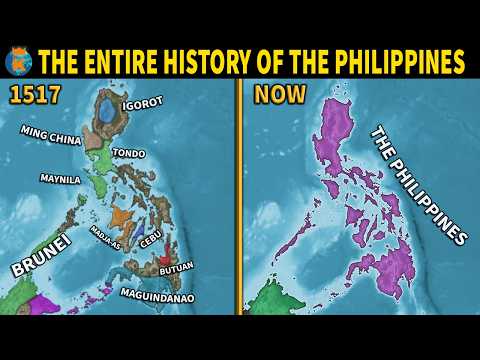
This blog post provides a detailed overview of the history of the Philippines, covering its geological formation, early human settlements, colonial periods, struggles for independence, and contemporary political landscape, highlighting key events and figures that shaped the nation.
The Philippines is an archipelago in the Pacific Ocean, consisting of over 7,000 islands. It sits on a subduction zone in the Ring of Fire, a geologic belt that surrounds the Pacific and is the source of significant seismic activity. This geologic history has made the islands mineral-rich but also means that the inhabitants must contend with the destructive potential of earthquakes and volcanic eruptions.
Of the 7,000 islands, only about 1,000 are inhabited, with most of those being around one square mile in size. The archipelago is divided into three main island groups:
The earliest traces of Homo sapiens in the Philippines date back approximately 47,000 years. They were preceded by earlier hominids, such as Homo luzonensis, dated to around 134,000 years ago, and evidence suggests that Homo erectus was present on the islands as far back as 700,000 years ago. The ancestors of the modern native population established themselves around 3,000 BCE, having migrated from Taiwan and other nearby islands, belonging to the Austronesian language and cultural group.
Early settlements in the Philippines were typically located along rivers and were somewhat isolated due to geography. This isolation prevented the development of overarching political connections, leading to communities that maintained relationships through intermarriage and trade. By 2000 BCE, trade networks were well established, evidenced by Philippine jade artifacts found throughout the region, produced using techniques common to India. This trade network, known as the Maritime Jade Road, existed for approximately 3,000 years until 1000 CE.
The last 1,500 years of this era appear to have been a time of extended peace, supported by a lack of archaeological evidence of violent deaths, although this may simply reflect unexcavated sites.
Written Philippine history begins around 900 CE with the Laguna Copperplate Inscription, which records the forgiveness of a debt. By this time, the people had organized themselves into sociopolitical units called barangays, akin to city-states, which could range from 30 to 500 people. Some barangays formed confederacies ruled by a paramount leader known as a datu. In areas with greater contact with the Indian subcontinent, rulers were referred to as rajas, while in areas influenced by Islam, they were called sultans.
Early Philippine cultures practiced polytheistic animism, believing that all things have spirits that must be honored to maintain good fortune. Ancestor worship was also prevalent, with ancestors sometimes taking on animal aspects. Magic and witchcraft were widely believed to influence daily life, and practitioners could be highly respected or feared.
Buddhism and Hinduism were introduced to the Philippines before the 9th century CE, with some barangays owing tribute to the powerful Indonesian Buddhist state of the Srivijaya Empire between the 6th and 13th centuries. This influence was followed by the Majapahit Empire, which further shaped local belief systems and culture.
Islam first arrived in the Philippines in 1380 through the missionary Makhdum Karim, who preached Sunni Islam in the Sulu Archipelago and built the first mosque. He was followed by the Indonesian prince Raja Binda, who established the Sultanate of Sulu in the early 15th century.
The history of the Philippines is generally organized into pre-colonial and post-colonial eras. Most information about the pre-colonial period comes from the chronicles of other countries, particularly China. The oldest documented barangay is Tondo, located on the Pasig River delta, which was associated with Manila, an independent barangay that monopolized trade across Southeast Asia.
The first contact between the Philippines and Europeans occurred in 1521 when the Spanish expedition led by Ferdinand Magellan arrived. Magellan planted the Spanish flag and called the islands "Las Islas de San Lazaro." He met with local leaders, including Raja Humabon, who converted to Catholicism, influencing many others to follow suit. However, Datu Lapu-Lapu, a rival chief, resisted conversion and led a successful attack against Magellan, resulting in the navigator's death.
The Spanish did not attempt to colonize the Philippines again until 1542, when an expedition led by Ruy Lopez de Villalobos claimed the islands for Spain. It wasn't until 1565, under Miguel Lopez de Legazpi, that the first Spanish colony was established in Cebu, marking the beginning of a colonial hold that would last until the end of the 19th century.
The Spanish expanded their control over the islands, establishing Manila as the capital of the Spanish East Indies. The Spanish colonial administration was characterized by the forced integration of local cultures, the establishment of Catholic missions, and the exploitation of natural resources. Despite the rapid growth of the colonies, the Philippines often cost more to maintain than it contributed to the Spanish crown.
The shift to industrialism in the 19th century made Filipino trade in raw materials increasingly valuable, leading to the opening of ports to the world in 1834. This period saw the emergence of a Filipino middle class and a growing national identity, culminating in the Propaganda Movement, which sought civil rights and representation in the Spanish Parliament.
The Philippine Revolution began in August 1896, aiming for independence from Spain. The revolutionaries, led by figures like Emilio Aguinaldo, declared the First Philippine Republic in 1899. However, the United States, which had intervened in the Spanish-American War, refused to recognize the new government, leading to the Philippine-American War.
The Philippines became an unofficial territory of the United States following the Treaty of Paris in 1898, which included a $20 million payment from the U.S. to Spain. The American colonial government established local administrations and introduced reforms, but resistance continued, leading to a brutal conflict characterized by guerrilla warfare and severe repression.
The Philippines gained independence on July 4, 1946, after World War II. The early years of the Republic were marked by political instability, economic challenges, and social reforms. Presidents like Manuel Roxas and Carlos Garcia sought to rebuild the nation and address the legacies of colonial rule.
Ferdinand Marcos, who ruled from 1965 to 1986, began as a reformist leader but devolved into a dictatorship marked by martial law, human rights abuses, and corruption. His regime ended with the People Power Revolution, leading to the election of Corazon Aquino, who implemented a transitional government.
In the 21st century, the Philippines has faced various challenges, including the rise of controversial leaders like Rodrigo Duterte, whose administration has been marked by a war on drugs and shifting foreign policy. Ferdinand Marcos Jr., elected in 2022, continues to navigate the complexities of post-pandemic recovery and international relations.
The history of the Philippines is a rich tapestry of cultural influences, colonial struggles, and the quest for independence. As the nation continues to evolve, it remains a significant player in the geopolitical landscape of the Pacific and beyond, with its future shaped by both its past and the challenges of modern governance.



















