
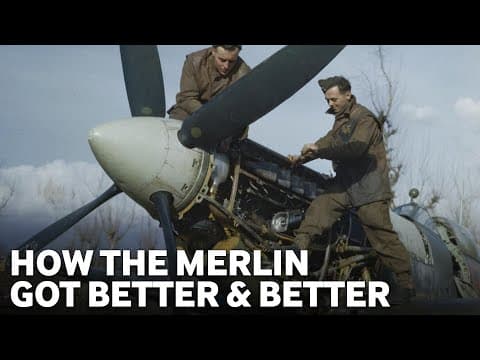
The Rolls-Royce Merlin engine was pivotal in World War II, powering iconic aircraft like the Spitfire and Mustang. Its development, production challenges, and impact on aerial combat are explored, highlighting its significance in the Allied victory.
Welcome to Air Space at the Imperial War Museum Duxford. For the last eighty years, discussions have revolved around what could have changed the outcome of World War II. Among the many aircraft that played a vital role, one component stands out: the Rolls-Royce Merlin engine. This blog post delves into the significance of the Merlin engine, its development, and its impact on the war effort.
The Rolls-Royce Merlin engine is often remembered for its association with legendary aircraft such as the Spitfire, Hurricane, Mustang, and Lancaster. However, it powered over 50 different aircraft types, including the Fairey Battle and the Boulton Paul Defiant. The engine's development began in 1933, evolving from the PV12 engine, initially producing around 900 to 990 horsepower. By the time it was fully operational in the Mk I Spitfire and Hurricane, it had surpassed 1100 horsepower.
The Merlin engine is relatively compact, with a displacement of 27 liters (approximately 1650 cubic inches). In comparison, its German counterparts, such as the Daimler-Benz 601 and BMW 801, were significantly larger, at 39 liters and 42 liters, respectively. The Merlin's design allowed it to utilize 100 octane fuel, which was crucial for its performance.
The collaboration between Rolls-Royce and Supermarine was instrumental in the development of the Spitfire. The Merlin engine was essential for enhancing the aircraft's capabilities, allowing for significant advancements in speed and maneuverability. Despite its brilliance, the Merlin engine had flaws, such as carburetor flooding during negative G maneuvers, which could be detrimental in dogfights.
Throughout the war, the Merlin engine underwent continuous improvements. By the end of the conflict, it was capable of producing up to 2,050 horsepower, particularly in the de Havilland Hornet, which, although completed too late for combat, showcased the engine's potential.
The demand for the Merlin engine was immense, especially during wartime. To meet production needs, Rolls-Royce licensed Packard in the United States to manufacture the engine. Between 1942 and 1945, Packard produced over 55,000 Merlin engines using American mass production techniques. This collaboration was vital, especially as British factories faced bombing raids.
In 1940, a contract was offered to Ford of America to produce Merlin engines. However, Henry Ford withdrew from the agreement, citing concerns about supplying materials to foreign powers involved in the conflict. Despite this setback, Ford's Trafford plant eventually employed 17,000 workers to contribute to the production of Merlin engines.
By late 1940 to mid-1943, Merlin engines powered some of the most formidable aircraft of World War II. The engine's versatility allowed it to be adapted for various roles, including powering tanks. The continuous enhancements made to the Merlin engine kept it competitive against German engines, which were also evolving rapidly.
As the war progressed, the power output of the Merlin engine increased significantly, with models achieving between 1,350 and 2,050 horsepower. This development was crucial as it allowed Allied aircraft to maintain an edge over their adversaries, particularly in high-altitude engagements.
By the end of the war, over 150,000 Merlin engines had been produced. The engine's contribution to the Allied victory cannot be overstated. It not only powered iconic aircraft but also represented the ingenuity and collaboration of the Allied forces.
Having worked at the Imperial War Museum Duxford for 20 years, I can attest to the enduring legacy of the Merlin engine. Its sound remains one of the most beautiful in aviation history, symbolizing the triumph of engineering and innovation during one of the most challenging periods in history.
The Rolls-Royce Merlin engine was more than just a power unit; it was a cornerstone of the Allied air strategy during World War II. Its development, production, and the aircraft it powered played a crucial role in shaping the outcome of the war, making it an essential topic of discussion in any analysis of the conflict.



















