
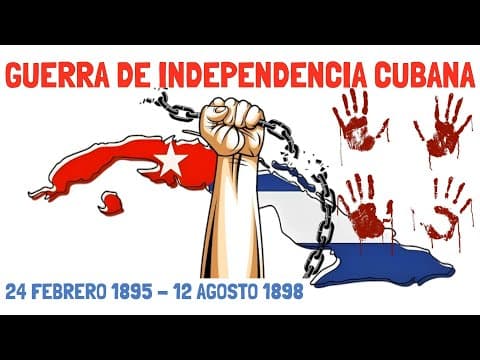
The Cuban War of Independence, lasting from 1895 to 1898, was a pivotal conflict in Cuba's history, marked by the fight against Spanish colonial rule and the subsequent involvement of the United States, leading to significant changes in Cuba's sovereignty and governance.
The Cuban War of Independence, also known as the necessary war, was an armed conflict that took place on the island of Cuba from February 24, 1895, to August 12, 1898. This conflict is a fundamental chapter in Cuba's history, marking the struggle for independence and self-determination of an oppressed people. The war lasted three and a half years and had profound antecedents, complex causes, and significant consequences for both Cuba and the international landscape.
Before the arrival of Christopher Columbus in the Americas, the territory of Cuba was primarily inhabited by the Taíno people, an Arawak group settled in the Antilles and the Caribbean. The name "Cuba" is believed to derive from the Taíno language, although its exact meaning is uncertain. Some theories suggest it comes from the word "siba" or "kiva," meaning cave or mountain, while others argue it may be a derivation of "cubanacan," meaning place of the center.
When Columbus arrived on Cuban shores on October 27, 1492, he famously declared it the most beautiful land ever seen, naming the island "Juana" in honor of Prince Juan of the Spanish crown. By 1556, the name "Cuba" began to take hold, as it was pronounced by some natives.
In 1511, Diego Velázquez de Cuéllar was sent to the island by the Spanish crown to conquer and claim new territories. He was appointed governor and quickly established encomiendas, which subjected the indigenous population to forced labor and conversion to Christianity. The Taíno people resisted this invasion, led by the cacique Hatuey, who became known as the first rebel of the Americas.
The Spanish conquest led to the rapid decline of the indigenous population due to forced labor and diseases such as smallpox, which the Spaniards inadvertently brought with them. Consequently, the Spanish turned to the African slave trade to sustain their economic interests, integrating enslaved Africans into the growing Cuban population.
As the extraction of gold dwindled, cattle ranching became the primary source of wealth on the island. The Spanish crown established a monopoly on trade with the New World, leading to increased attacks from French, English, and Dutch corsairs. The city of Havana was fortified in response to these threats, and by the 17th century, Cuba's economy began to flourish, particularly through the production of tobacco and sugar.
By the early 19th century, Cuba was notably developed and prosperous, boasting the first railway line in Latin America by 1837. However, this prosperity was built on the backs of enslaved laborers, leading to the emergence of reformist movements. In 1868, Carlos Manuel de Céspedes initiated the first Cuban War of Independence, known as the Ten Years' War, advocating for the abolition of slavery and independence from Spain.
Despite initial successes, the war ended in 1878 without achieving its goals due to a lack of unity among the independence forces and the superior organization of the Spanish military. Following this, U.S. investments in Cuba increased, particularly in sugar and tobacco, leading to further discontent among the Cuban populace.
On February 24, 1895, José Martí, a key figure in the independence movement, initiated the second war for independence, known as the War of 1895. This conflict was better organized, with the Cuban forces employing guerrilla tactics against the Spanish military. However, the Spanish responded with brutal tactics, including the concentration of civilians in camps, leading to widespread suffering and death.
The U.S. media, particularly yellow journalism, sensationalized the situation, claiming that American lives were at risk. This manipulation of public opinion culminated in the mysterious explosion of the USS Maine in Havana Harbor on February 15, 1898, which was blamed on Spain, prompting the U.S. to declare war.
The Spanish-American War shifted the focus of combat from land to sea, where the U.S. naval forces easily outmatched the Spanish fleet. After months of fighting, Spain sought an armistice on August 12, 1898. The Treaty of Paris, signed on December 10, 1898, marked the end of the war, with Spain relinquishing control of Cuba, Puerto Rico, Guam, and the Philippines to the United States.
Cuba was liberated from Spanish rule but soon faced new challenges under U.S. occupation. The Platt Amendment, enacted in 1901, recognized Cuba's independence but imposed restrictions on its sovereignty, allowing the U.S. to maintain a military presence and control over certain territories, including the naval base at Guantanamo Bay.
On May 20, 1902, the Republic of Cuba was officially established, with Tomás Estrada Palma as its first president. However, the legacy of foreign intervention and internal strife would continue to shape Cuba's future, leading to further political upheaval and the eventual Cuban Revolution.
The Cuban War of Independence was a significant struggle that not only sought to free Cuba from Spanish colonial rule but also set the stage for future conflicts involving foreign powers. The complexities of this period highlight the challenges faced by nations striving for self-determination and the impact of external influences on their sovereignty.



















