
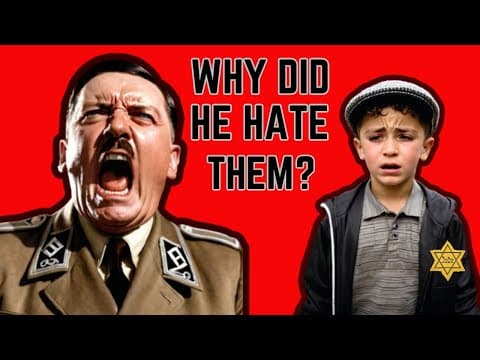
This blog post explores the origins of Adolf Hitler's anti-Semitism, tracing it from his early life experiences in Austria, through his exposure to anti-Semitic ideologies in Vienna, to the political climate following World War I, ultimately leading to the Holocaust and his unwavering beliefs until his death.
Adolf Hitler's hatred for the Jews is one of the most infamous aspects of history. But where did this hatred originate? Was it a product of personal experiences, societal influences, or something deeper? This post delves into the dark origins of Hitler's anti-Semitism, exploring the reasons behind his hatred and whether he ever felt remorse for his actions.
Hitler was born in Austria in 1889 into a turbulent family environment. His father was strict, and his relationship with his mother was complex. Despite these early challenges, there is no evidence that Hitler harbored any particular animosity towards Jews in his formative years. It was only later, during his time in Vienna as a young man, that he encountered more virulent forms of anti-Semitism.
Vienna at the time was a melting pot of various ethnicities, including a significant Jewish population. The city's political and cultural climate, influenced by widespread anti-Semitic sentiments, likely played a crucial role in shaping Hitler's views. In Vienna, Hitler was exposed to the works of many anti-Semitic writers and thinkers, such as Carl Lueger, the mayor of Vienna, who used anti-Semitism as a political tool. These ideas deeply influenced Hitler, leading him to perceive Jews as the source of Germany's problems.
Hitler's time as a struggling artist in Vienna also contributed to his growing resentment. He failed to gain admission to art school and lived in poverty, often blaming Jews for his misfortunes and the broader societal issues he observed around him. This personal failure and frustration became intertwined with his emerging anti-Semitic beliefs.
Hitler's experiences during World War I further fueled his hatred. Like many Germans, he was devastated by Germany's defeat in the war. The so-called "stab-in-the-back" myth, which falsely claimed that Jews and other internal enemies had betrayed Germany, became a convenient explanation for the loss. Hitler embraced this narrative, further solidifying his belief that Jews were to blame for Germany's suffering.
The Treaty of Versailles, which imposed harsh penalties on Germany, exacerbated Hitler's hatred. He perceived the treaty as a humiliation and blamed Jews for what he saw as the betrayal of the German nation. This sense of betrayal and humiliation became central to his ideology.
As Hitler rose to power, he began to articulate his anti-Semitic views more explicitly in his speeches and writings. In his book Mein Kampf, Hitler outlined his belief in racial purity and depicted Jews as a corrupting influence on society. Nazi ideology was built on the idea of Aryan superiority and the need to purify the German race, with Jews portrayed as a threat responsible for everything from economic hardship to moral decay.
Hitler's anti-Semitism reached its horrifying climax with the Holocaust, the systematic extermination of six million Jews. The "Final Solution" was Hitler's plan to rid Europe of Jews entirely. This genocide was carried out with chilling efficiency, supported by a vast network of concentration camps, SS officers, and collaborators across Nazi-occupied Europe. Hitler's speeches and directives indicate that he viewed this extermination as a necessary step to achieve his vision of a pure Aryan race.
Despite the unimaginable suffering he caused, there is no evidence that Hitler ever felt remorse for his actions. Even in his final days, he remained committed to his twisted ideology. In his last will and testament, written shortly before his tragic end in 1945, Hitler reiterated his belief that Jews were responsible for the war and justified their extermination. His unwavering belief in his anti-Semitic views until the very end suggests that he never saw Jews as human beings deserving of empathy or mercy.
Adolf Hitler's hatred of the Jews was not a sudden development but rather a product of a lifetime of exposure to anti-Semitic ideas, personal failures, and a desire to find a scapegoat for Germany's problems. His anti-Semitism was central to his identity and to the ideology of the Nazi Party, resulting in one of the most horrific genocides in history. The legacy of pain and loss from the Holocaust continues to resonate in the world today, reminding us of the dangers of hatred and intolerance.



















