
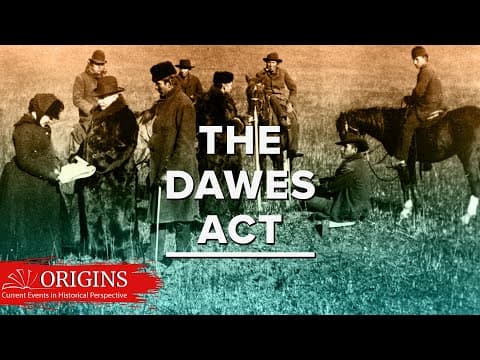
The Dawes Act of 1887 fundamentally altered Native American land ownership from communal to individual allotments, leading to significant loss of land, cultural erosion, and political disenfranchisement for Native peoples. Despite its initial intentions, the act failed to improve the lives of Native Americans and has had lasting repercussions, though recent legal decisions have begun to restore tribal sovereignty and cultural heritage.
Until the late nineteenth century, tribal nations across the United States owned their reservation lands communally. Families could settle, plant crops, and own improvements, but the land itself belonged to the entire nation for future generations' use. This system was dramatically altered by the passage of the General Allotment Act in 1887, commonly known as the Dawes Act. This act not only disrupted communal land ownership but also dealt a significant blow to Native Americans' political rights, economic sufficiency, and cultural heritage.
The Dawes Act mandated the division of reservations into small parcels: 160 acres for the head of a family, 80 acres for unmarried adults, 60 acres for minor orphans, and 40 acres for other children. Furthermore, it required all Native peoples to become American citizens and subject to the laws of the states in which they resided. This land allotment scheme was rooted in the belief that dismantling communal ownership and redistributing land as private property would lead Native peoples to become better, more civilized members of American society.
Senator Henry Dawes of Massachusetts, the act's architect, expressed this sentiment at a meeting of white progressive reformers in 1885. He argued that communal land ownership stifled individual enterprise and selfishness, which he believed were essential for civilization. However, this perspective ignored the realities of Native American life, where many tribes had successfully established homes, schools, and hospitals.
While the rhetoric surrounding the Dawes Act framed it as a means of civilizing Native Americans, its underlying goal was the transfer of vast amounts of land from tribal communities to the United States government. At the time of the act's passage, the U.S. consisted of only thirty-eight states, and the admission of many Western territories required extinguishing Native titles to their lands. Once reservations were divided, any remaining unallotted lands were designated as excess and sold to white settlers.
Although the final draft of the Dawes Act exempted certain tribes, subsequent legislation, such as the Curtis Act of 1898, extended allotment to previously exempted tribes, including the Cherokee, Choctaw, Chickasaw, Creek, and Seminole Nations.
The Dawes Act's push to incorporate Indigenous peoples into American society also led to a loss of political rights. While U.S. citizenship is often viewed positively as a means of extending civil rights, for Native peoples, it often meant the abrogation of protections afforded by their tribal nations. Many states enacted laws that explicitly barred Native Americans from voting, further disenfranchising them. This was particularly detrimental to Native women, who, unlike American women, had historically held political leadership roles and voting rights within their tribes.
It wasn't until 1962 that all fifty states guaranteed Native peoples the right to vote, highlighting the long struggle for political recognition and rights.
The Dawes Act was part of a broader federal policy aimed at dismantling tribal nations and eradicating Indigenous cultures. This included the establishment of Indian Boarding Schools, which sought to "kill the Indian, save the man," aiming to eliminate Indigenous languages, cultures, and political sovereignty. These assimilationist programs severed many Native peoples' connections to their heritage, further compounding the damage caused by land allotment.
Privatizing land ownership forced many Native individuals to choose between maintaining traditional relationships with their lands or selling their allotments to survive economically. The Dawes Act did not transform Native peoples into the yeoman farmers that Dawes envisioned; instead, it led to further land loss, the breakdown of tribal communities, and increased poverty as they were thrust into an unfamiliar economic system.
It was not until 1934 that the federal government began to acknowledge the failures of the allotment policy. By that time, the damage had been done: tribal governments had been weakened, and boarding schools had stripped Native youth of their languages and cultures. However, this is not the end of the story.
In the decades following the Dawes Act, there has been a resurgence in the strength of tribal governments and the restoration of reservations. Efforts to revitalize languages and cultures are underway, and recent legal victories, such as the 2020 U.S. Supreme Court case McGirt v. Oklahoma, have reaffirmed the existence of reservations and tribal sovereignty.
Today, as we reflect on the devastation wrought by the Dawes Act and the policies that followed, there is hope for the continued revitalization of tribal nations and the restoration of their cultural heritage. The journey toward healing and recognition continues, and the resilience of Native peoples remains a testament to their enduring spirit.



















