
This blog post explores the motivations behind the destruction of Greek statues by early Christians, examining the interplay of religious intolerance, political power, and cultural transformation in the late Roman Empire.
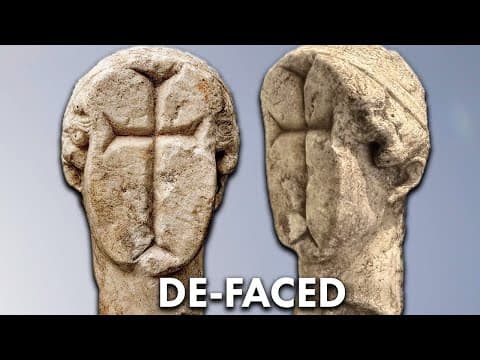
The head of a marble statue of a Greek god, now defaced, serves as a poignant reminder of the violent intersection between ancient Christianity and Greco-Roman religious practices. This act of destruction, where a Christian likely used a chisel or axe to obliterate the statue's face and carve a cross in its place, is not an isolated incident. Across the Mediterranean, museums display evidence of ancient Christian violence against divine statues, highlighting a broader narrative of religious intolerance and conflict during the late Roman period.
As Christianity gained political and social dominance within the Roman Empire, the physical destruction of sacred images became a common occurrence. This violence was not merely reactionary; it was deeply rooted in political, religious, and symbolic meanings. The deliberate mutilation of statues—such as chopping off noses or gouging out eyes—was not just about erasing offensive objects but was a calculated act with specific intentions.
To understand the motivations behind these acts, we must first explore how ancient Greeks and Romans perceived divine statues. Unlike modern views that often regard these statues as mere art, ancient cultures saw them as vital components of their religious practices. Statues were not just aesthetic objects; they were focal points for communal rituals and mediums for divine presence. Worshippers engaged with these statues in various ways, from dressing and perfuming them to offering sacrifices and participating in public ceremonies.
For instance, in the city of Magnesia, images of Olympian gods were adorned with fine garments and honored in formal dining settings, symbolizing divine feasts. Such interactions illustrate that these statues were perceived as living embodiments of the gods, capable of manifesting divine power.
The destruction of these statues can be traced back to the Christian condemnation of idolatry. Early Christian writers vehemently opposed the worship of graven images, viewing it as a significant corruption of true faith. However, early Christians did not entirely reject visual representation; they opposed images associated with cultic practices. This distinction explains why three-dimensional statues were often targeted for destruction, while two-dimensional images continued to thrive.
A key motivation behind the destruction of statues was the belief that demons inhabited these images. Christian apologists argued that the miraculous powers attributed to these statues were not divine but rather demonic. This belief led to a perception that destroying these statues was a necessary act of purging evil from the community. The act of carving crosses onto defaced statues served as a protective measure, symbolizing the expulsion of demonic forces.
Archaeological evidence reveals that Christian attacks on statues were often selective. Mutilations targeted specific body parts, such as eyes, noses, and mouths, suggesting a ritualistic intent to neutralize the perceived powers of these images. For example, gouging out a statue's eyes could symbolize blinding it, while destroying its mouth could represent silencing its influence. This selective destruction indicates that early Christians viewed these statues as embodied objects with a presence that needed to be controlled.
The destruction of divine statues also had significant political implications. Statues were not merely religious symbols; they represented civic identity and imperial authority. As Christianity reshaped the Roman Empire, the destruction of pagan statues became a battleground for asserting control over public space and cultural memory. For instance, in Ephesus, a Christian named Deus destroyed an image of the goddess Artemis and left an inscription celebrating his victory, marking a clear assertion of Christian dominance.
Bishops emerged as powerful figures in the late Roman world, often leading efforts to destroy pagan temples and statues. The destruction of the Temple of the Greco-Egyptian god Sopus in Alexandria, led by Bishop Theophilus, exemplifies the violent episodes that erupted during this period. These acts were often sanctioned by the state, particularly under emperors like Theodosius I, who issued laws aimed at suppressing non-Christian practices.
The process of Christianization in the Roman Empire was neither straightforward nor uniform. It involved a complex interplay of destruction, adaptation, and reinterpretation of existing religious practices. While some statues were violently defaced, others were repurposed or ignored altogether. This complexity reflects a broader negotiation between preservation and rejection, as communities navigated the shifting religious landscape.
Scholars describe this process as a dynamic interplay between syncretism—where local communities integrate new religious symbols—and anti-syncretism, which involves the rejection of certain practices deemed incompatible with Christianity. The destruction of statues represents one aspect of this anti-syncretism, but it was not the only response. Many statues were adapted or recontextualized, illustrating the nuanced ways in which communities engaged with their religious heritage.
The destruction of Greek statues by ancient Christians is a multifaceted narrative that encompasses religious intolerance, political power struggles, and cultural transformation. It serves as a reminder of the complexities involved in the process of Christianization, which was marked by both violent rejection and creative adaptation. As we reflect on this historical moment, we can draw parallels to contemporary shifts in religious landscapes, where the dynamics of belief and practice continue to evolve in intricate ways.



















