
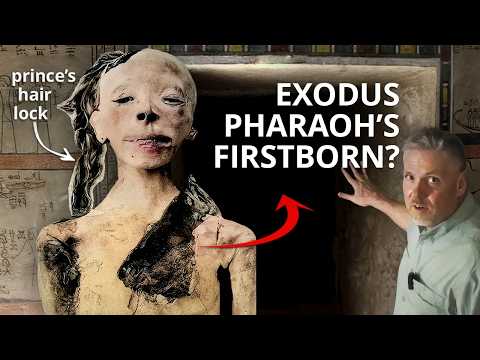
This article explores the excavation of Amenhotep II's tomb in the Valley of the Kings, uncovering key archaeological evidence that aligns with the biblical account of the Exodus Pharaoh. The findings include the mummy of Amenhotep II, his son Webensenu, and unique physical features that may correspond to biblical plagues, providing compelling insights into this historical and religious mystery.
Over 120 years ago, French archaeologist Victor Loret excavated a tomb in the Valley of the Kings that has since remained relatively unknown despite its significant findings. This tomb, belonging to Pharaoh Amenhotep II, holds remarkable archaeological evidence that may shed light on the biblical story of the Exodus Pharaoh. This article delves into the details of the excavation, the discoveries made, and their implications in understanding the Exodus narrative.
In 1898, Victor Loret began excavating at the base of a cliff in the Valley of the Kings. He noticed chisel marks indicating the entrance to a tomb. Near the entrance, he found a funerary statuette inscribed with the name Amenhotep II, confirming the tomb's owner.
Upon entering, Loret observed that the tomb had already been looted, a common fate for many tombs in the Valley of the Kings. Valuable artifacts were missing, but some items considered less valuable remained.
When revisiting the tomb, it was locked and access was restricted. Through negotiation and payment, Loret and his team gained entry for a limited time, allowing them to document and explore the tomb further.
Loret's exploration revealed a complex tomb structure:
At the bottom of a staircase in the six-pillared room lay the royal sarcophagus of Amenhotep II. Although the sarcophagus lid was removed by looters, inside was a coffin containing the mummy of Amenhotep II, wrapped in a shroud bearing his name.
Loret found several funerary statuettes inscribed with the name Amenhotep II and one bearing the name of the royal prince Webensenu, believed to be Amenhotep II's son. This suggested that Webensenu was buried in the tomb alongside his father.
In a chamber to the right, three mummies were found side by side, including that of a young boy aged between 11 and 15 years. This boy had a distinctive royal hairstyle known as the "prince's lock," further supporting the identification as Webensenu.
Fragments of canopic jars inscribed with Webensenu's name were also discovered, confirming his burial in the tomb.
In another chamber, nine coffins were stacked, containing mummies of other pharaohs. These were believed to have been relocated for protection from looters during antiquity. Among these was Thutmose IV, the successor and younger brother of Webensenu.
The mummy of Amenhotep II was studied by G. Elliot Smith, who noted unusual boil-like sores, or tubercles, covering the body. This feature is unique among mummies found in the Valley of the Kings.
The Bible describes the Lord striking down all the firstborn in Egypt, including the firstborn of Pharaoh (Exodus 12). The discovery that Webensenu, the son of Amenhotep II, died before his father and was buried in his tomb aligns with this account.
The boils on Amenhotep II's mummy correspond intriguingly with the biblical plague of boils (Exodus 9:10), where Moses threw a piece of burning sulfur into the air, causing festering boils on people and animals.
Some argue that the Pharaoh of the Exodus should not have a mummy because he drowned in the Red Sea. However, the biblical text does not explicitly state that Pharaoh himself drowned, only his army and chariots (Exodus 14). Psalm 136:15 mentions that God overthrew Pharaoh but does not say he drowned.
Furthermore, Exodus 14:30 states that the Israelites saw the bodies of the Egyptians who drowned on the seashore, implying the Pharaoh's body would have been recovered if he had died there.
The Bible (1 Kings 6:1) states that 480 years passed from the Exodus to the building of Solomon's temple, dated to 966 BC. This places the Exodus around 1446 BC.
Egyptian chronology, though debated, places Amenhotep II within the 18th Dynasty, fitting well with the biblical timeline. His father, Thutmose III, reigned for 54 years, matching the biblical account of a long reign before Moses returned to Egypt (Acts 7:30).
Amenhotep II fits the biblical criteria:
Despite this, Amenhotep II's tomb remains relatively unknown and closed to the public, and modern scholarship often debates these identifications.
The excavation of Amenhotep II's tomb provides compelling archaeological evidence that aligns with the biblical account of the Exodus Pharaoh. The discovery of his mummy, the burial of his son Webensenu, and the unique physical features observed offer a fascinating glimpse into this historical mystery.
This evidence supports the reality of the Exodus event, the existence of the Israelites as a people, and the historical Pharaoh who held them in bondage. It also underscores the significance of the biblical narrative and its impact on understanding ancient history.
The story of Amenhotep II and his tomb invites further exploration and study, bridging archaeology, history, and faith.
For those interested in deeper study, additional resources and books are available that explore the archaeological evidence and biblical chronology in greater detail.



















