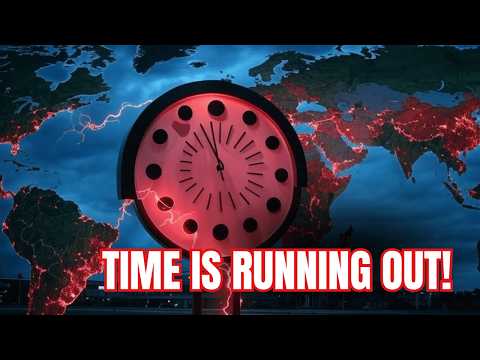
The Doomsday Clock, a symbol of existential threats, has been moved to 89 seconds to midnight in 2025 due to escalating nuclear tensions, climate change, and the risks posed by artificial intelligence. This blog explores the origins of the clock, the recent adjustments, and the psychological and societal implications of living under the threat of annihilation.
The Doomsday Clock, a chilling symbol conceived by scientists who helped build the atomic bomb—including Albert Einstein and J. Robert Oppenheimer—has haunted humanity’s collective imagination since 1947. Designed to measure how close civilization is to annihilation, the clock’s hands inch toward midnight as existential threats like nuclear war, climate disasters, and emerging technologies escalate. In 2025, the Bulletin of the Atomic Scientists pushed the clock to 89 seconds to midnight, the closest it has ever been. This grim adjustment reflects unprecedented global instability: intensifying nuclear tensions, unchecked climate change, the specter of AI-driven warfare, and the lingering shadow of pandemics. As the clock ticks closer to its terminal hour, the question looms—can humanity pull back from the brink?
The Doomsday Clock was born from the ashes of World War II. In 1945, scientists involved in the Manhattan Project, including Einstein and Oppenheimer, founded the Bulletin of the Atomic Scientists to warn the public about the dangers of nuclear weapons. Two years later, artist Martyl Langsdorf designed the clock as a stark metaphor for humanity’s proximity to self-destruction. Initially set at seven minutes to midnight, the clock’s first major shift came in 1949, when the Soviet Union tested its first atomic bomb, prompting the Bulletin to move it to three minutes.
Throughout the Cold War, the clock fluctuated in response to geopolitical events—reaching a harrowing two minutes to midnight in 1953 after the U.S. and USSR tested thermonuclear weapons. The clock’s furthest point from midnight, 17 minutes in 1991, followed the Strategic Arms Reduction Treaty (START), which slashed nuclear arsenals and eased Cold War tensions. Over time, the Bulletin expanded its scope beyond nuclear threats to include climate change, bioweapons, and disruptive technologies, transforming the clock into a universal barometer of human survival.
In January 2025, the Bulletin advanced the clock to 89 seconds to midnight, marking the first time in three years that the countdown shifted closer to global catastrophe. Daniel Holz, chair of the Bulletin’s Science and Security Board, emphasized the precariousness of the moment: "When you are at this precipice, the one thing you don’t want to do is take a step forward." The decision cited multiple converging crises: Russia’s nuclear saber-rattling in Ukraine, North Korea’s accelerated missile tests, and China’s expanding nuclear arsenal. Climate change also played a pivotal role, with 2024 ranking as the hottest year on record and global emissions still rising.
The Bulletin further highlighted the destabilizing role of artificial intelligence in military systems, warning that autonomous weapons could escalate conflicts beyond human control. This adjustment underscored a grim reality: despite decades of scientific progress, humanity’s capacity for self-destruction has outpaced its ability to collaborate on solutions.
The 2025 shift was not driven by a single event but by a cascade of interconnected failures. Nuclear diplomacy collapsed as Russia suspended participation in arms control treaties, while collaborations between Russia, China, and North Korea on missile and nuclear technology deepened global mistrust. Meanwhile, climate pledges remained unfulfilled; nations backtracked on emissions targets, and fossil fuel production surged. The Bulletin also flagged biological risks, noting that advances in gene-editing technology raised the specter of engineered pathogens. AI’s rapid militarization added another layer of risk—autonomous drones and AI-driven cyberattacks blurred the lines between human and machine decision-making.
Holz described the cumulative effect as a "perfect storm," where geopolitical fractures, environmental neglect, and technological recklessness amplify one another. Even the COVID-19 pandemic’s lessons had faded, with global health systems unprepared for new outbreaks. The Bulletin’s diagnosis was clear: leaders were ignoring the "symptoms" of existential threats.
Artificial intelligence emerged as a central concern in the 2025 Doomsday Clock update. Military applications of AI, such as autonomous drones and algorithm-driven warfare, were singled out for their potential to escalate conflicts unpredictably. The Bulletin warned that AI systems, trained on biased or incomplete data, could misinterpret threats or launch retaliatory strikes without human oversight. For example, AI-integrated defense systems in the U.S., Russia, and China have already been deployed in experimental capacities, raising fears of accidental escalation.
Additionally, AI’s role in disinformation campaigns—deepfakes, social media manipulation—threatened to destabilize democracies and inflame social divisions. While some experts argued AI could mitigate risks by improving climate modeling or disease tracking, the Bulletin stressed that its current trajectory leans toward harm. "The speed of AI development far outstrips our ability to regulate it," Holz noted, calling for international agreements akin to nuclear treaties to govern AI’s military use.
The 89-second announcement sparked alarm worldwide. U.N. Secretary-General António Guterres called it "a wake-up call we cannot afford to ignore," while climate activist Greta Thunberg criticized governments for "prioritizing profit over survival." However, geopolitical rivals dismissed the Bulletin’s assessment as hyperbolic. Russian officials accused the group of Western bias, and China’s state media argued the clock "ignores Western contributions to global instability."
Within scientific circles, debates erupted over the clock’s utility. Some researchers praised its role in raising public awareness, while others argued it oversimplified complex risks. Meanwhile, international institutions like the IAEA and IPCC faced scrutiny for their inability to curb nuclear proliferation or enforce climate agreements. The Bulletin acknowledged these criticisms but defended the clock as a necessary "metaphor" to galvanize action. Still, the muted response from world leaders suggested the clock’s warnings were being met with resignation rather than resolve.
History offers fleeting glimpses of hope. The most dramatic reversal occurred in 1991, when START reduced U.S. and Soviet nuclear stockpiles, rolling the clock back to 17 minutes. Smaller regressions followed the Paris Climate Accord (2015) and the Iran nuclear deal (2016). These successes shared common factors: diplomatic cooperation, public pressure, and scientific advocacy. For instance, the 1980s anti-nuclear movement, fueled by films like The Day After and protests across Europe, pressured leaders to pursue arms control. Similarly, the ozone layer’s recovery—a rare environmental victory—stemmed from the Montreal Protocol’s binding targets.
Yet these examples also highlight the fragility of progress. The U.S. withdrawal from the Iran deal and the Paris Accord’s unmet goals demonstrate how quickly gains can unravel. The Bulletin’s 2025 report urges a return to multilateralism, citing past achievements as proof that "the clock can be turned back—but only if we act together."
Beyond the geopolitical and technological threats that push the Doomsday Clock forward, there’s an overlooked consequence—how the constant specter of annihilation affects the human psyche. Psychologists argue that living under the shadow of existential threats fosters a collective sense of helplessness, anxiety, and even apathy. Studies show that prolonged exposure to apocalyptic rhetoric can lead to "doom fatigue," where individuals either disengage from the crisis entirely or feel overwhelmed to the point of inaction.
This phenomenon was evident during the Cold War, when nuclear drills and fear of mutually assured destruction became an accepted part of daily life. Today, climate anxiety—especially among younger generations—reflects a similar crisis of optimism. While the Doomsday Clock aims to serve as a wake-up call, some experts fear that it may unintentionally contribute to fatalism. Addressing these psychological impacts requires not just warning of catastrophe but also offering tangible solutions and pathways for hope.
Despite its iconic status, some critics argue that the Doomsday Clock is an outdated model for communicating risk. In an era where crises unfold in real-time across social media, does a metaphorical clock still serve a purpose? Skeptics say the Bulletin’s approach is too alarmist and subjective, noting that the clock’s adjustments are not based on a strict formula but on expert deliberation. Others argue that emphasizing an exact "time until doom" simplifies complex global challenges into a binary countdown, potentially discouraging nuanced policy discussions.
Some futurists propose alternative models, such as AI-driven global risk assessments that use real-time data to provide a more dynamic and less symbolic measure of existential threats. While the Bulletin defends the clock’s role in public awareness, the question remains: in a world increasingly defined by uncertainty, would a more adaptive and data-driven approach replace the 20th-century relic that has long shaped humanity’s fears?
For decades, movies, television, and literature have reflected and amplified fears of impending catastrophe, shaping public perception of the threats that drive the Doomsday Clock forward. Cold War-era films like Dr. Strangelove and The Day After dramatized the horror of nuclear annihilation, reinforcing the urgency of arms control. More recently, climate disaster films like Don’t Look Up and AI-driven dystopias such as The Terminator and Black Mirror have captured anxieties about environmental collapse and runaway technology.
While some argue that these portrayals heighten awareness, others believe they sensationalize real-world dangers, making them feel more like science fiction than tangible threats. Interestingly, the Bulletin of the Atomic Scientists has at times referenced pop culture in its messaging, recognizing its influence on public discourse. As existential risks grow more complex, the question remains: does fiction inspire action, or does it numb audiences to the real dangers lurking just beyond midnight?
Now it’s time to hear from you: If the Doomsday Clock is a metaphor for humanity’s proximity to catastrophe, what single action do you think could move its hands away from midnight? Share your thoughts in the comments below.